Description
Product Overview
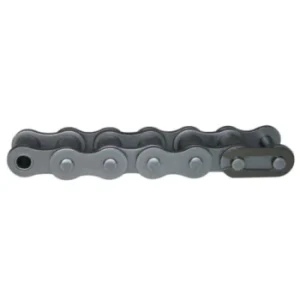
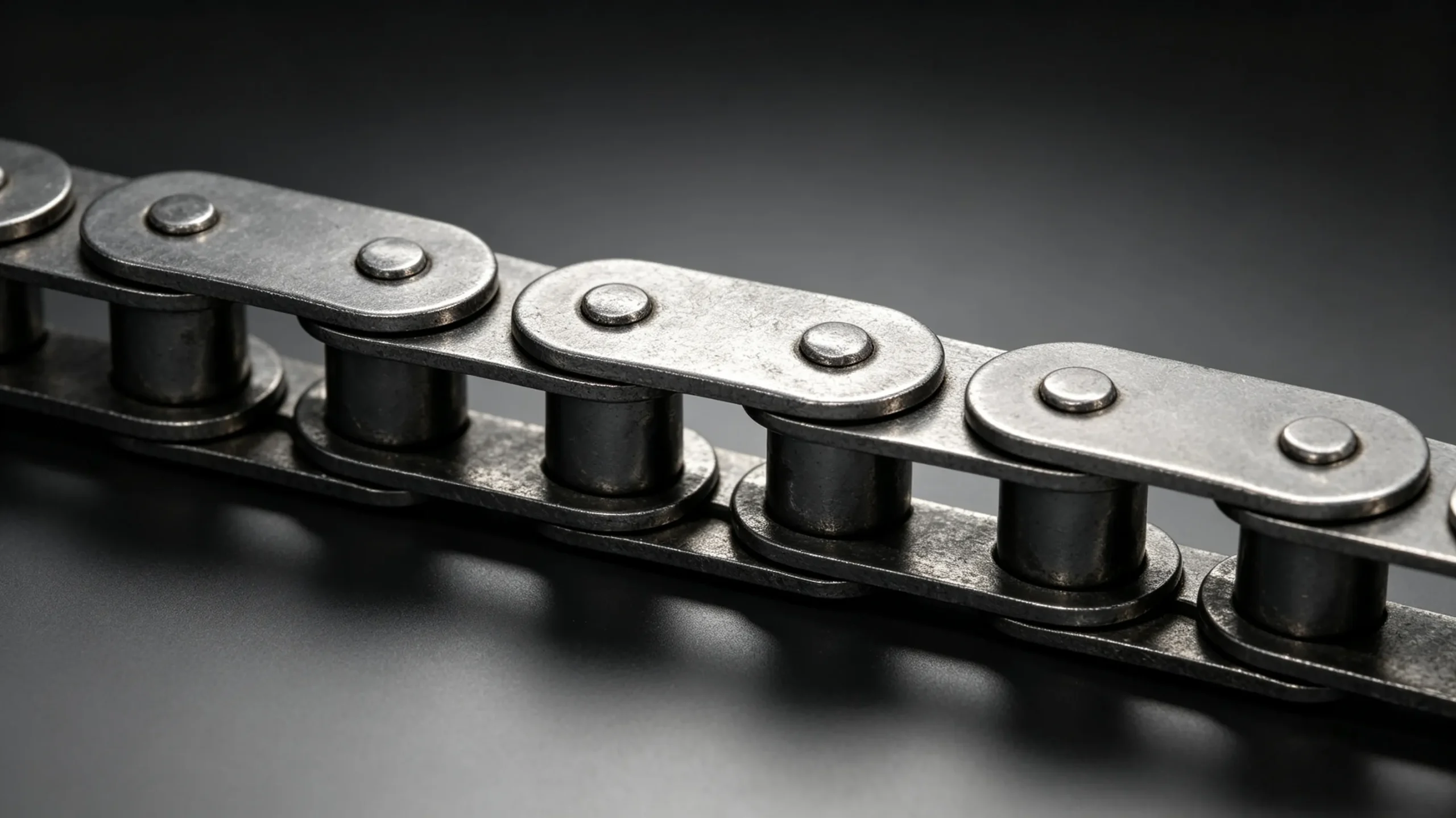
Heavy duty roller chains — technically designated as ANSI heavy series or H-series chains — are a strengthened variant of standard ANSI roller chains produced with increased plate thickness and, in most sizes, increased pin diameter compared to the standard series. The pitch remains identical to the standard series, as does the roller diameter, which means heavy series chains run directly on standard ANSI sprockets without modification. This direct dimensional compatibility is the key practical advantage of heavy series chains: they can be substituted for standard chains in any existing drive without changes to sprockets, shaft centres, or tensioner settings.
The plate thickness increase is the primary source of the strength gain. Standard ANSI link plates are proportioned to meet the tensile and fatigue requirements of the standard series load rating — any additional load capacity requires additional plate cross-section. Heavy series plates are typically 25–30% thicker than standard series plates at the same pitch, raising the plate’s tensile contribution and, more importantly, its fatigue limit. Fatigue resistance improvement is proportionally greater than the raw tensile increase because fatigue life scales non-linearly with stress amplitude — a 25% reduction in plate stress raises the fatigue life by a factor of several rather than a proportional 25%.
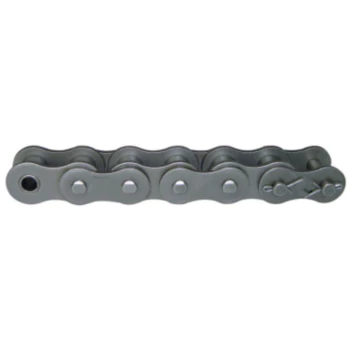
ANSI heavy series — thicker plates and larger pins for high-load drives in construction and agricultural equipment
Simplex Heavy Duty Roller Chain Specifications
The table below shows key dimensional and strength data for standard ANSI heavy series simplex chains. The H suffix designates heavy series — for example, 40H is the heavy series variant of the standard ANSI #40 chain.
| Chain No. | Pitch P (mm) | Roller Ø d1 (mm) | Inner Width b1 (mm) | Pin Ø d2 (mm) | Plate Depth h2 (mm) | Plate Thick. t (mm) | Q min (kN) | Avg Q0 (kN) | Weight (kg/m) |
|---|---|---|---|---|---|---|---|---|---|
| 40H | 12.700 | 7.95 | 7.85 | 3.96 | 12.00 | 2.03 | 16.9 | 20.4 | 0.72 |
| 50H | 15.875 | 10.16 | 9.40 | 5.08 | 15.09 | 2.42 | 26.7 | 32.1 | 1.08 |
| 60H | 19.050 | 11.91 | 12.57 | 5.94 | 18.00 | 3.25 | 37.7 | 45.2 | 1.87 |
| 80H | 25.400 | 15.88 | 15.75 | 7.92 | 24.00 | 4.00 | 66.7 | 80.0 | 3.10 |
| 100H | 31.750 | 19.05 | 18.90 | 9.53 | 30.00 | 4.80 | 105.0 | 126.0 | 4.63 |
| 120H | 38.100 | 22.23 | 25.22 | 11.10 | 35.70 | 5.60 | 150.3 | 180.0 | 6.93 |
| 140H | 44.450 | 25.40 | 25.22 | 12.70 | 41.00 | 6.40 | 198.0 | 237.6 | 9.22 |
| 160H | 50.800 | 28.58 | 31.55 | 14.27 | 47.80 | 7.20 | 249.0 | 298.8 | 13.40 |
| 200H | 63.500 | 39.68 | 37.85 | 19.85 | 60.00 | 9.52 | 347.0 | 416.4 | 24.50 |
Duplex and Triplex Heavy Series Chains
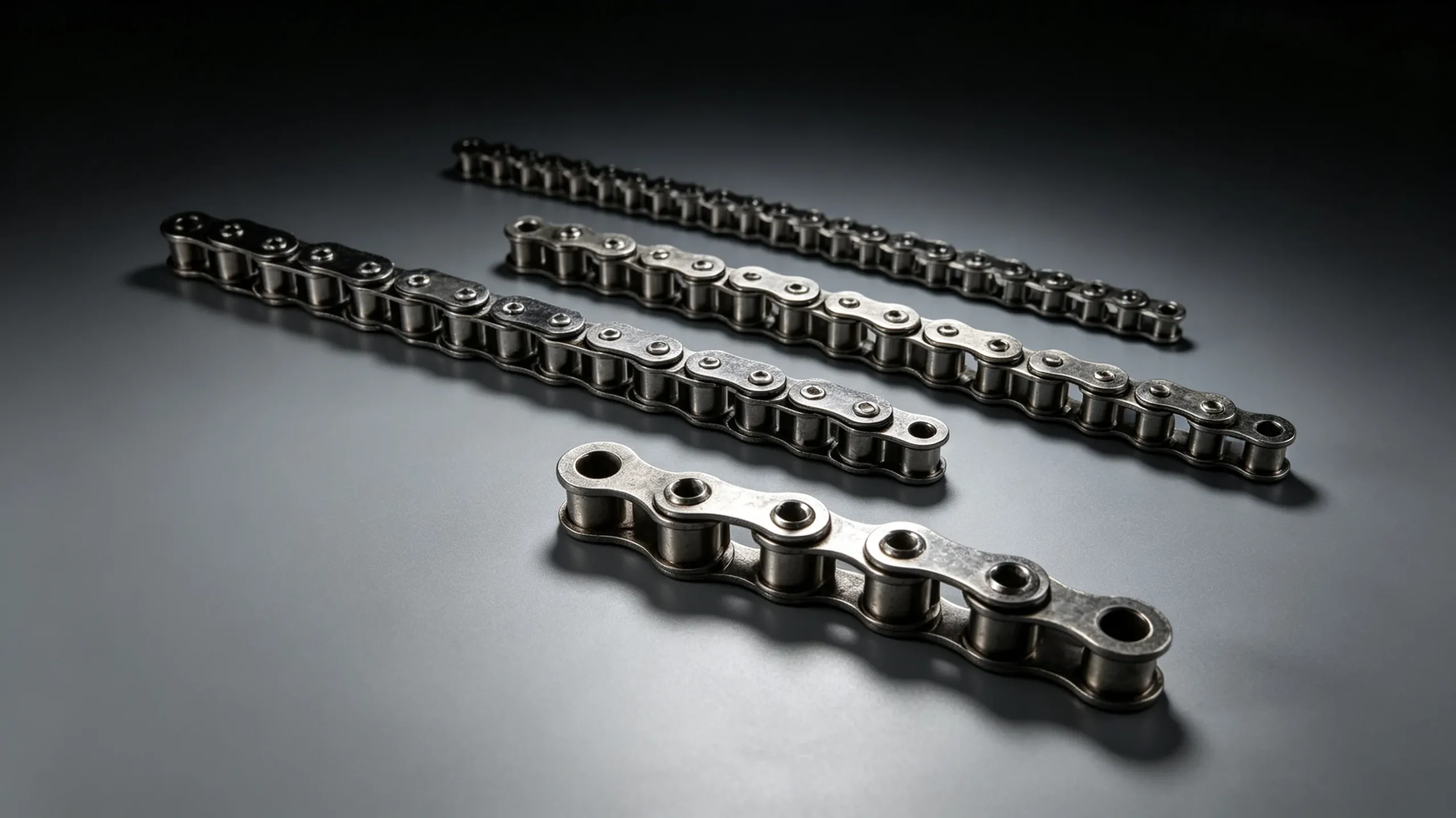
When a single-strand heavy series chain reaches the limit of its tensile or fatigue rating, duplex (two-strand) and triplex (three-strand) configurations multiply the effective chain capacity without increasing pitch. Heavy series duplex chains are standard in skid steer loader final drives, combine harvester main drives, and tracked vehicle undercarriage drive mechanisms — applications where the continuous high-torque demand over a machine’s working life requires both the fatigue margin of heavy series plate construction and the additional tensile capacity of multi-strand assembly.
One important practical consideration with multi-strand heavy series chains is sprocket alignment. Multi-strand chains require precise parallel alignment between driver and driven sprockets across all strands simultaneously. A misalignment that would cause only surface wear on a simplex chain causes rapid side-plate fatigue on the outer strands of a multi-strand assembly, because the outer strand links are loaded in combined tension and lateral bending. Precise shaft alignment, proper sprocket spacing, and correct side clearance between sprocket flanges are critical installation requirements for multi-strand heavy duty chains.
Primary Applications
Construction equipment is the highest-volume market for heavy duty roller drive chains. Mini-excavators, skid steer loaders, compact track loaders, and road planers all use heavy series chains in their final drives, track drives, and attachment drives. The operating profile — high torque at low speed, frequent directional reversals, operation in mud and sand — creates the fatigue-dominated failure mode that heavy series plates are designed to resist. Standard series chains reach their fatigue limit within a single construction season in these applications; heavy series chains regularly achieve 2–3 seasons between replacements in the same equipment.
Agricultural machinery main drives — the primary power take-off chain that drives the combine’s threshing drum, the baler’s plunger, or the forage harvester’s feed rolls — operate at high torque for 600–1,200 hours per season during harvest. The cyclic load variation from material blockages and feeding irregularities creates the same fatigue-dominated failure pattern as construction equipment, and heavy series chains are the standard specification in OEM agricultural drive manuals for these high-torque positions. Heavy cottered chains (chains with cotter pins instead of spring clips at the connecting link) are specified for these applications, as the cotter pins resist the vibration-induced disconnection that spring clips can experience in high-shock agricultural duty.
Heavy Cottered Chain
Heavy cottered chains are heavy series chains assembled with cotter-pin connecting links throughout — not just at the join point, but at every outer link pair in the chain. The cotter pins pass through drilled holes in the pin ends and are bent outward to retain the outer link plates. This construction eliminates the risk of outer plate displacement under extreme shock loading that can occur with conventionally peened pins in high-impact applications. Heavy cottered chains are primarily specified in agricultural main drives, mining conveyors, and heavy construction equipment where the combination of maximum plate thickness, through-hardened pins, and cotter-retained outer links provides the highest available reliability margin within the standard ANSI pitch system.
Components and Matching Parts
Customer Reviews
“We service a fleet of mini-excavators and compact track loaders. Standard chain on the track drives was lasting 1,200–1,500 hours. Switched to 50H heavy series 18 months ago — current fleet average is 2,800 hours and still measuring within 2% elongation on the most-used machines. The price difference versus standard chain is trivial against the labour saving from fewer chain changes.”
“We fit 80H heavy series as standard on combine thresher drum drives. The seasonal harvest duty in our region is intense — 900+ hours in a 6-month window. These chains are holding up to that schedule without mid-season failures, which was a persistent problem with the standard series chains we previously used. Cottered connecting link option is always specified on our orders.”
“We stock 40H through 120H as standard spare parts for our construction machinery customer base. This is the most reliable chain we have found at a competitive price point. Technical data sheet matches the actual measured specifications, which is not always the case with economy-priced alternatives in this segment. Repeat orders are straightforward.”
Frequently Asked Questions
Get in Touch
Ready to Place Your Order?
Send us your specifications. Standard enquiries receive a full quotation within 2 business days.
See also our articles on why heavy duty roller chain outperforms standard chain and what a heavy duty roller chain is and when it is needed.