Description
Why Choose B Series with Straight Side Plates
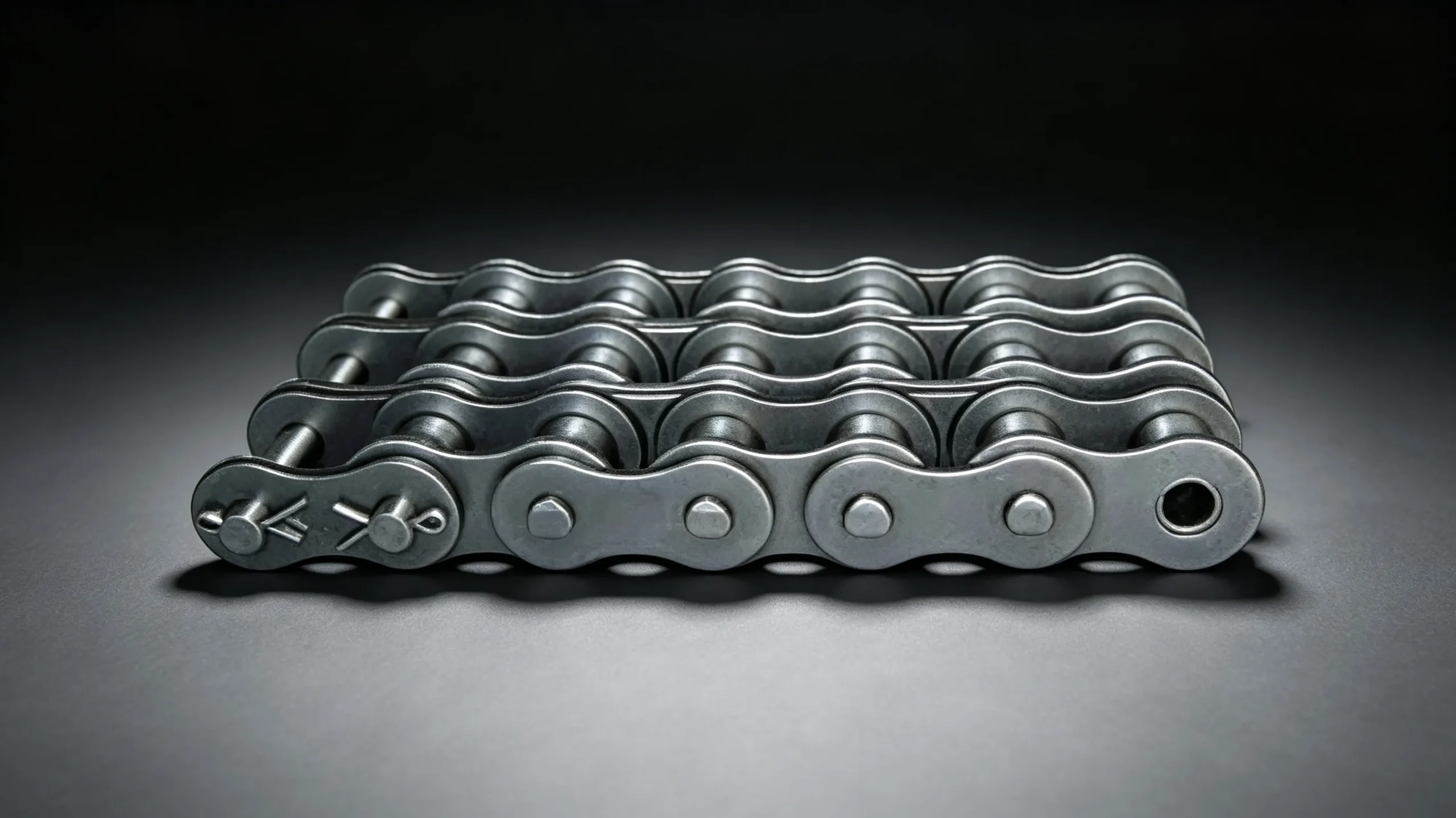
Standard B series roller chain link plates follow a figure-of-eight profile that minimises material use and weight at the cost of concentrating stress at the narrowed waist section. Straight side plate variants replace this profile with constant-width plates — a change that increases the plate’s tensile cross-section, raises the fatigue limit, and improves resistance to the elongation that standard chains develop under sustained high-cycle loading. The practical outcome is a chain that lasts longer in demanding conveyor applications, requires less frequent replacement, and holds its pitch more accurately over the course of a production season.
B series straight side plate chains are produced to ISO 606 dimensional tolerances. Pin diameter, roller diameter, and inner plate width match the standard B series specification exactly, so straight side plate chains run directly on existing ISO B series sprockets without any modification. This makes them a straightforward upgrade for any conveyor or drive line where the standard B series chain is failing prematurely under fatigue loading — simply replace the chain with the C-type version and retain all existing sprockets and hardware.
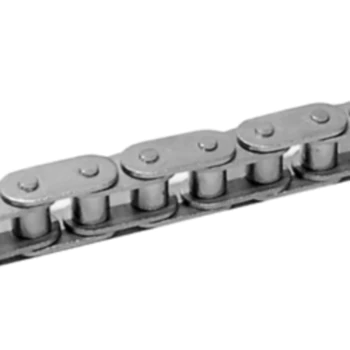
ISO B Series C-Type — same pitch as standard B series, greater plate strength for demanding conveyors
B Series Straight Side Plate Specification Table
Dimensional data for the most commonly ordered B series straight side plate sizes. The pitch, roller diameter, inner width, and pin diameter match standard B series — the plate depth (h2) and plate thickness (t) are the parameters that change, reflecting the increased material cross-section of the straight plate profile.
| ISO Chain No. | Pitch P (mm) | Roller Ø (mm) | Inner Width (mm) | Pin Ø (mm) | Plate Depth h2 (mm) | Plate Thick. t (mm) | Trans. Pitch (mm) | Q min (kN) | Weight (kg/m) |
|---|---|---|---|---|---|---|---|---|---|
| 08B-1C | 12.700 | 8.51 | 7.75 | 4.45 | 12.07 | 1.80 | 13.92 | 19.6 | 0.78 |
| 10B-1C | 15.875 | 10.16 | 9.65 | 5.08 | 15.09 | 2.03 | 16.59 | 27.5 | 1.10 |
| 12B-1C | 19.050 | 12.07 | 11.68 | 5.72 | 16.13 | 2.42 | 19.46 | 32.2 | 1.28 |
| 16B-1C | 25.400 | 15.88 | 17.02 | 8.28 | 21.10 | 4.15 | 31.88 | 72.8 | 3.02 |
| 20B-1C | 31.750 | 19.05 | 19.56 | 10.19 | 26.42 | 4.50 | 36.45 | 112.0 | 4.10 |
| 24B-1C | 38.100 | 25.40 | 25.40 | 14.63 | 33.40 | 6.00 | 48.36 | 192.0 | 7.90 |
| 32B-1C | 50.800 | 29.21 | 30.99 | 17.81 | 42.29 | 7.00 | 58.55 | 300.0 | 22.30 |
Single Pitch vs Double Pitch: Which to Select
B series straight side plate chains are available in both single-pitch and double-pitch configurations. Single-pitch chains (the standard B series sizes above) have a pitch equal to the roller diameter plus clearance, and are used for power transmission drives and moderate-speed conveyors. Double-pitch variants — sometimes called conveyor-pitch or CP chains — have a pitch exactly twice the single-pitch value and are used for slower conveying applications where the lower chain weight and reduced cost of the longer-pitch chain is beneficial.
The selection rule is straightforward: single pitch for drives above 100 RPM sprocket speed or where sprocket centre distance is short; double pitch for conveying at below 100 RPM where the chain is carrying loads but not transmitting significant mechanical power. Double pitch straight side plate B series chains use the same rollers and pins as single-pitch but with elongated link plates — they run on double-pitch sprockets with alternate teeth removed, or on appropriately designed conveyor rollers.
Horizontal and Vertical Conveyor Applications
Straight side plate B series chains are particularly well matched to two conveyor geometries that load chains in ways that standard plate design handles poorly. Horizontal conveyors carrying heavy unit loads — pallets, crates, industrial components — subject the chain to sustained high mean tension that accumulates fatigue cycles in the plate material over every loop of the conveyor. Straight plate construction distributes this tension across greater plate width, reducing the stress at any single cross-section and extending the number of cycles before crack initiation.
Vertical conveyors, elevators, and inclined conveyors add the weight of the carried load directly to the chain tension on the loaded strand, then reverse to near-zero tension on the return strand — a condition known as tension cycling that is the most damaging fatigue loading mode for roller chain link plates. Straight side plate chains are specifically specified for vertical elevating conveyors in the food industry (dairy product and bakery elevating systems), automotive assembly plants, and distribution centre sorters where the combination of load weight and continuous cycle count would shorten standard chain service life unacceptably.
Available Chain Components and Accessories
Customer Reviews
“We’ve standardised on 16B-1C straight side plate for all our vertical pasteuriser elevator drives. The improvement in fatigue life compared to standard 16B-1 was immediately measurable — we’re getting 2.2× the chain runs between replacements. The dimensional compatibility with our existing sprockets made the changeover straightforward with no downtime for sprocket replacement.”
“Our packaging line runs 20 hours a day, 6 days a week. Standard B series chain on the case-packer infeed was lasting 7–9 months. Switched to 12B-1C twelve months ago and the chain shows less than 1.2% elongation — well within service life. We expect to get at least 20 months from this set.”
“Ordered 10B-1C and 12B-1C for our bakery elevation conveyors. The quality is clearly better than what we were getting from the previous local importer — tight pitch tolerance and the plate surfaces are clean and properly treated. Delivery was exactly as scheduled and the documentation was complete for our ISO 22000 audit.”
Frequently Asked Questions
Get in Touch
Ready to Place Your Order?
Send us your specifications and annual volume. Standard enquiries receive a full technical quotation within 2 business days.
Find out more about chain selection criteria in our guide on roller chain components and their function.