Description
Product Overview
When a standard ANSI roller chain reaches the limit of its load capacity before it reaches the limit of its dimensional envelope, the SH series offers the next step. Rather than moving to a larger pitch — which means replacing sprockets, modifying shaft centres, and re-engineering the surrounding drive package — SH series chains deliver a substantial tensile strength increase within exactly the same physical dimensions as ANSI heavy series chains. The governing engineering change is the substitution of through-hardened pins for the conventional surface-hardened type: through-hardening produces a pin that is hard and wear-resistant through its full cross-section, not just at the surface layer, which raises the shear failure load substantially while also improving resistance to the fatigue cracking that develops under high-cycle shock loading.
SH chains are dimensionally identical to ANSI heavy series standard roller chains. Pin diameter, roller diameter, inner plate depth, plate thickness, and overall width match the heavy series specification exactly. This means SH chains run on existing ANSI-profile sprockets without modification, and replacement of a standard or heavy series chain with an SH series chain requires only the chain itself — no ancillary hardware changes. For drive systems that are already at the upper end of standard chain capacity, or that have experienced recurrent chain fatigue failures without an identifiable root cause in misalignment or lubrication, SH series is usually the first specification to try before moving to multi-strand or larger-pitch alternatives.
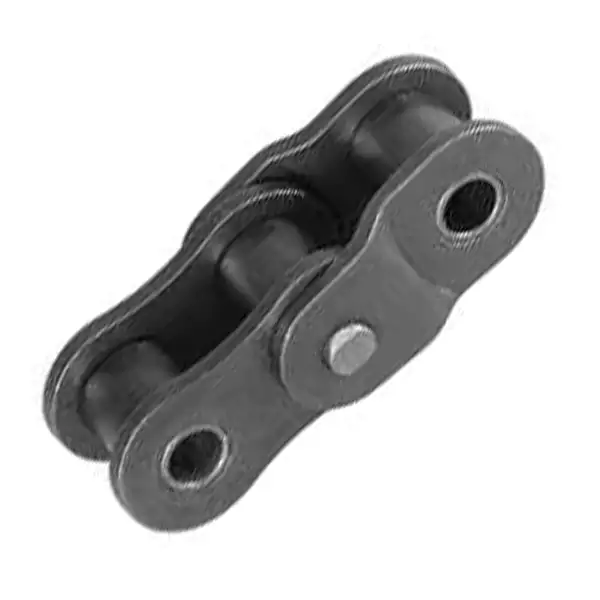
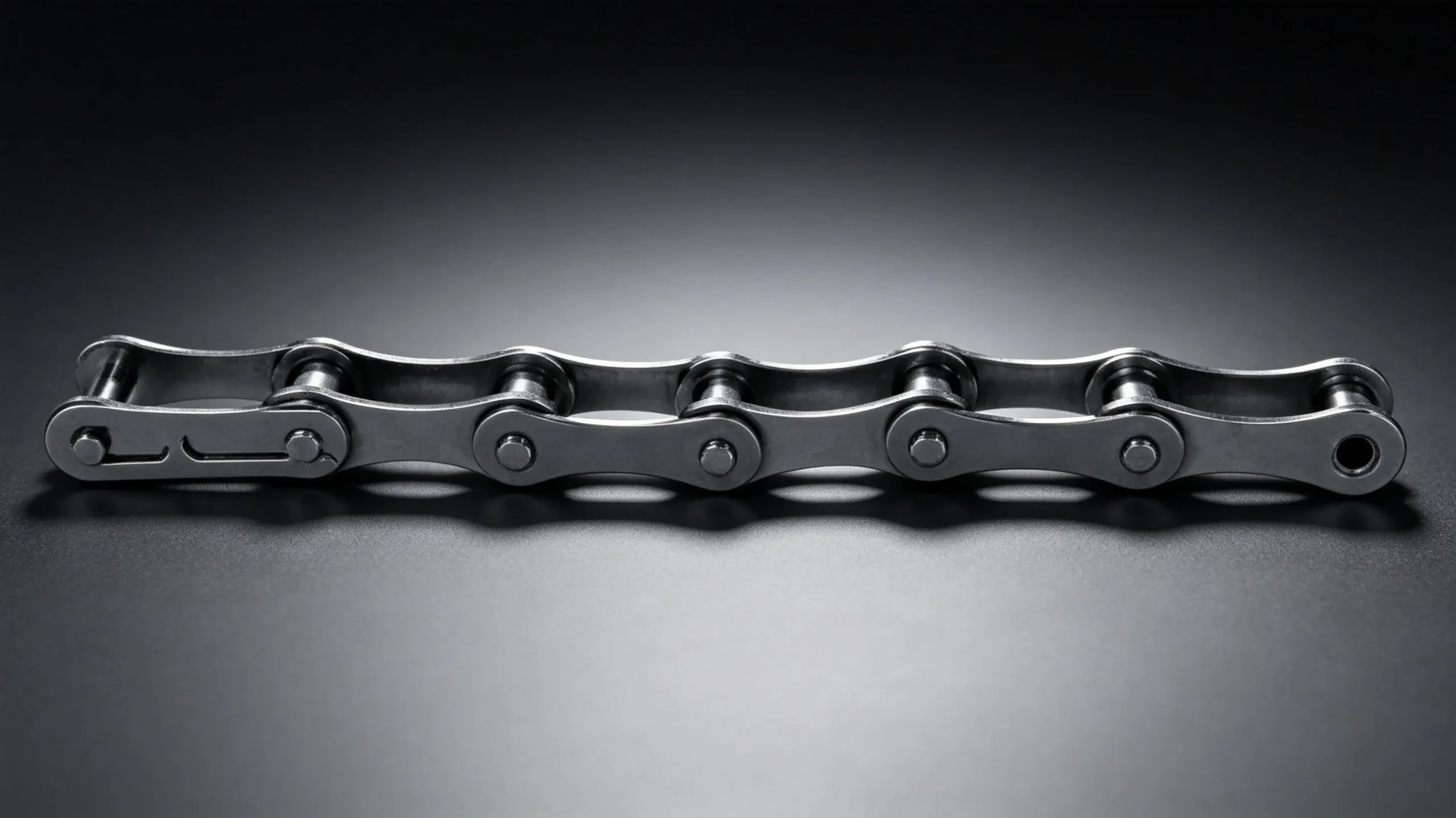
SH Series — through-hardened pin construction for elevated tensile and shock load ratings
Tensile Strength Comparison: SH vs Standard ANSI
The table below shows the minimum ultimate tensile strength (Q min) for selected SH series chain numbers versus the equivalent ANSI standard heavy series values. The SH series gain ranges from approximately 25% on smaller pitches to over 35% on larger pitch sizes, reflecting the proportionally greater benefit of through-hardening at higher pin diameters.
| Chain No. | Pitch (mm) | Roller Ø d1 (mm) | Inner Width b1 (mm) | Pin Ø d2 (mm) | Plate Depth h2 (mm) | Q min (kN) | Avg Strength Q0 (kN) | Weight (kg/m) |
|---|---|---|---|---|---|---|---|---|
| 25SH | 6.350 | 3.30 | 3.18 | 2.31 | 6.00 | 5.09 | 5.6 | 0.11 |
| 35SH | 9.525 | 5.08 | 4.77 | 3.58 | 9.00 | 11.00 | 13.6 | 0.41 |
| 40SH | 12.700 | 7.95 | 7.85 | 3.96 | 12.00 | 22.40 | 24.8 | 0.82 |
| 50SH | 15.875 | 10.16 | 9.40 | 5.08 | 15.09 | 30.40 | 36.2 | 1.25 |
| 60SH | 19.050 | 11.91 | 12.57 | 5.94 | 18.00 | 44.10 | 50.4 | 1.87 |
| 80SH | 25.400 | 15.88 | 15.75 | 7.92 | 24.00 | 88.20 | 93.0 | 3.10 |
| 100SH | 31.750 | 19.05 | 18.90 | 9.53 | 30.00 | 116.60 | 129.1 | 4.52 |
| 120SH | 38.100 | 22.23 | 25.22 | 11.10 | 35.70 | 158.20 | 175.3 | 6.60 |
| 160SH | 50.800 | 28.58 | 31.55 | 14.27 | 47.80 | 274.00 | 293.0 | 10.30 |
| 200SH | 63.500 | 39.68 | 37.85 | 19.85 | 60.00 | 506.10 | 562.3 | 19.16 |
Chain Component Design and Function
Understanding why SH series chains outperform standard chains under heavy and shock loads requires looking at each component’s specific role in the chain assembly and how through-hardening changes the failure mode hierarchy.
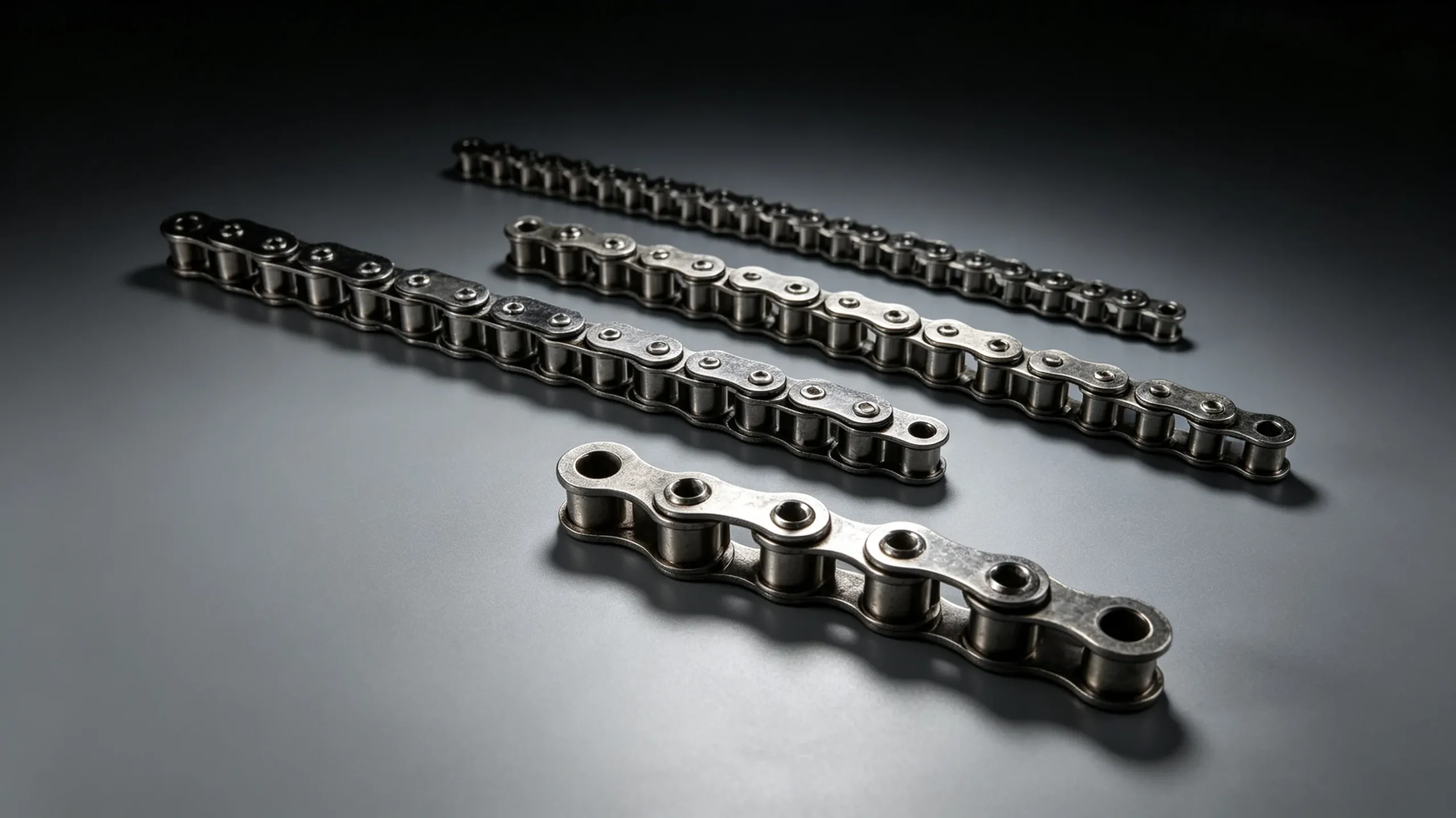
Pin — The pin transmits the entire tensile load and shear force between inner and outer link plates. Standard pins are case-hardened to a surface depth, leaving a softer core that can yield under high shock loads when the surface layer is breached. Through-hardened SH pins are hard from surface to centre, raising the shear threshold substantially.
Bushing — Receives the compressive load from the roller and transmits articular forces to the pin. Bushing wear is the primary driver of chain elongation; SH series bushings are manufactured to the same heavy-series dimensional tolerances as standard ANSI heavy chains, so elongation rates in non-shock applications are comparable.
Roller — Provides the sprocket engagement interface, protecting the bushing from direct sprocket tooth impact. High hardness and precision roundness are critical for smooth engagement at speed.
Link Plates — The inner and outer plates carry the chain tension through their figure-of-eight or straight profiles. SH series plates match ANSI heavy series thickness specifications exactly — the strength gain comes from the pins, not from modified plates.
Typical Drive Applications
SH series chains are specified most frequently in applications where standard chains have been failing prematurely under shock or fatigue loading, or where the application engineer has calculated that a standard chain is operating above 80% of its rated working load. Common drive scenarios include heavy conveyor drive heads with frequent load surges; bucket elevator drives handling dense bulk materials; agricultural equipment main drives subject to intermittent high torque from blocked or overloaded sections; wood processing machinery drives at gearbox output shafts; and industrial press feeder drives where the press ram creates cyclic impulse loads on the drive chain.
The SH series is also commonly specified for primary drives where a chain failure would cause significant downstream damage or production loss — where the modest unit cost premium over standard chain is trivially small compared to the cost of unplanned downtime. In these applications, the extra 25–35% tensile margin effectively functions as a safety buffer against the kind of instantaneous overload events that cause standard chains to fail without warning.
Components and Matching Parts Available
Customer Reviews
“We specified 80SH for a bucket elevator drive that was failing on standard 80H every 4–5 months. Running 18 months now without a chain failure. The through-hardened pin construction is clearly the right answer for this kind of intermittent shock loading — the standard chain was cracking at the pin shear point every time the elevator snagged.”
“The dimensional compatibility was the deciding factor for us. We couldn’t modify the sprocket centres without a major shutdown, so being able to fit SH series directly on our existing 60SH-profile sprockets was essential. Chains arrived with full material certificates — no issues at goods-in inspection.”
“Switched three conveyor head drive chains from standard ANSI to SH series after a series of fatigue failures on the afternoon shift when production volumes peaked. No further failures in 11 months. Lead time from order to delivery was under 10 days — faster than we got from our previous local supplier.”
Frequently Asked Questions
Get in Touch
Ready to Place Your Order?
Send us your specifications and annual volume. Standard enquiries receive a full technical quotation within 2 business days.
For background on how SH chains relate to standard heavy series, see our article on standard vs heavy series roller chain differences and our guide on breaking strength of ANSI roller chain.