Description
Product Overview
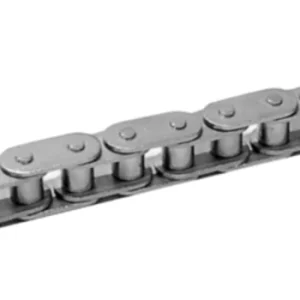
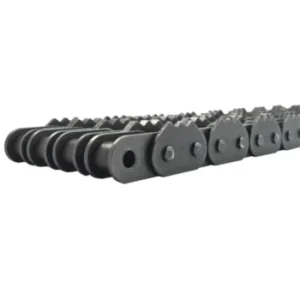
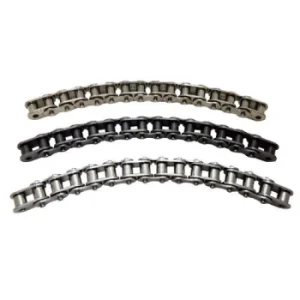
A Series Short Pitch Precision Roller Chains are the most widely specified roller chain standard in North America and countries that have adopted ANSI/ASME B29.1 as their primary drive chain reference. The ‘short pitch’ designation distinguishes these chains from double-pitch conveyor chains: A series chains have a pitch equal to their roller diameter plus a small clearance, producing a compact, dense assembly that is efficient for power transmission drives where sprocket tooth count, shaft centre distance, and chain speed are all closely managed.
Tensile strength in A series chains is determined by a combination of factors: the grade of alloy steel used for pins, bushings, and plates; the heat treatment applied to each component; the quality of pitch hole fabrication in the link plates; and the shot peening intensity applied to plates and pins before assembly. Fatigue strength — the resistance to crack initiation under cyclic stress — is equally important in practice and often the governing failure mode in high-cycle applications such as packaging line drives and agricultural feeder mechanisms that operate continuously over long seasons.
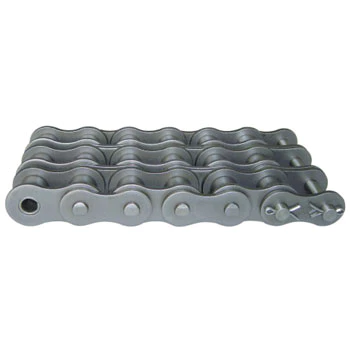
ANSI A Series — from #25 simplex to #240 triplex, stainless steel options available
Specifications — A Series Simplex (Single Strand)
The following table covers the primary single-strand A series chain numbers from #25 through #100. Duplex and triplex specifications share the same pitch and roller dimensions — only the transverse pitch and total width change with strand count.
| ANSI No. | ISO No. | Pitch P (mm) | Roller Ø d1 (mm) | Inner Width b1 (mm) | Pin Ø d2 (mm) | Plate Depth h2 (mm) | Q min (kN) | Weight (kg/m) |
|---|---|---|---|---|---|---|---|---|
| 25 | 04C-1 | 6.350 | 3.30 | 3.18 | 2.31 | 6.00 | 3.33 | 0.09 |
| 35 | 06C-1 | 9.525 | 5.08 | 4.77 | 3.58 | 9.00 | 7.78 | 0.28 |
| 40 | 085-1 | 12.700 | 7.95 | 7.85 | 3.96 | 12.00 | 14.10 | 0.61 |
| 50 | 10A-1 | 15.875 | 10.16 | 9.40 | 5.08 | 15.09 | 21.80 | 0.92 |
| 60 | 12A-1 | 19.050 | 11.91 | 12.57 | 5.94 | 18.00 | 31.30 | 1.44 |
| 80 | 16A-1 | 25.400 | 15.88 | 15.75 | 7.92 | 24.00 | 55.60 | 2.49 |
| 100 | 20A-1 | 31.750 | 19.05 | 18.90 | 9.53 | 30.00 | 87.50 | 3.73 |
| 120 | 24A-1 | 38.100 | 22.23 | 25.22 | 11.10 | 35.70 | 125.60 | 5.81 |
| 160 | 32A-1 | 50.800 | 28.58 | 31.55 | 14.27 | 47.80 | 222.40 | 10.30 |
| 200 | 40A-1 | 63.500 | 39.68 | 37.85 | 19.85 | 60.00 | 347.00 | 16.48 |
Construction Quality and Manufacturing Standards
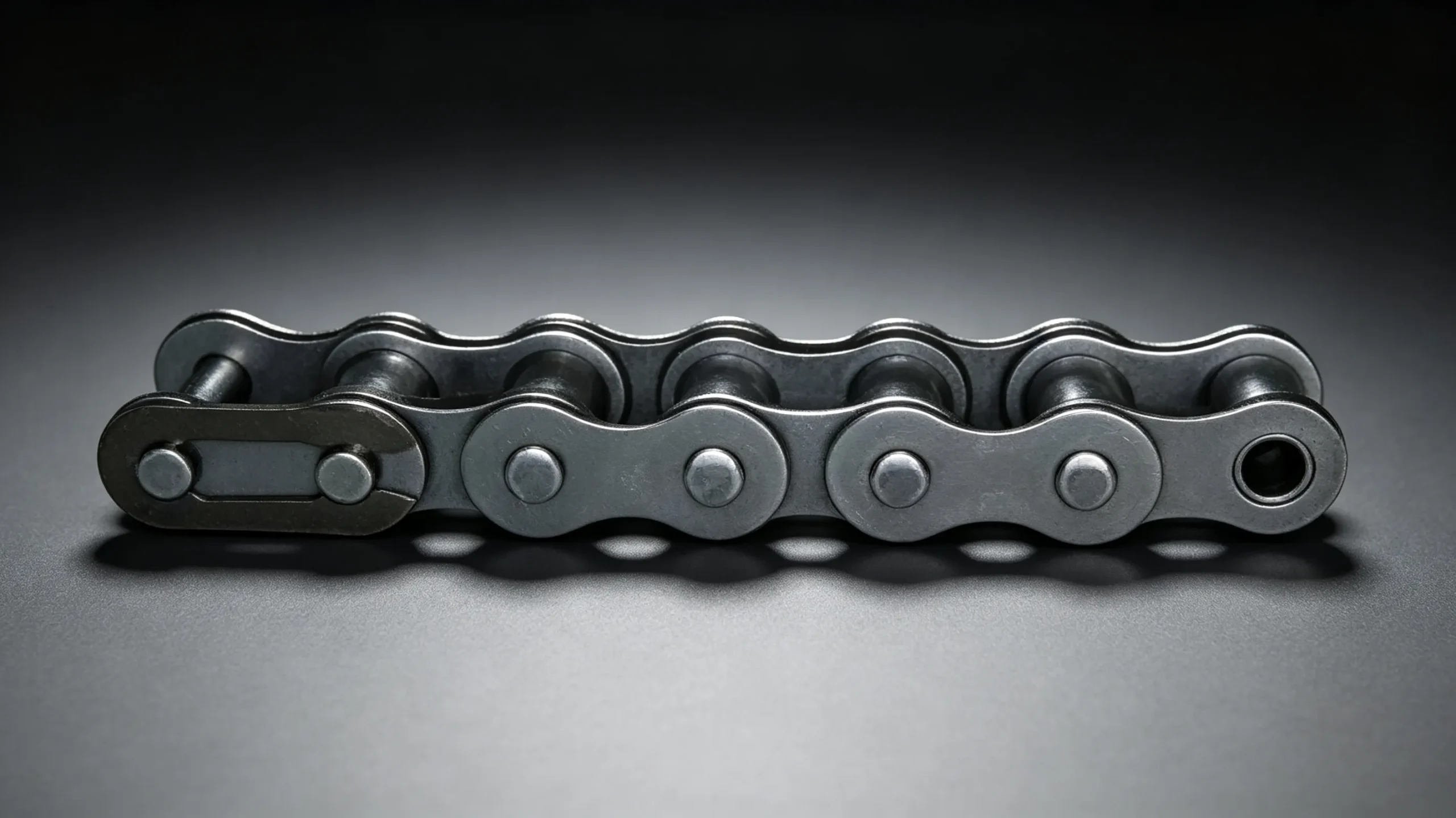
Our A series roller chains are manufactured to ANSI/ASME B29.1 tolerances throughout. Pitch holes in inner and outer link plates are punched using precision tooling that holds hole diameter and position to within ±0.01mm — critical for maintaining pitch accuracy over the full chain length. Shot peening of link plates improves fatigue life by inducing compressive residual stress at the plate surface, delaying the onset of fatigue cracking under cyclic tension. Pre-stretching during the final assembly stage removes the initial seating elongation that would otherwise occur during the first hours of service, ensuring chains arrive dimensionally stable and ready to run without an extended bed-in period.
Heat treatment processes cover all contact surfaces: pins and bushings are case-hardened to provide wear resistance at the articulation interface, while rollers receive through-hardening for shock resistance at sprocket engagement. Plate hardness is controlled to balance tensile strength with the toughness needed to resist crack propagation under shock loading — plates that are too hard become brittle and fail catastrophically rather than deforming to absorb energy.
Duplex and Triplex Configurations
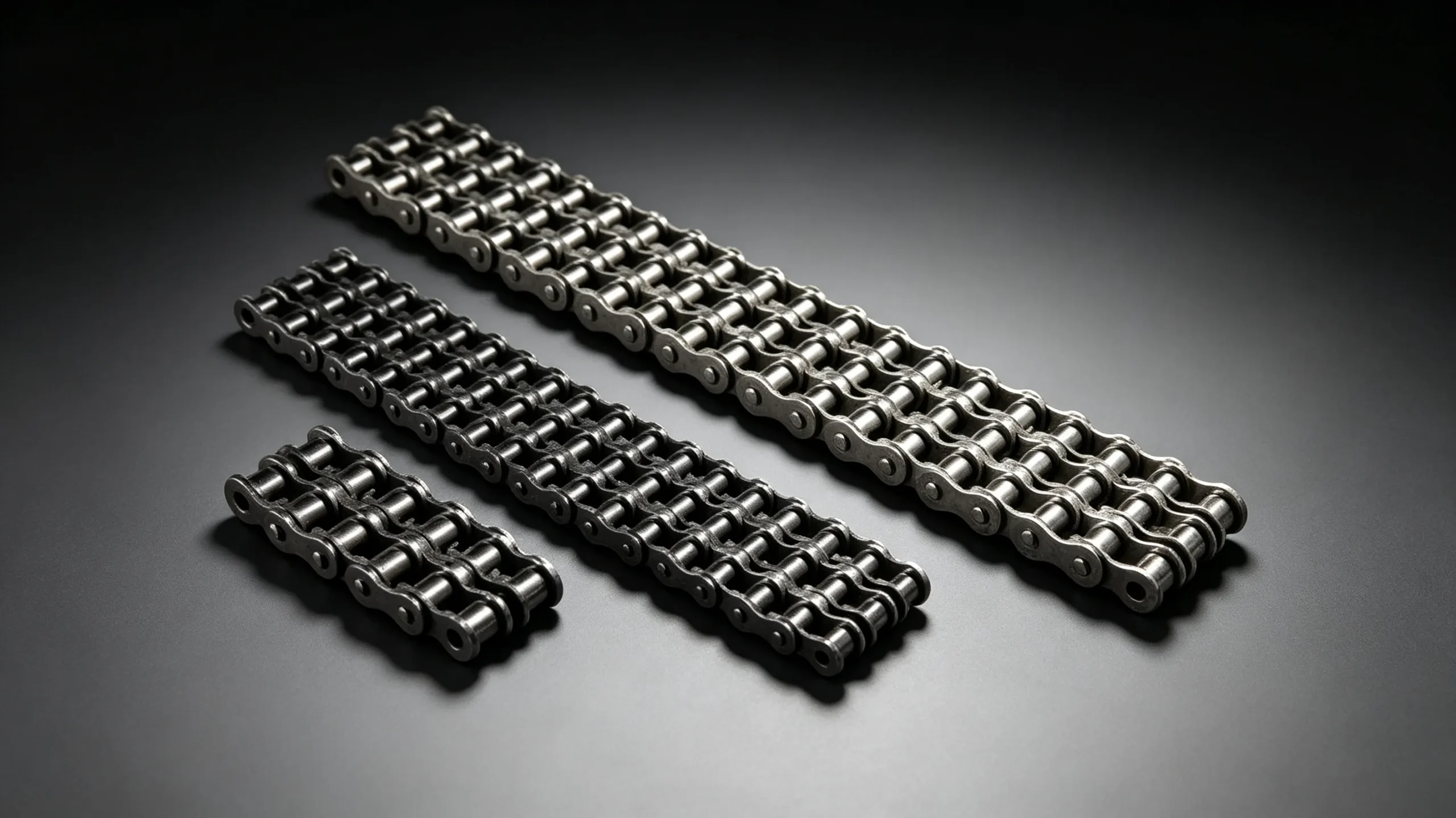
When a single-strand chain reaches the limit of its tensile or fatigue capacity, moving to duplex (two-strand) or triplex (three-strand) configuration doubles or triples the effective chain cross-section within the same pitch. Multi-strand A series chains use the same inner and outer links as their simplex equivalents, with spacer plates between strands to maintain the correct transverse pitch for matched sprockets. Two-pitch offset links and heavy-duty cotter-pin connecting links are available for all A series multi-strand configurations.
One practical advantage of multi-strand A series over moving to a larger pitch is that the smaller pitch maintains a higher wrap angle per unit of sprocket tooth count, which distributes the load across more teeth simultaneously. This is particularly beneficial in applications with small sprockets or short centre distances where a larger pitch would reduce the tooth engagement count unacceptably.
Industries and Applications
A Series short pitch precision roller chains appear in virtually every sector of manufacturing and processing. The range of pitch sizes from #25 (6.35mm) through #240 (76.2mm) covers drives from small instrument feeding mechanisms through to main shaft drives on heavy processing equipment. Common application categories include agricultural machinery main drives and feeder mechanisms; packaging line drives for filling, sealing, labelling, and case-packing equipment; conveyor head and tail drives in distribution centres and manufacturing plants; machine tool indexing and feed mechanisms; food processing conveyors (available in stainless steel for washdown applications); textile machinery drives; and general industrial gearbox output drives.
Chain Components and Available Parts
Customer Reviews
“We’ve been running #60 A series duplex on our primary packaging line head drives for two years. Consistent quality batch to batch — the pitch tolerance is tight enough that we don’t get the vibration we were experiencing with the cheaper chains we were buying previously. Clear specification sheets and fast response to technical queries.”
“Our OEM customers specify ANSI #80 single strand for the main drive on their combine harvesters. We’ve been sourcing from here for four seasons and have had zero warranty claims related to chain failure. Lead time is reliable and the packing is good enough for sea freight without damage.”
“We needed stainless steel #50 simplex for our fish processing line wash-down conveyors. The team confirmed material grade and supplied full material traceability documentation without any extra charge. Perfect for our HACCP audit requirements. Will be expanding to #60 stainless on the second line.”
Frequently Asked Questions
Get in Touch
Ready to Place Your Order?
Send us your specifications and annual volume. Standard enquiries receive a full technical quotation within 2 business days.
For more background, see our articles on how a roller chain works and simplex, duplex, and triplex chain key differences.