Description
Product Overview
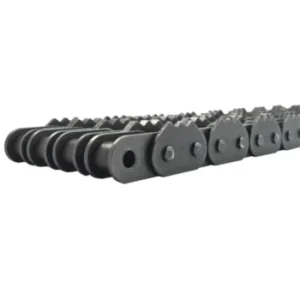
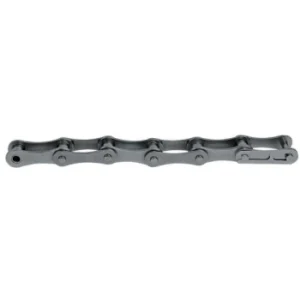
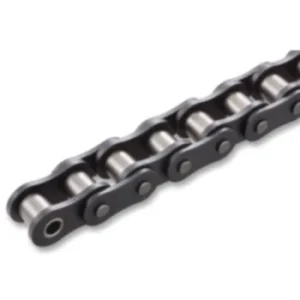
B Series Short Pitch Precision Roller Chains follow the ISO 606 / DIN 8187 / BS 228 standard — the dominant roller chain specification across Europe, the United Kingdom, Australia, and most markets that have adopted European engineering norms as their reference standard. While the pitch numbering convention and chain designations differ from ANSI A series, the underlying engineering principles are identical: the chain transmits power and conveying force through the articulation of hardened pins within hardened bushings, with rollers reducing engagement wear at the sprocket teeth.
The key dimensional differences between B series and A series chains — at the same nominal pitch — are in the roller diameter and the inner plate width. B series chains generally have a smaller roller diameter and different inner plate width relative to pitch than their ANSI equivalents. This means a B series #10B-1 chain with a 15.875mm pitch is not dimensionally interchangeable with a ANSI #50 chain of the same pitch: both share 15.875mm pitch but differ in roller diameter, inner width, and transverse pitch. Confirming which standard your equipment was designed to is therefore the first step before placing any replacement chain order.
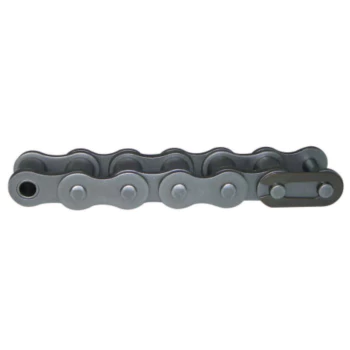
B Series ISO/BS — the standard specification for European-designed industrial machinery
B Series Simplex Specification Table
The table below covers the primary B series simplex chain designations. Duplex (-2) and triplex (-3) variants share the same pitch, roller diameter, and inner width — only the transverse pitch and overall width change.
| ISO Chain No. | Pitch P (mm) | Roller Ø d1 (mm) | Inner Width b1 (mm) | Pin Ø d2 (mm) | Pin Length L (mm) | Plate Depth h2 (mm) | Plate Thick. t (mm) | Q min (kN) | Weight (kg/m) |
|---|---|---|---|---|---|---|---|---|---|
| 04B-1 | 6.000 | 4.00 | 2.80 | 1.85 | 6.80 | 5.00 | 0.60 | 3.2 | 0.11 |
| 06B-1 | 9.525 | 6.35 | 5.72 | 3.28 | 13.15 | 8.20 | 1.30 | 9.0 | 0.41 |
| 08B-1 | 12.700 | 8.51 | 7.75 | 4.45 | 16.70 | 11.81 | 1.60 | 18.0 | 0.69 |
| 10B-1 | 15.875 | 10.16 | 9.65 | 5.08 | 19.50 | 14.70 | 1.70 | 22.2 | 0.93 |
| 12B-1 | 19.050 | 12.07 | 11.68 | 5.72 | 22.50 | 16.13 | 1.85 | 29.0 | 1.15 |
| 16B-1 | 25.400 | 15.88 | 17.02 | 8.28 | 36.10 | 21.10 | 4.15 | 60.0 | 2.71 |
| 20B-1 | 31.750 | 19.05 | 19.56 | 10.19 | 41.30 | 26.42 | 4.50 | 95.0 | 3.70 |
| 24B-1 | 38.100 | 25.40 | 25.40 | 14.63 | 53.40 | 33.40 | 6.00 | 160.0 | 7.10 |
| 28B-1 | 44.450 | 27.94 | 30.99 | 15.90 | 65.10 | 37.08 | 7.50 | 200.0 | 12.85 |
| 32B-1 | 50.800 | 29.21 | 30.99 | 17.81 | 66.00 | 42.29 | 7.00 | 250.0 | 17.50 |
Reinforced and Cotter Pin Variants
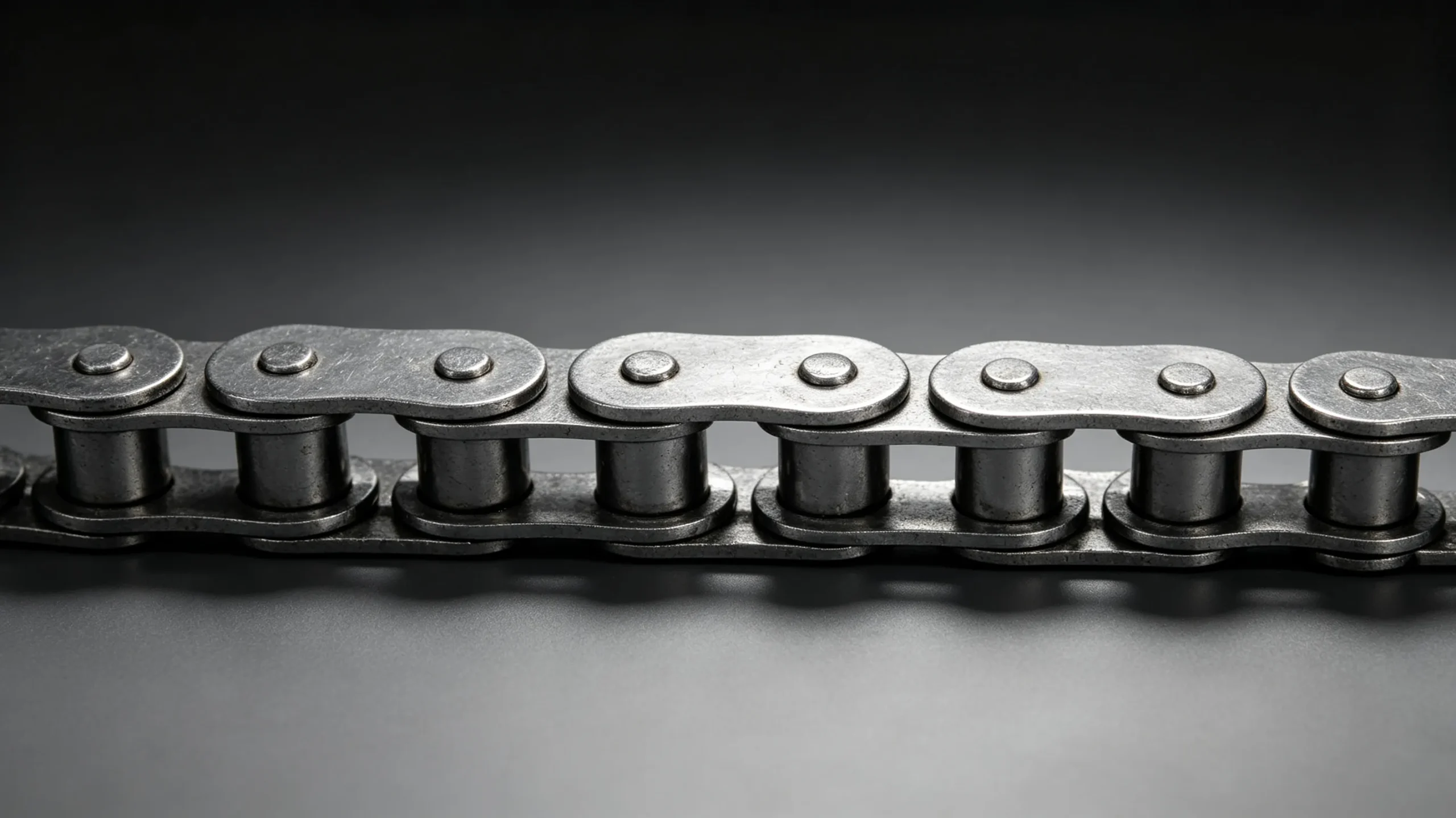
Standard B series simplex chains are supplied with spring-clip (slotted) connecting links suitable for most conveyor and low-to-moderate speed drive applications. For higher-speed drives, shock-loaded applications, or anywhere that vibration could cause a spring clip to disengage, cotter-pin connecting links are available as standard across the full B series range. Reinforced (heavy-duty) B series chains increase plate thickness and pin diameter relative to the standard ISO tolerance band, providing higher tensile and fatigue ratings while remaining dimensionally compatible with standard B series sprockets at all contact surfaces.
Cotter-pin chain assemblies require the chain ends to be joined differently from spring-clip versions — the pin protrudes from both sides of the outer plate and is retained by split cotter pins bent outward. This connection is significantly more vibration-resistant and is the standard recommendation for any B series chain running above 1,500 rpm or subject to frequent shock loading from materials impacting the conveyor.
Application Areas for B Series Chain
B series chains are standard equipment in European-designed agricultural machinery including tractors, balers, combine harvesters, and forage equipment. The agricultural sector is one of the highest-volume B series chain markets because the seasonal nature of agricultural operations means chains are often run at or near their rated capacity for extended periods during harvest, then stored for months between seasons — a usage pattern that favours chains with high fatigue resistance and good corrosion protection on the bare metal surfaces.
Industrial applications for B series chain include material handling conveyors across automotive, food processing, packaging, and distribution sectors. B series 16B-1 through 24B-1 is commonly found in the drive trains of industrial washing machines and dishwashers, where the chain operates in high-humidity, chemical-laden environments that require either stainless steel specification or robust corrosion protection on carbon steel chains. Textile machinery, printing presses, and paper handling equipment also represent significant B series markets, where long chain runs and high-cycle operation demand consistently tight pitch tolerance across the full chain length.
Components and Matching Parts
Customer Reviews
“We order 10B-1 and 12B-1 in volume every spring for our dealer network’s pre-season combine harvester service kits. Quality is consistent, material certificates arrive with every batch, and the pricing is the best we’ve found for this specification. Delivery to the Netherlands is typically 8–10 days.”
“Specified 08B-1 stainless for our fish conveyor wash-down sections to comply with our BRCGS audit requirements. The team confirmed 316L grade and provided full traceability documentation. The chains have been running 14 months without any corrosion — substantially better than the 304 grade we were previously using from a different supplier.”
“We manufacture packaging lines that are exported globally. Fitting B series chain as standard keeps our equipment compatible with European spare parts networks worldwide. The chain quality here is high enough that we’ve started recommending this supplier to our end customers for replacement parts.”
Frequently Asked Questions
Get in Touch
Ready to Place Your Order?
Send us your specifications and annual volume. Standard enquiries receive a full technical quotation within 2 business days.
Learn more about roller chain standards in our article on the difference between ANSI and ISO roller chain, and find out what distinguishes BS from ANSI roller chain standards.