
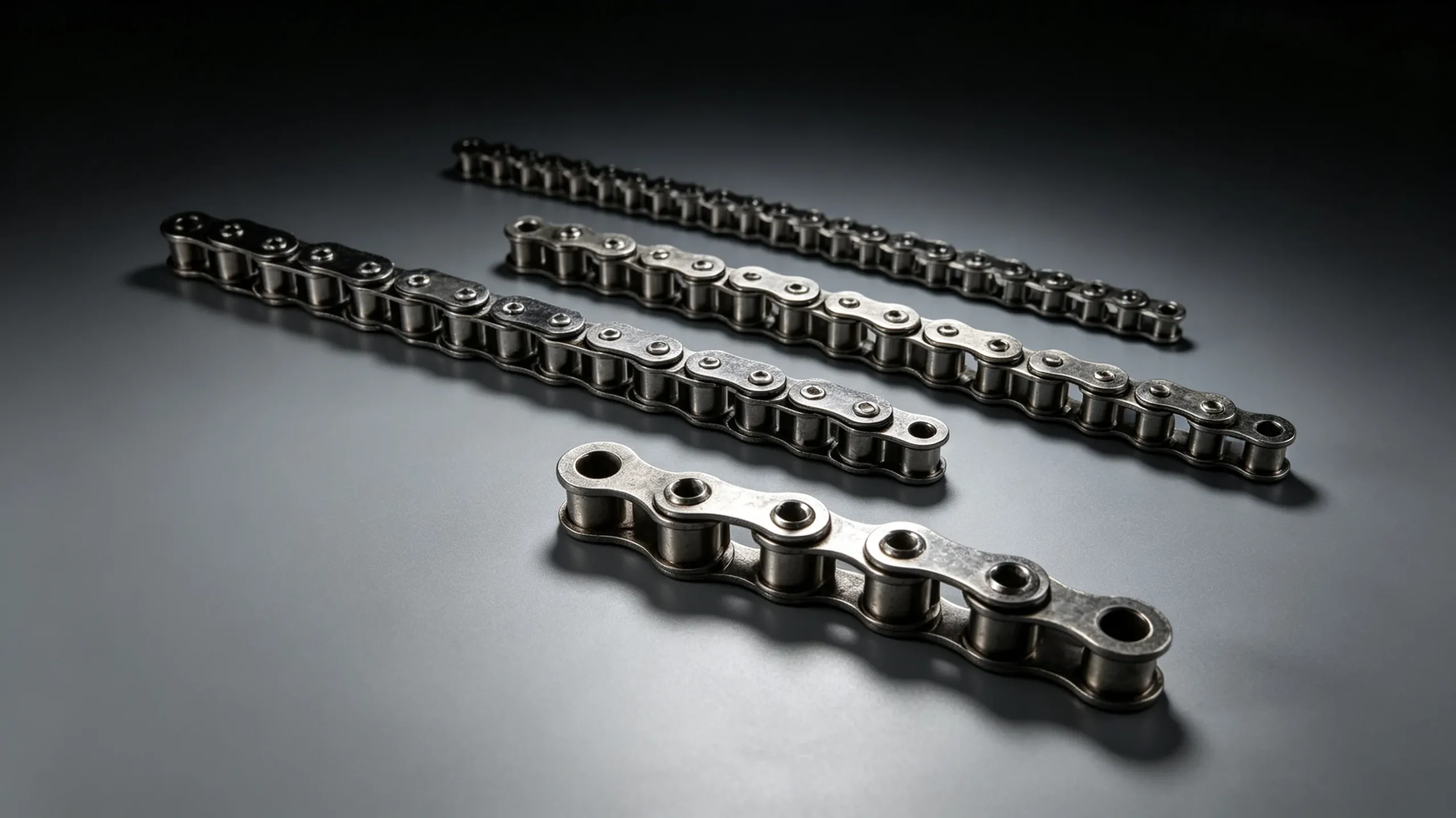
In the catalogue of roller chain specifications, the shape of the link plate outer edge rarely gets a dedicated section. Yet for engineers specifying chains for agricultural machinery, mining conveyors, and any other application where loading is variable and fatigue life is the limiting design constraint, the plate profile is one of the most consequential decisions in the specification. Sawtooth plate roller chain replaces the conventional smooth outer plate edge with a repeating serrated geometry — and this single change produces measurable improvements in fatigue life, thermal behaviour, and total cost of ownership that standard flat plate chain cannot match under variable load conditions.
Understanding Link Plate Fatigue: Why the Outer Edge Matters
In any loaded roller chain, the link plates experience cyclic bending stress every time the chain articulates across a sprocket. The stress is highest at the pin hole edges — this is the geometric stress concentration point in the plate, where the circular hole interrupts the load path and causes stress to concentrate around the hole perimeter. Under repetitive cycling, fatigue micro-cracks initiate at the highest-stress point on the pin hole edge and propagate outward through the plate body.
The outer edge profile of the plate — whether flat or serrated — affects the overall stress field within the plate body. A flat plate concentrates virtually all of the bending compliance in the plate centre section, which means the stress field around the pin hole remains relatively high during articulation. The sawtooth plate geometry introduces controlled geometric complexity along the plate periphery that redistributes the bending deformation and changes the stress field at the critical pin hole location.
Advantage 1: Reduced Peak Stress at the Pin Hole
Finite element analysis of sawtooth plate roller chain under representative agricultural drive loading conditions shows that the peak stress at the pin hole edge is measurably lower in sawtooth plates than in flat plates of identical material, thickness, and overall dimensions. The serrations effectively redirect a portion of the bending load path away from the pin-hole concentration zone and distribute it across the serrated plate periphery.
The quantitative improvement varies with plate geometry and loading conditions. In comparative static stress analysis, sawtooth plates typically show pin hole peak stress reductions of 8 to 15 percent relative to flat plates at equivalent applied load. Under cyclic loading, this stress reduction translates to a disproportionately large improvement in fatigue life — because fatigue life scales approximately with the inverse cube of stress amplitude, a 10 percent reduction in peak stress can produce a 30 to 35 percent improvement in fatigue life cycles to crack initiation.
| Parameter | Standard Flat Plate | Sawtooth Plate | Improvement |
|---|---|---|---|
| Peak stress at pin hole (relative) | 1.00x (baseline) | 0.87–0.92x | 8–13% reduction |
| Fatigue cycles to crack initiation (cyclic loading) | Baseline | 1.2–1.4x longer | 20–40% increase |
| Plate surface area | Baseline | 8–15% greater | Better thermal performance |
| Weight vs standard | Baseline | Marginally heavier | Negligible in practice |
| Sprocket compatibility | Standard matched sprockets | Same — no change needed | No conversion cost |
| Cost vs standard chain | Baseline | 10–20% premium | Recoverable through longer life |
Advantage 2: Greater Plate Surface Area for Thermal Management
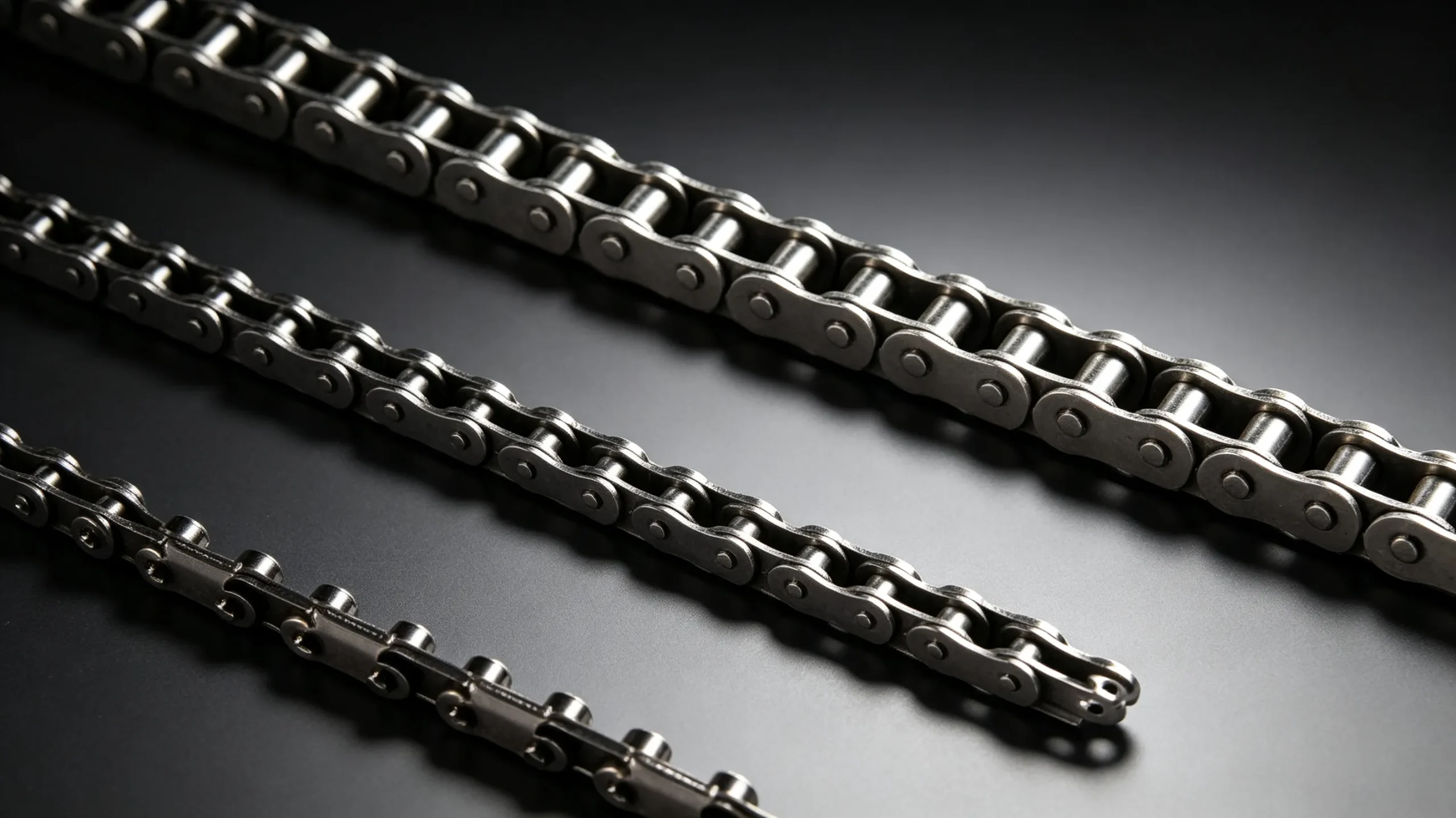
The serrated edge geometry of a sawtooth plate increases the total outer surface area of the link plate by 8 to 15 percent compared to a flat plate of equivalent overall height. This additional surface area provides more area for convective and radiative heat dissipation during continuous operation under sustained load. In applications where industrial roller chain operates for extended periods at high load — mining conveyor main drives, continuous agricultural processing equipment — this improved thermal dissipation helps maintain lower plate temperatures.
Lower operating temperature has a secondary benefit: it preserves lubricant viscosity at the pin-bushing interface for longer. As plate temperature rises, lubricant in contact with the hot steel surfaces thins, and thin lubricant provides less hydrodynamic film thickness at the pin-bushing contact — accelerating wear. The sawtooth geometry moderates this temperature rise slightly, contributing to longer lubrication film life alongside the primary fatigue life improvement.
Advantage 3: No Sprocket Modification Required
One of the practical advantages of sawtooth plate roller chain is that the plate modification is entirely external to the chain engagement geometry. The pitch, roller diameter, inner link width, and pin dimensions are identical to standard chain of the same designation. The serrated edge is on the outer periphery of the plate — the part that faces away from the sprocket teeth during engagement. This means sawtooth chain installs directly onto existing matched sprockets without any modification, conversion cost, or change to the drive geometry.
This compatibility makes sawtooth plate chain a direct plug-in upgrade for applications where standard chain is currently failing by plate fatigue. There is no need to replace sprockets, adjust centre distances, or modify drive housings — the only change is the chain itself. This simplicity of adoption is a significant practical advantage compared to alternative approaches to improving fatigue life, such as increasing chain pitch (which requires new sprockets) or adding a second strand (which requires duplex sprockets and wider shaft assemblies).
Advantage 4: Most Beneficial Where It Is Needed Most
The fatigue life improvement from the sawtooth plate geometry is not uniform across all loading conditions — it is specifically greatest under the conditions that are most damaging to standard flat plate chain. Under steady-state loading at constant tension, both flat plate and sawtooth plate chain perform similarly, as steady-state stress at the pin hole is well within the endurance limit of correctly heat-treated medium-carbon steel.
Under variable loading with frequent peaks above the mean tension — the operating profile of combine harvester feeder drives, baler plunger drives, and conveyor systems with non-uniform material flow — the sawtooth geometry provides its maximum benefit. Each load peak pushes the pin hole stress closer to the fatigue limit, and the 8 to 13 percent stress reduction from the sawtooth geometry provides a correspondingly larger proportion of the total fatigue life at these peak events. In harvest machinery field trials, sawtooth plate roller chain has demonstrated service lives 30 to 50 percent longer than flat plate chain of identical pitch and material in the same drives.
Advantage 5: Lower Total Cost of Ownership Despite Higher Unit Price
The unit price of sawtooth plate roller chain is typically 10 to 20 percent higher than standard flat plate chain of the same pitch. For applications where the chain is genuinely fatigue-limited — where flat plate chain fails by plate cracking rather than by wear elongation — this premium is recovered within the first replacement cycle through the extended service life. If a standard chain lasts one harvest season (approximately 500 operating hours) before showing plate fatigue cracking, and the sawtooth equivalent achieves 700 hours, the sawtooth chain is more economical per operating hour despite the higher unit cost.
The full cost comparison must also include the value of avoided downtime. A chain failure during harvest — when a combine harvester or baler feeder chain breaks in the field — costs not just the replacement chain but also the delay time, transport for parts, and potentially lost crop if the breakdown occurs during a narrow weather window. For Australian grain and hay producers, where the harvest window can be as short as two to three weeks, the downtime cost of an avoidable chain failure can exceed the annual cost of the chain supply itself.
When Sawtooth Plate Chain Provides Less Benefit
It is important to be accurate about when the sawtooth plate upgrade is and is not worth the premium. For smooth, steady-state drives — pump drives, fan drives, packaging machine conveyors with uniform product — flat plate chain will outlast its wear elongation limit long before any fatigue cracking occurs. The fatigue life improvement from the sawtooth geometry provides no practical benefit if the chain is being replaced for elongation rather than plate fracture.
The correct specification decision is: if your current chain is failing by elongation (gradual wear to the 3 percent replacement threshold), standard flat plate chain is appropriate and the sawtooth upgrade is unnecessary. If your current chain is failing by plate cracking at the pin holes — particularly after shorter-than-expected service in a variable or shock-load drive — sawtooth plate roller chain is the engineering solution.
EverPower Roller Chains Australia is a specialist supplier of sawtooth plate roller chain in ANSI and ISO series for agricultural, mining, and industrial applications across New South Wales and Australia. Contact our Sydney team to discuss whether the sawtooth plate upgrade is appropriate for your specific drive and load conditions.
+61 2 9708 3322 | [email protected] | 27 Harley Crescent, Condell Park NSW 2201