
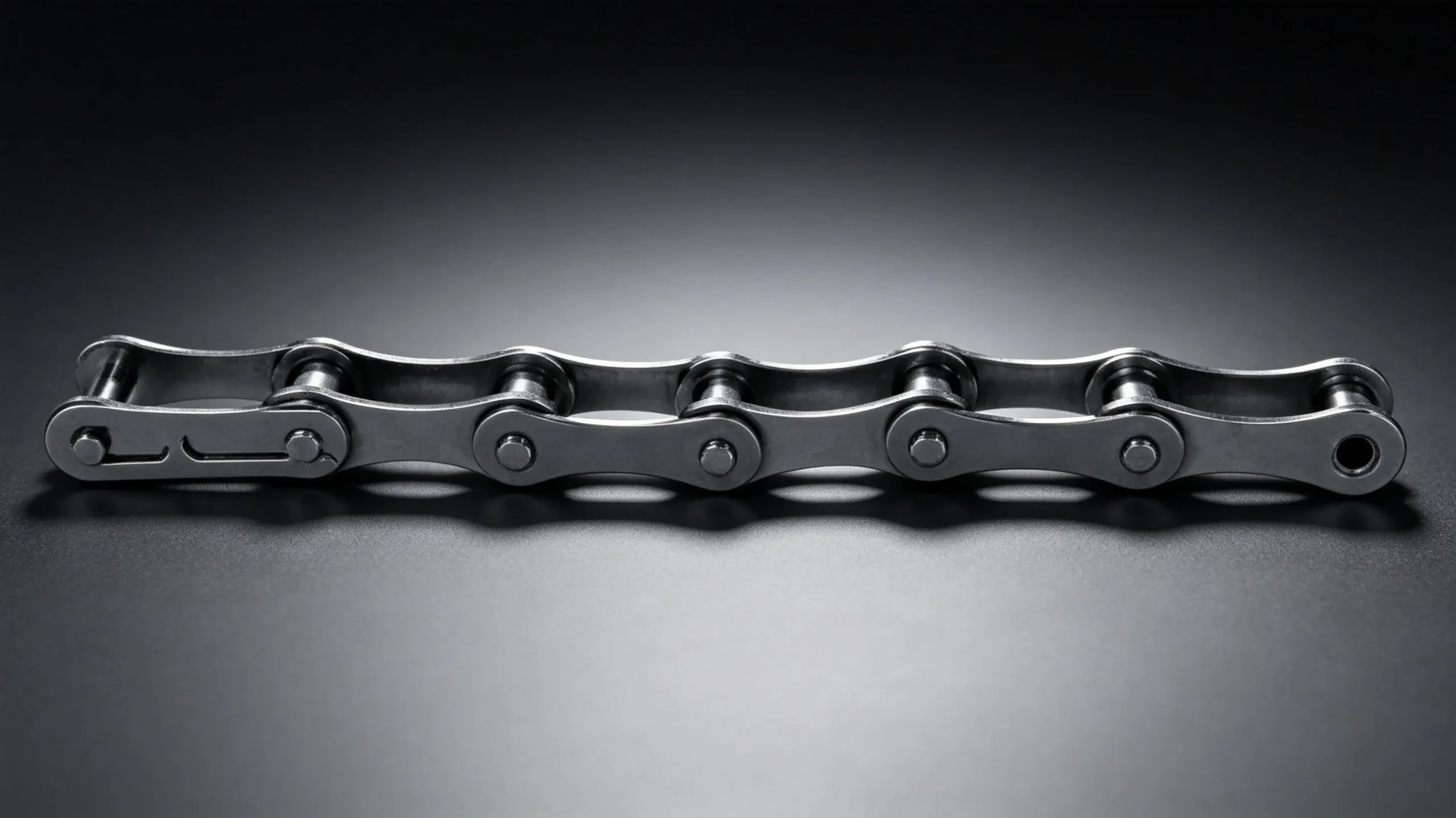
Agricultural machinery places uniquely demanding requirements on roller chain drives. The loading is rarely steady — a combine harvester feeder house, a square baler plunger drive, or a silage chopper can swing from near-zero tension to peak tension many times per minute as crop density varies. Chain that performs adequately on a smooth industrial conveyor can fail within a single harvest season on agricultural equipment, not because it was poorly made but because it was not designed for this loading profile. Sawtooth plate roller chain was developed specifically to address the fatigue demands of agricultural drives, and understanding why it outperforms standard flat plate chain in these applications requires a closer look at what actually kills chain in the field.
The Agricultural Loading Profile: Why It Is Uniquely Damaging
Most industrial roller chain is rated and tested under steady-state tensile loading. Agricultural machinery drives operate under a fundamentally different loading profile: high-frequency variable tension with regular peak spikes that can reach three to five times the mean running tension. This variable profile matters enormously for fatigue life because plate fatigue is governed by stress amplitude — the range between minimum and maximum stress in each cycle — rather than by mean stress alone.
In a combine harvester feeder house, the chain tension varies with every fistful of crop that enters the header. Dense spots in the field produce sudden load spikes; thin patches produce near-zero tension. The chain cycles through this variable loading continuously for 10 to 14 hours per day during harvest. At 500 RPM on a typical feeder drive with a 17-tooth sprocket and ANSI 60 chain running at approximately 1.5 m/s, the chain articulates over the driving sprocket roughly 26 times per second. Over a 300-hour harvest season, that is approximately 28 million articulation cycles — each one accompanied by a variable tension event.
What Fails First in Agricultural Chain: The Pin-Hole Fatigue Zone
Fatigue failures in agricultural roller chain link plates almost universally initiate at the pin-hole edge — the geometric stress concentration point in any loaded link plate. Under steady loading, the stress at this location is bounded by the applied load and the plate geometry. Under variable loading with peak spikes, the stress amplitude at the pin hole reaches values that can exceed the plate fatigue endurance limit during each peak event, even when the mean load is well within the rated working load.
Standard flat plate chain addresses this geometry as well as the plate cross-section and material allow — but the flat plate profile concentrates bending compliance in the mid-plate section, which keeps the stress concentration factor at the pin hole relatively high during articulation. This is acceptable for steady industrial drives. For variable agricultural loads, the repeated exceedance of the pin-hole endurance limit during peak events is what drives premature plate fracture — the failure mode that ends chain life in agricultural applications far sooner than wear elongation.
How the Sawtooth Profile Changes the Fatigue Equation
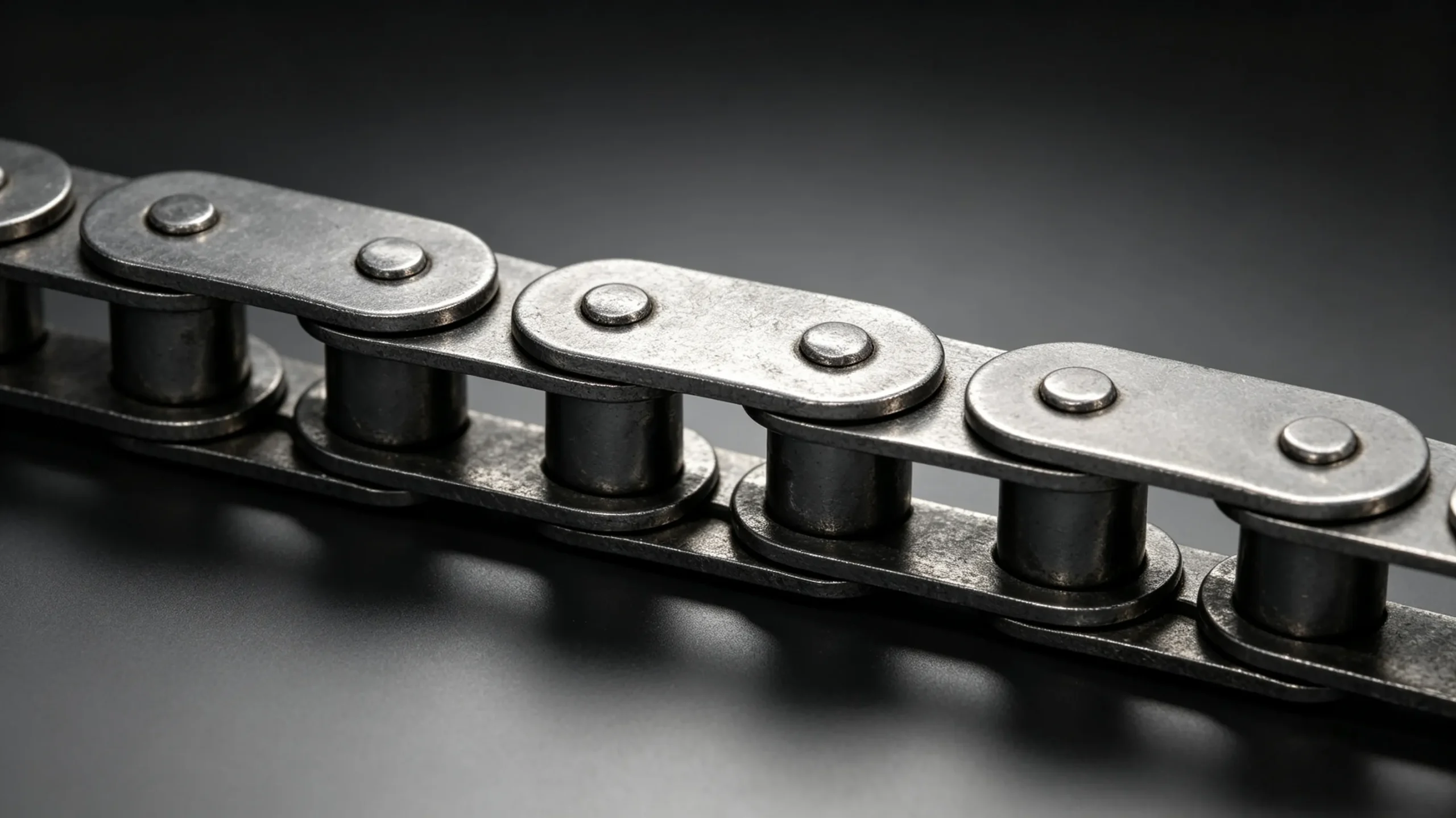
The serrated outer edge of a sawtooth plate roller chain redistributes the stress field within the plate body during bending articulation. Finite element modelling of sawtooth plates under representative agricultural loading shows peak stress values at the pin-hole edge 8 to 13 percent lower than in flat plates of identical material and cross-section. Under cyclic loading, this stress reduction translates to a fatigue life improvement of 20 to 40 percent — the relationship is non-linear because fatigue life scales with approximately the inverse cube of stress amplitude.
In practical terms: if your current standard flat plate chain achieves 300 hours in a combine feeder drive before showing pin-hole cracking, sawtooth plate roller chain of the same pitch and material is likely to achieve 380 to 420 hours in the same drive under the same conditions. Over a three-year period, that improvement might represent one fewer chain replacement per season — a saving that comfortably recovers the 10 to 20 percent price premium of sawtooth chain over standard.
Agricultural Applications Where Sawtooth Chain Is Most Effective
Combine Harvester Feeder House
Variable crop density produces continuous tension fluctuation in feeder chains. Sawtooth plate fatigue resistance is most effective under exactly this loading profile.
Square Hay Baler Plunger Drive
The reciprocating plunger cycles between near-zero tension and high compression load on every stroke — the highest-amplitude fatigue loading pattern in agricultural machinery.
Forage Harvester Cutterhead Drive
High rotational inertia combined with sudden crop engagement produces sharp tension spikes that accelerate standard flat plate fatigue.
Straw Walker and Cleaning Shoe Drives
Continuous oscillatory motion generates cyclic loading at high frequency — a fatigue-dominated application where sawtooth plate life improvement is consistent.
Round and Square Baler Feed Rollers
Variable crop flow through the feed mechanism produces moderate-amplitude variable loading at high cycle count over a full baling season.
Grain Auger and Elevator Drives
While loading is more uniform than harvesting drives, auger blockages generate sudden shock peaks that accelerate flat plate fatigue at the pin holes.
Sawtooth Chain vs Standard Chain: Agricultural Field Performance Data
| Metric | Standard Flat Plate Chain | Sawtooth Plate Chain |
|---|---|---|
| Hours to pin-hole fatigue cracking (combine feeder, typical harvest conditions) | 250–350 hours | 370–480 hours |
| Plate fracture failure rate per 1,000 operating hours | Higher | 20–40% lower |
| Elongation life (to 3% threshold) | Broadly similar | Broadly similar — elongation is wear-driven, not plate-profile dependent |
| Cost per 1,000 operating hours (including replacement) | Baseline | Typically 5–15% lower despite higher unit price |
| Pre-season inspection failure rate | Higher in variable-load drives | Lower — fewer chains replaced at pre-season check |
| Suitability for high shock loads (balers, choppers) | Adequate with correct service factor | Preferred — direct fatigue life advantage |
Compatibility and Sourcing: No Conversion Required
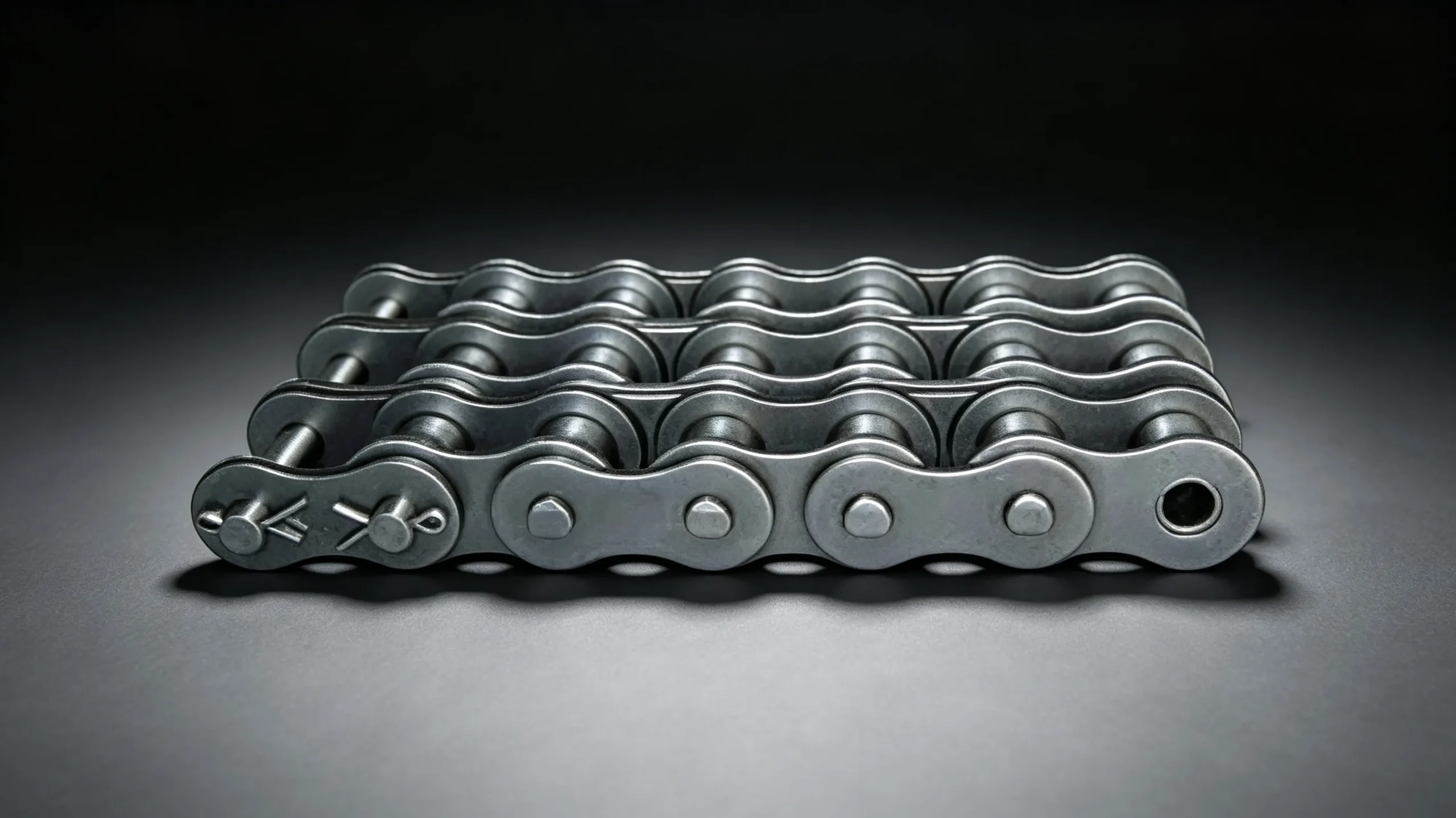
One of the practical strengths of sawtooth plate roller chain for agricultural OEM and aftermarket applications is that it requires no changes to the drive system. The pitch, roller diameter, inner width, and pin dimensions are identical to standard chain of the same ANSI or ISO designation. Sawtooth chain mounts on the same sprockets, uses the same connecting links, and is cut and joined with the same tools as standard chain. The only change is the chain itself — making it a genuinely zero-cost-to-convert upgrade for any agricultural drive currently running standard flat plate chain.
For Australian agricultural operators sourcing replacement chain at the start of harvest season, sawtooth plate roller chain is available in ANSI 60 and ANSI 80 — the two sizes most commonly used on North American brand harvesting equipment dominant in Australian grain farming. ISO 12B and 16B equivalent sawtooth chain is available for European-brand equipment. Verify the chain standard (ANSI vs ISO) by measuring roller diameter and inner width before ordering, as both standards use 19.05 mm pitch for their respective mid-range chains.
When to Use Standard Chain Instead
Sawtooth plate chain earns its premium in drives where fatigue is the limiting failure mechanism — where the chain fails by plate cracking rather than by wear elongation. In agricultural drives where the chain consistently reaches 3 percent elongation (from wear) before any plate cracking occurs, the fatigue life improvement from the sawtooth profile provides no practical benefit. For these drives, standard flat plate chain is appropriate and more economical.
The simplest diagnostic is to examine the failed chain before discarding it. If the plates show cracks at the pin holes, fatigue is the failure mode and sawtooth chain is the upgrade. If the plates are intact but the chain has stretched to the replacement threshold, wear elongation is the failure mode and improved lubrication is the correct response rather than a chain type change.
EverPower Roller Chains Australia supplies sawtooth plate roller chain in ANSI 60, ANSI 80, ISO 12B, ISO 16B and other sizes for agricultural machinery across New South Wales and Australia. Contact our Sydney team for pricing and availability ahead of your harvest season.
+61 2 9708 3322 | [email protected] | 27 Harley Crescent, Condell Park NSW 2201