Description
Attachment-Ready Conveyor Chain
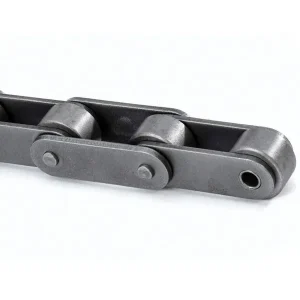
Hollow pin roller chains provide what standard chains cannot: a through-bore in every pin that accepts cross rods, attachment bolts, and custom fixtures — turning the chain itself into a configurable conveyor platform without sacrificing any structural chain rating.
What Makes Hollow Pin Chains Different
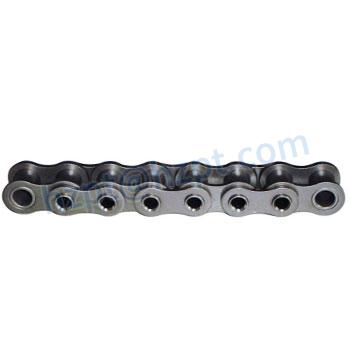
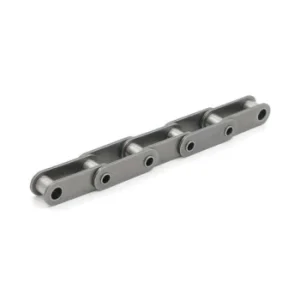
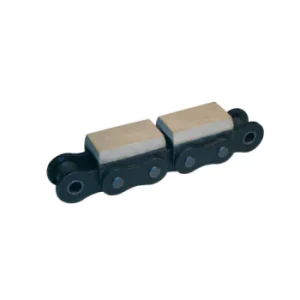
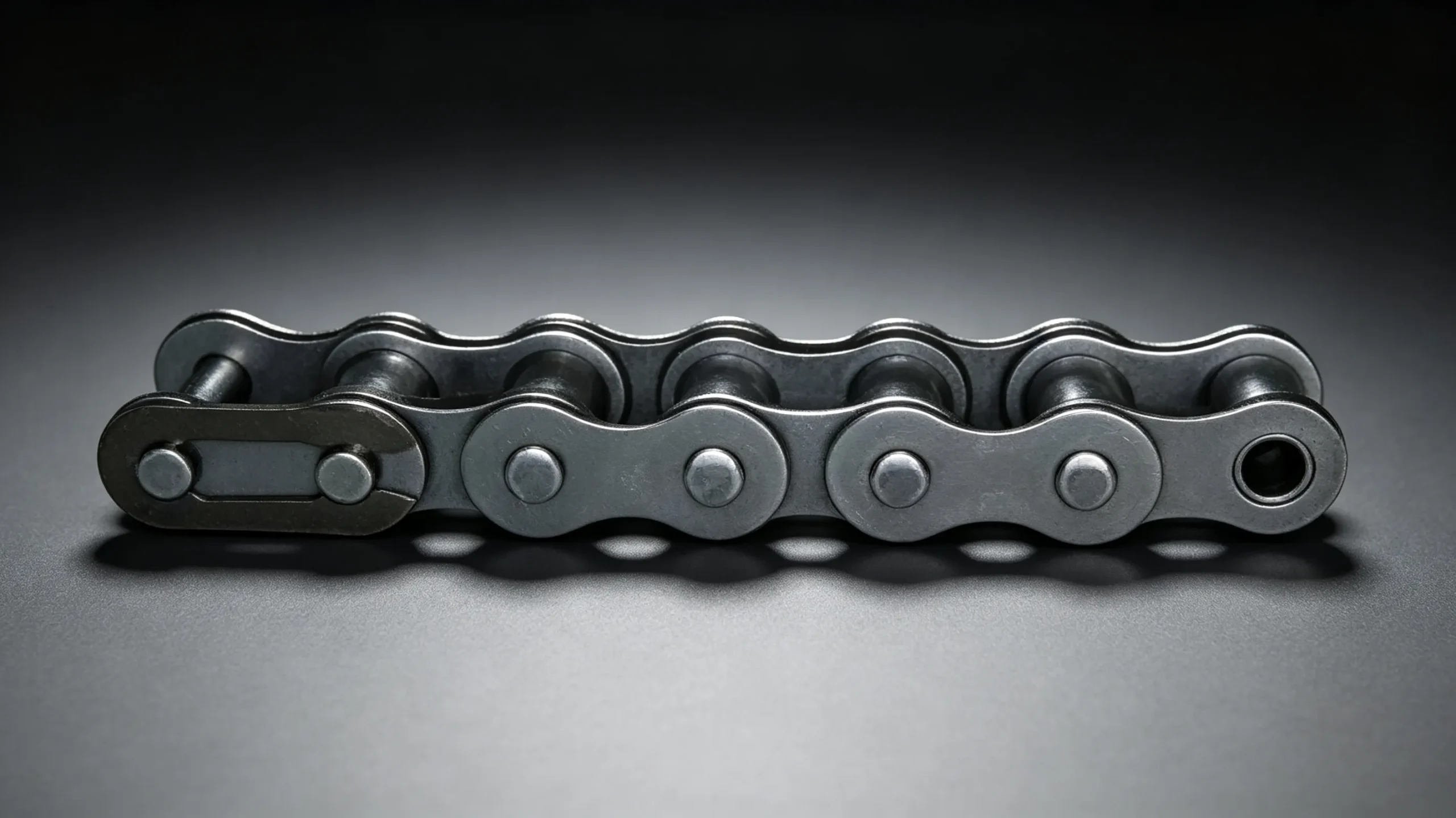
In standard roller chains, the pin is a solid cylindrical bar that connects the inner and outer link plates and receives the bushing load from the articulation between links. In hollow pin chains, the same structural function is performed by a tube — a pin with a cylindrical through-bore running its full length. This bore accepts a secondary element: typically a cross rod that passes through the pin bores of a pair of adjacent chains to carry a scraper flight, a pushrod, a conveyor slat, or a custom attachment. The hollow pin bore can also accept bolts directly, allowing attachments to be fitted and repositioned without drilling or welding.
The structural consequence of the hollow pin design is that the effective pin cross-section is reduced compared to a solid pin of the same outer diameter. Hollow pin chains are therefore rated at lower tensile strengths than equivalent-pitch solid-pin chains. This is a deliberate design compromise: the attachment flexibility gained outweighs the tensile reduction in the conveying applications where hollow pin chains are specified. For applications requiring both high tensile ratings and attachment capability, the correct approach is to specify a standard chain with attachment links rather than hollow pin chain throughout the run.
Hollow pin chain — through-bore pins in ISO B series and ANSI A series pitch sizes
Hollow Pin Chain Specifications
The table below covers the primary hollow pin sizes in ISO B series and ANSI A series pitch. Inner bore diameter is the critical dimension for cross rod and bolt selection.
| Chain No. |
Pitch P (mm) |
Roller Ø (mm) |
Inner Width (mm) |
Pin OD (mm) |
Pin Bore ID (mm) |
Plate Depth (mm) |
Q min (kN) |
Weight (kg/m) |
| HP08B-1 |
12.700 |
8.51 |
7.75 |
4.45 |
2.5 |
11.81 |
14.0 |
0.72 |
| HP10B-1 |
15.875 |
10.16 |
9.65 |
5.08 |
3.0 |
14.70 |
18.5 |
0.98 |
| HP12B-1 |
19.050 |
12.07 |
11.68 |
5.72 |
3.5 |
16.13 |
24.0 |
1.30 |
| HP16B-1 |
25.400 |
15.88 |
17.02 |
8.28 |
5.0 |
21.10 |
48.0 |
2.88 |
| HP20B-1 |
31.750 |
19.05 |
19.56 |
10.19 |
6.5 |
26.42 |
74.0 |
3.92 |
| HP40-1 (ANSI) |
12.700 |
7.95 |
7.85 |
3.96 |
2.5 |
12.00 |
12.5 |
0.65 |
| HP50-1 (ANSI) |
15.875 |
10.16 |
9.40 |
5.08 |
3.0 |
15.09 |
17.8 |
0.95 |
| HP60-1 (ANSI) |
19.050 |
11.91 |
12.57 |
5.94 |
3.5 |
18.00 |
25.0 |
1.44 |
Primary Application Categories
Hollow pin chains are specified whenever the conveyor design requires accessories that must pass through or attach to the chain pins, or when attachment positions must be easily changeable without chain replacement. The following application categories represent the majority of hollow pin chain installations:
📦
Scraper and Flight Conveyors
Agricultural grain elevators, silage conveyors, and bulk material handling systems use cross rods through hollow pins to carry scraper flights that push material along conveyor troughs. The cross rod distributes the load across both chain strands simultaneously, preventing the torsional loading that occurs when flights are cantilevered from attachment links on one chain only.
🏭
Chip and Swarf Conveyors
Machine tool chip conveyors in metal cutting facilities carry steel swarf from machining centres to collection hoppers. Hollow pin chains carry cross-bar scrapers that push chips without allowing them to wrap around the chain — a critical failure mode for standard chains in this application.
📬
Postal and Parcel Sorting
Automated parcel sorting systems use hollow pin chains to carry diverter arms and pushers that redirect parcels to the correct chute. The through-pin mounting allows the pushers to be precisely timed relative to barcode scan triggers, and repositioned when the system configuration changes.
🔧
Custom Attachment Systems
Any application requiring non-standard attachment geometry benefits from hollow pin chain’s flexibility. Attachments are bolted directly through the pin bore, eliminating the need for separate attachment link blanks and reducing both cost and the number of non-standard components in the chain assembly.
Cross Rod and Attachment Bolt Selection
Selecting the correct cross rod or attachment bolt for a hollow pin chain requires matching three parameters: the pin bore inner diameter (ID), the required cross rod length to span the full chain width plus the attachment footprint, and the material specification for the environment. Standard cross rods are manufactured from carbon steel with ground and polished external surfaces for precise bore fit. Stainless steel cross rods are available for food processing and corrosive environments. The cross rod outer diameter should be a close sliding fit in the pin bore — excessive clearance allows rocking under load, which generates brinelling wear at the bore entrance that progressively loosens the fit further.
Attachment bolts follow the same diameter selection principle but use a threaded section to engage a nut or threaded attachment plate on the external face. The thread length must not extend into the chain running zone where it could contact the inner link plates. Our sales team provides a cross rod and bolt sizing guide on request — send your chain number and attachment geometry and we will confirm the correct rod dimensions.
Components and Matching Parts
◆
Matched Sprockets for Hollow Pin Chain
Sprockets with the correct tooth profile for hollow pin chain pitch and roller diameter. The hollow pin does not change the sprocket engagement geometry — standard B or A series sprockets are suitable.
◆
Cross Rods — Carbon and Stainless Steel
Ground and polished cross rods in standard lengths and diameters to fit HP08B through HP20B and ANSI HP40 through HP60 bore sizes. Custom lengths cut to your flight spacing dimension.
◆
Attachment Bolts and Nuts
Threaded attachment bolts in matched diameters for hollow pin bore sizes. Carbon and stainless steel grades available. Pre-assembled with nuts for convenient cross-rod installation.
◆
Scraper Flights — UHMWPE and Steel
Pre-drilled scraper flight blanks in UHMWPE (for food and light material) and mild steel (for bulk solids and agricultural applications) drilled to match standard cross rod spacing.
◆
Connecting Links
Hollow pin chain connecting links that maintain the pin bore through the join point, allowing cross rods to pass through the connecting link location without interruption.
Customer Reviews
★★★★★
“We design grain conveying systems for the Nordic market. Hollow pin chain with UHMWPE flights is our standard configuration for bucket elevator drags. The through-pin cross rod mounting gives us a much more rigid flight attachment than the bracket-and-bolt method we used previously, and re-spacing the flights for different grain types takes minutes rather than hours.”
L
Lars Petersen
Conveyor Systems Engineer — Aarhus Agricultural Equipment A/S
★★★★★
“HP10B-1 for our machining centre chip conveyors. The chain quality is consistent and the pin bores are on-tolerance — we’ve had no problems with cross rod fit since switching to this supplier. We order in 50-metre batches quarterly and delivery is always on time.”
A
Akira Yamamoto
Purchasing Manager — Nagoya Machine Tool Components
★★★★★
“Specified HP12B-1 for our parcel diverter system. The flexibility to reposition the diverter attachments without changing chain was the key reason for specifying hollow pin chain, and it has worked exactly as expected. Technical support team provided clear guidance on cross rod sizing — no back-and-forth needed.”
C
Christine Bouchard
Process Engineer — Montréal Packaging Automation
Frequently Asked Questions
Can hollow pin chains be mixed with standard roller chains in the same conveyor run?+
No — hollow pin and standard chains cannot be mixed in the same strand. The pin outer diameter and bore geometry differ from standard pins, and the connecting link between the two types would not maintain consistent pitch or engagement. If you need attachment capability on only part of a conveyor run, use attachment links on a standard chain at the required positions rather than hollow pin chain throughout.
What is the pin bore diameter tolerance for cross rod fitting?+
Standard hollow pin bore tolerances are H7 (a close clearance fit), suitable for sliding fit cross rods that must be insertable by hand but without looseness during operation. If a tighter fit is required for press-fit cross rods in indexing applications, we can specify H6 bore tolerance on request. Our sales team will provide bore dimension tables for each chain size on request.
Are stainless steel hollow pin chains available for food processing?+
Yes — hollow pin chains in 304 and 316L stainless steel are available for food processing, pharmaceutical, and washdown environments. UHMWPE or stainless steel cross rods can be specified simultaneously. Full material certificates and compliance documentation provided with every stainless hollow pin chain order.
What is the load rating difference between hollow pin and solid pin chains of the same pitch?+
Hollow pin chains are typically rated at 60–80% of the tensile strength of equivalent-pitch solid pin chains, depending on the bore-to-pin-OD ratio. The practical consequence is that hollow pin chain selection should be based on the hollow pin tensile rating, not the standard chain rating for the same pitch. Our specification tables list the actual hollow pin Q min values — always use these rather than the equivalent solid-pin chain figures.
Can cross rods be inserted and removed without disassembling the chain?+
Yes — this is one of the key advantages of hollow pin design. Cross rods are inserted laterally through the aligned pin bores after the chain is installed. Retaining clips or e-rings at each cross rod end prevent axial movement during operation. To reposition or remove a cross rod, remove the retaining clips at both ends and slide the rod out sideways — no chain removal or link disassembly required.
Get in Touch
Ready to Place Your Order?
Send us your specifications. Standard enquiries receive a full quotation within 2 business days.
For more on hollow pin chain applications, see our article on what a hollow pin roller chain is and how it is used.