Description
Timber Gripping Conveyor Chain
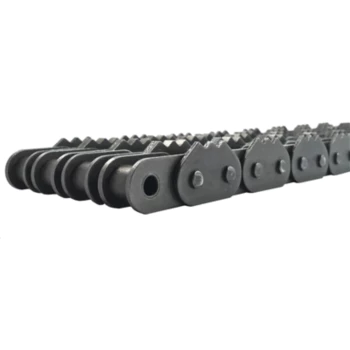
Sharp top chains are built around a single principle: grip timber precisely, hold it through the full conveyor run, and do it for longer than any standard chain could manage in a sawdust-laden environment.
Overview and Working Principle
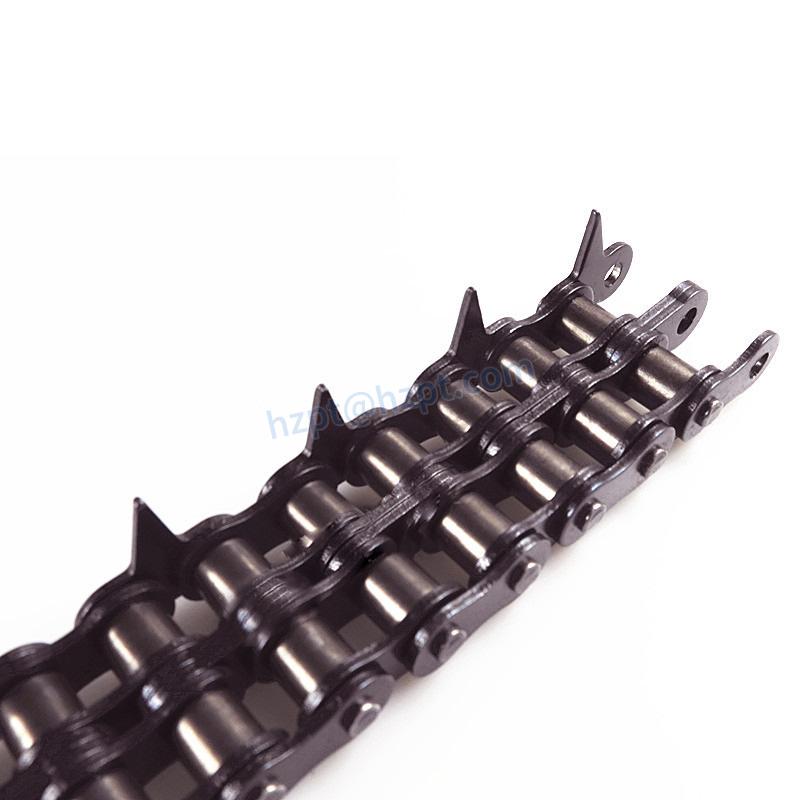
The sharp top chain is a derivation of the standard roller chain, distinguished by the addition of precision-machined tooth profiles on the outer link plates. Each tooth is calculated to provide the minimum penetration depth necessary for a firm grip on the timber surface — deep enough to hold positively against conveyor drag forces, shallow enough to avoid surface bruising that reduces lumber recovery value. This balance is not achievable with a single universal tooth angle across all applications: the correct sharpness depends on timber species, moisture content, conveyor speed, and the load per tooth contact. Our engineering team specifies the tooth geometry per application rather than applying a catalogue standard regardless of context.
Unlike attachment chains or rubber-top conveyor chains, which rely on mechanical fixtures or friction respectively, sharp top chains physically embed fractionally into the timber surface. This characteristic makes them self-indexing: as long as the chain is running at the correct tension and speed, the timber stays aligned without additional guide rails or clamping devices. In high-throughput sawmill environments where throughput directly determines revenue, that positioning accuracy translates into fewer misaligned cuts, less wasted trim, and higher lumber recovery rates from each log.
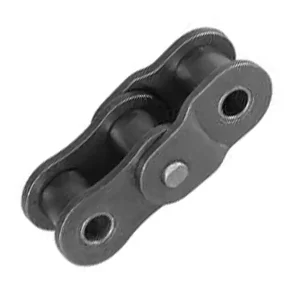
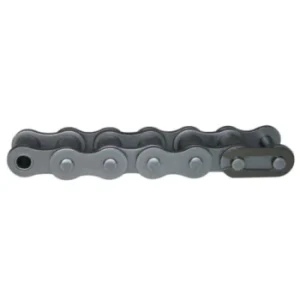
Standard sharp top chains — chrome-hardened pins, solid center plate construction
Available Tooth Pattern Configurations
Three primary tooth configurations cover the full range of timber processing conveying requirements. Understanding which configuration applies to your specific application is the first step in specifying the correct chain.
🦷
3-Points Per 2 Pitches — Standard Timber Infeed
The most widely ordered configuration for log infeed and general timber conveying. Three tooth tips per two chain pitches creates a consistent grip pattern across variable bark textures without over-concentrating load on any single point. Suitable for softwood, hardwood, and mixed-species infeed lines running at up to 1,000 fpm.
🔩
4-Points Per Pitch — Smooth Surface High Speed
Doubles the tooth contact density for conveying processed boards, kiln-dried lumber, and smooth-faced cants where bark texture is absent. The increased tooth count compensates for lower surface friction at line speeds above 800 fpm. Required on most green chain outfeed sorter applications.
⚙️
Metric Sharp Top Chains — ISO/BS Pitch
For European-manufactured sawmill equipment (Baljer & Zembrod, Heinola, EWD, and equivalent) where the conveyor drive specification follows ISO/BS chain standards. Available from 16B-1 through 32B-1 in both 3-per-2-pitch and 4-per-pitch tooth patterns.
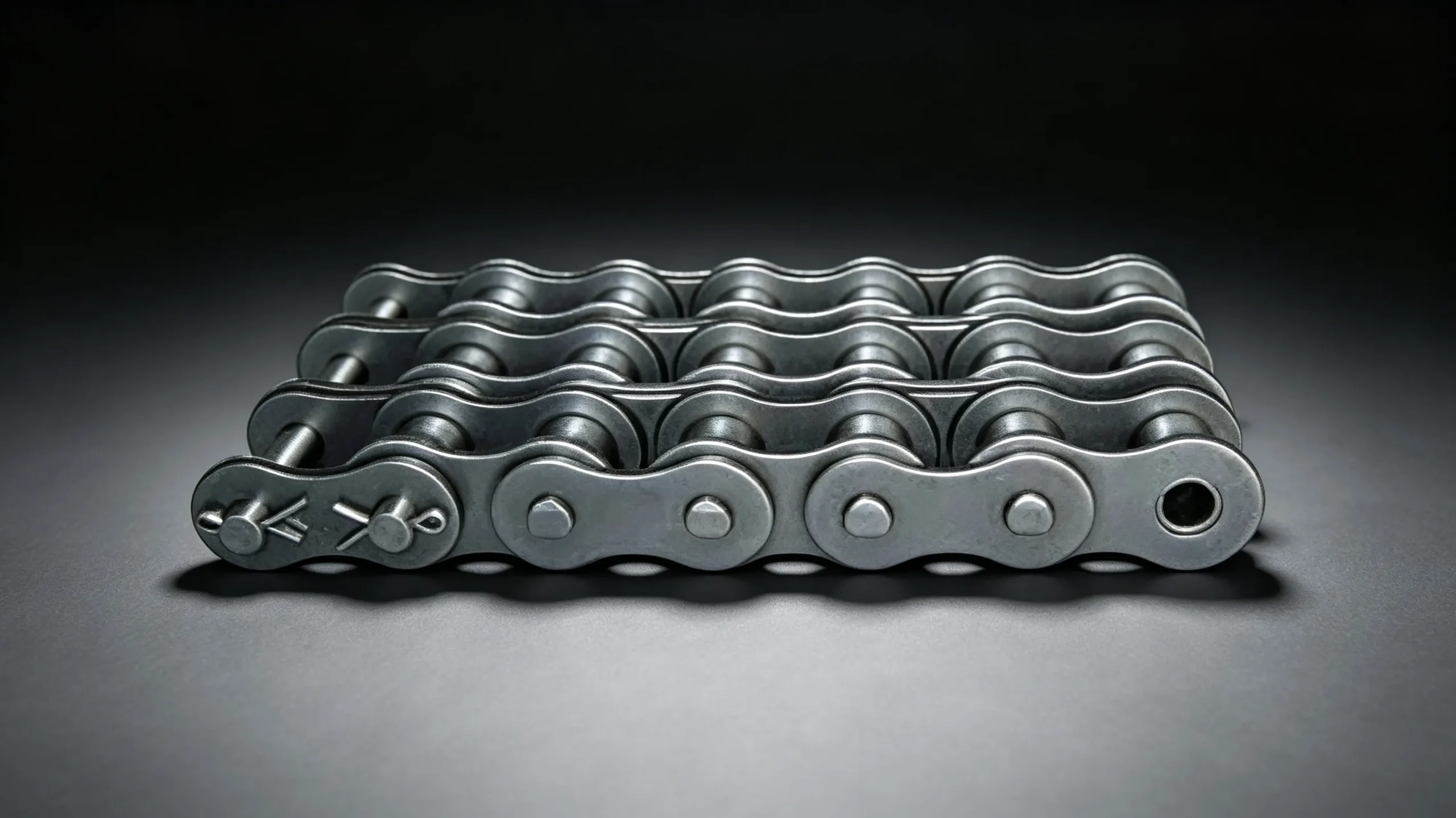
Specification Table — ANSI Single Strand, 3-Points Per 2 Pitches
Key dimensional data for single-strand ANSI sharp top chains. Double and triple strand configurations available — contact us for transverse pitch and overall width data.
| Chain Size |
Pitch (in) |
Roller Ø (in) |
Inner Width (in) |
Pin Ø (in) |
Pin Length (in) |
Tooth Tip Width (in) |
| 60-1 |
0.750 |
0.850 |
0.512 |
0.689 |
0.878 |
1.000 |
| 80-1 |
1.000 |
1.140 |
0.685 |
0.914 |
1.130 |
1.275 |
| 100-1 |
1.250 |
1.325 |
0.750 |
1.142 |
1.374 |
1.544 |
| 120-1 |
1.500 |
1.594 |
0.909 |
1.370 |
1.750 |
1.942 |
Metric Series — ISO / BS Sizes
| Chain No. |
Pitch (mm) |
Roller Ø (mm) |
Pin Ø (mm) |
Inner Width (mm) |
Overall Width (mm) |
| 16B-1 |
25.40 |
15.88 |
8.28 |
17.02 |
38.89 |
| 20B-1 |
31.80 |
19.05 |
10.19 |
19.56 |
49.30 |
| 24B-1 |
38.10 |
25.40 |
14.63 |
25.40 |
59.90 |
| 32B-1 |
50.80 |
29.21 |
17.81 |
30.99 |
64.70 |
Application Environments
Sharp top chains are installed at multiple points in a modern sawmill or timber processing line. On log infeed conveyors, they handle bark-covered round logs of variable diameter — a demanding grip challenge that rubber-top and flat-top chains handle poorly at production speeds. On green chain outfeed systems, they carry freshly sawn boards at speeds exceeding 1,200 fpm while maintaining precise lateral alignment for the manual or automated sorting that follows. In debarker and chipper feed sections, the solid center plate design prevents the sawdust packing that causes conventional chains to seize and snap mid-run. Plywood plant veneer conveyors, shake and shingle production lines, and wood-chip screen decks are further applications where the combination of grip, durability, and debris resistance that sharp top chains provide is not matched by alternative chain designs.
Special Order Options
Standard sharp top chains are manufactured from alloy steel with factory lubrication and conventional heat treatment. The following enhancements are available on request for applications requiring greater tooth durability, corrosion resistance, or reduced chain bed wear:
◆
Induction-Hardened Teeth
Selective induction hardening of tooth tips to above 58 HRC while the link plate core remains tough and impact-resistant. Extends tooth service life in abrasive applications by 40–70% compared to standard through-hardened teeth.
◆
Precision Ground Flat Bottom
CNC-ground flat surface on the center plate underside distributes load across the full plate width, reducing chain bed wear rates by up to 50% in long-run conveyor applications.
◆
Chrome Pins
Hard chrome plated pins for non-standard pitch configurations and OEM rebuild applications where original specification requires enhanced pin surface hardness beyond the standard alloy steel range.
◆
ProCoat Corrosion Barrier
Multi-layer coating applied to all exposed metal surfaces for outdoor log yard installations, coastal sawmill environments, and facilities where wash-down chemicals accelerate carbon steel corrosion.
◆
Solid Lubricant Fill (MoS₂)
Molybdenum disulfide dry-film lubricant at the pin-bushing interface for kiln-adjacent and fire-risk areas where conventional oil lubrication is prohibited.
Components and Matching Parts
◆
Matched Sprockets — ANSI and ISO
Tooth-form sprockets for all ANSI and ISO sharp top chain pitch sizes from 13 to 95 teeth in carbon, hardened, and cast iron grades.
◆
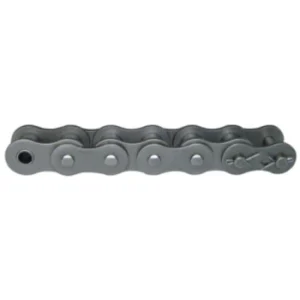
Cotter-Pin Connecting Links
Heavy-duty cotter-pin type rated to chain assembly tensile strength — the standard recommendation for all sawmill sharp top chain applications where vibration risk is present.
◆
Offset Links
Two-pitch offset links in all ANSI and ISO pitch sizes, manufactured to the same alloy and heat treatment specification as the main chain.
◆
Chain Bed Wear Plates
UHMWPE and hardened steel chain bed wear plates for common sharp top chain conveyor profiles. Replacement wear surfaces extend chain life by reducing underside abrasion.
Customer Reviews
★★★★★
“We run 80-1 and 100-1 sharp top on our log infeed and green chain systems. After switching to the induction-hardened tooth option, tooth life extended from around 9 months to over 18 months on the infeed side. The solid center plate has made sawdust-related failures essentially a non-issue since we installed these two seasons ago.”
B
Barry Loughlin
Senior Engineer — Tasmanian Hardwood Mills
★★★★★
“Ordered 20B-1 metric series for our European-spec primary breakdown conveyor. Tooth profile matches the original Renold chains exactly — dropped straight in without any sprocket changes. The chrome pin option suits our outdoor log deck environment where moisture is a constant problem for standard carbon pins.”
J
Johan Lindberg
Plant Manager — Sundsvall Timber AB, Sweden
★★★★★
“We’ve been testing these against our previous supplier on a side-by-side trial over one production season. Elongation rate is measurably lower and we haven’t had a single tooth failure on the new chains. Price is competitive and the documentation supports our ISO 9001 audit requirements without extra effort.”
M
Mike Trevors
Purchasing Manager — BC Forest Products, Canada
Frequently Asked Questions
How does sharp top chain differ from standard roller chain with attachments?+
Attachment chains add tabs or brackets to standard roller chain links, which then carry scrapers, pushers, or flights. Sharp top chains integrate the gripping element directly into the link plate as a machined tooth — there are no separate attachments to loosen, corrode, or snag. The tooth is part of the chain’s structural plate, so its grip force is limited only by the chain’s overall tensile strength, not by the strength of an attachment fastener.
Can I order sharp top chains in stainless steel?+
Stainless steel sharp top chains are available for applications where corrosion from wood acids, outdoor exposure, or chemical treatment is the primary concern. 304 and 316L grades are offered. Note that stainless steel’s hardness ceiling is lower than alloy steel, so tooth sharpness and wear life differ from the carbon steel equivalent — our team will advise on the appropriate tooth geometry and expected service life for your specific conditions.
What sprocket tooth count should I use for high-speed sharp top chain applications?+
For chain speeds above 1,200 fpm, a minimum sprocket tooth count of 17 is recommended to manage polygon effect (the periodic speed variation that occurs as chain links engage and leave sprocket teeth). At speeds above 1,400 fpm, a 21-tooth minimum is advisable. Running too few teeth at high speed generates vibration that accelerates tooth fatigue and causes premature plate cracking.
How do I measure for a replacement sharp top chain if I have lost the original chain number?+
Remove a section of the old chain and measure: (1) pitch — the distance between two adjacent pin centres; (2) roller outer diameter; (3) inner plate width — the gap between inner link plates. These three dimensions uniquely identify the base chain specification. Email the measurements to
[email protected] and we will identify the correct replacement and confirm tooth pattern options.
Do you supply sprockets to match sharp top chains?+
Yes — matched sprockets are available for all standard ANSI and ISO sharp top chain sizes. Specify chain number, strand count, and required tooth count. Hardened-tooth sprocket options are available for high-wear positions on log infeed and chipper conveyor drive heads.
Get in Touch
Ready to Place Your Order?
Send us your specifications. Standard enquiries receive a full quotation within 2 business days.
For more on sharp top chain selection, see our article on why sawtooth plate chains outperform standard chains in timber and agricultural machinery and our guide on what a sawtooth plate roller chain is.