
In most power transmission catalogues, roller chains are listed by pitch, strand count, and material. The link plate profile — the actual shape of the steel side plate that holds the pins — rarely appears as a separate specification. Yet for applications running under variable or shock-heavy loads, that plate profile is precisely what determines how long the chain lasts before fatigue cracking begins. The sawtooth plate roller chain addresses this directly by replacing the conventional smooth-edged flat plate with a serrated geometry that changes how stress distributes around the critical pin-hole locations.
The Standard Flat Plate and Its Limitation
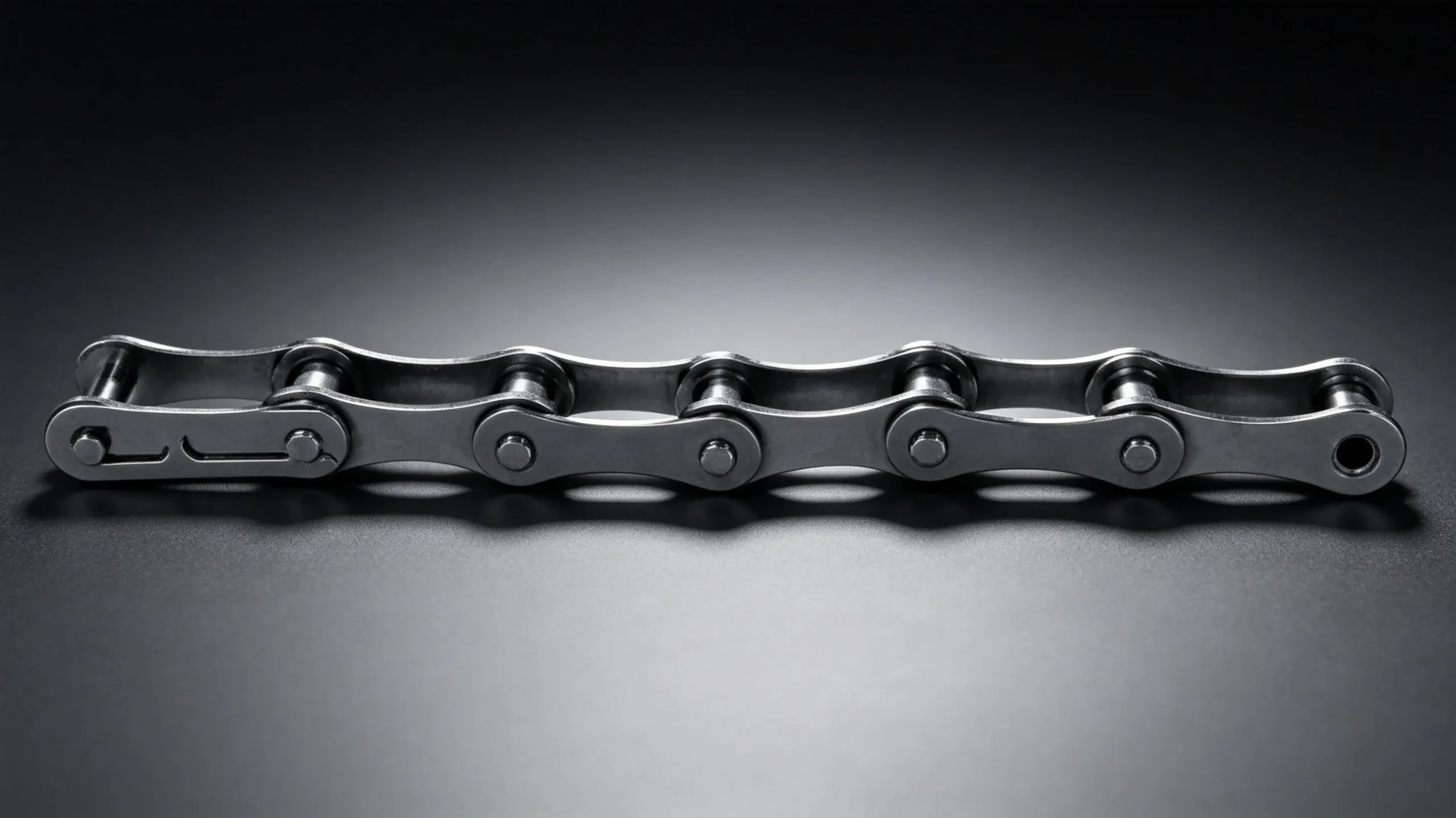
A conventional roller chain link plate is a flat, symmetrical figure-eight stamped from medium-carbon steel. The waisted centre reduces weight while keeping cross-sectional area at both pin holes, where tensile and bending loads are highest. Under steady-state loading, this geometry performs well. The problem arises under cyclic or impact loading — conditions that appear in agricultural machinery, hay balers, and reciprocating conveyor drives.
When a link plate flexes repeatedly during chain articulation under variable load, fatigue micro-cracks initiate at the pin hole edge. This is the geometric stress concentration point: the circular hole introduces a stress concentration factor of approximately 2.0 to 3.0 depending on hole diameter relative to plate width. Under enough cycles at sufficient stress amplitude, a crack propagates outward from the hole edge and eventually causes plate fracture — the most common failure mode in roller chains operating on agricultural equipment during harvest.
What Makes the Sawtooth Profile Different
The sawtooth plate replaces the smooth outer edge of the link plate with a repeating triangular or wave-form serration pattern along the plate periphery. This geometry change serves two distinct mechanical functions that together extend fatigue life beyond what is possible with a flat plate of identical material and thickness.
Stress Field Redistribution
The serrated edge profile introduces geometric discontinuities along the plate periphery that change the stress field within the plate body. Finite element analysis of sawtooth plates shows that the peak stress at the pin-hole edge — the fatigue initiation site — is reduced compared to a flat plate of equivalent cross-section. The serrations effectively redirect some of the bending load path away from the pin-hole concentration zone and distribute it across a wider area of the plate. In comparative fatigue testing conducted under cyclic tensile loading at amplitudes representative of agricultural machinery drives, sawtooth plates have demonstrated fatigue life improvements of 20 to 40 percent over flat plate equivalents at the same pitch and plate thickness.
Increased Plate Surface Area
The serrated edge also increases the total outer surface area of the plate compared to a flat plate of equal height. Under sustained high-load operation, roller chain plates can reach surface temperatures that reduce lubricant viscosity at the pin-bushing interface. The greater surface area of the sawtooth plate provides more radiative and convective cooling area, which helps maintain lower plate temperatures during continuous operation — a secondary benefit that contributes to longer lubricant film life at the bushing contact surfaces.
Where Sawtooth Plate Chain Is Used in Practice
The sawtooth plate design was developed specifically for applications where load is not steady but highly variable, with frequent peaks well above the mean operating tension. Combine harvester drives are the most cited application: the feeder house, threshing drum, and straw walker drives all experience sudden load spikes when dense crop material enters the system, followed by periods of low load during light feeding. This variable profile produces exactly the kind of cyclic stress amplitude that drives fatigue crack initiation in flat plate chains.
Combine Harvesters
Feeder, threshing, and straw walker drives experience severe variable loading during harvest — the most common application for sawtooth plate chain.
Square Hay Balers
Plunger drives cycle between near-zero tension during retraction and peak tension at compression — ideal conditions for fatigue-resistant plate geometry.
Mining Conveyors
Overland conveyors with frequent start-stop cycles and variable material loading benefit from extended plate fatigue life in heavy pitch sizes.
Forestry Equipment
Log infeed and processing drives in timber machinery experience impact loads from uneven material that accelerate fatigue in standard flat plate chain.
Sawtooth Chain vs Standard Chain: A Direct Comparison
| Parameter | Standard Flat Plate Chain | Sawtooth Plate Chain |
|---|---|---|
| Pin hole stress concentration | Higher — smooth plate concentrates stress at hole edge | Lower — serrations redistribute stress away from hole |
| Fatigue life under variable load | Baseline | 20–40% longer in comparative testing |
| Plate surface area | Baseline | 8–15% greater (pitch dependent) |
| Thermal behaviour | Standard | Marginally better due to greater surface area |
| Weight | Baseline | Marginally heavier (negligible in practice) |
| Sprocket compatibility | Standard matched sprockets | Standard matched sprockets — no change needed |
| Lubrication requirements | Standard | Identical — same lubricant and interval |
| Cost vs standard chain | Baseline | Typically 10–20% premium |
Specifying Sawtooth Plate Chain Correctly
Sawtooth plate roller chain is available across the full ANSI B29.1 pitch range from No. 40 through No. 120, and in ISO 606 equivalents. Simplex, duplex, and triplex strand configurations are all available. The sawtooth plate modification applies only to the link plates — all other chain dimensions, including pitch, roller diameter, inner width, and connecting link type, remain identical to standard chain of the same designation. This means sawtooth chain fits directly onto existing matched sprockets without modification.
When specifying, state the chain standard (ANSI or ISO), chain number (e.g. ANSI 60 or 12B), strand count, and the sawtooth plate designation. Request a material certificate confirming carbon steel grade and heat treatment specification. For agricultural OEM applications requiring consistent quality across bulk orders, request dimensional inspection reports verifying pitch and roller diameter against the relevant standard.
Is the Sawtooth Upgrade Worth the Cost?
For steady-state drives running at constant load — a pump drive, a fan drive, a conveyor moving uniform material at fixed speed — the flat plate chain is entirely adequate and the sawtooth premium is unnecessary. The fatigue life improvement only becomes significant when the load is variable with regular peaks above the mean, which is precisely the operating profile of most agricultural and many mining drives.
The calculation is straightforward: if a standard chain in your combine harvester feeder drive lasts one harvest season before showing plate cracking, and the sawtooth equivalent extends that to 1.5 seasons at a 15 percent price premium, the total cost per operating hour decreases despite the higher unit price. Add the cost of a mid-season breakdown — downtime during harvest is extremely expensive — and the economic case for sawtooth plate chain in agricultural applications is clear.
EverPower Roller Chains Australia supplies sawtooth plate roller chain in ANSI and ISO series for agricultural, mining, and industrial applications. Our Sydney team can advise on the correct specification for your drive conditions and provide samples for evaluation before bulk orders.
+61 2 9708 3322 | [email protected] | 27 Harley Crescent, Condell Park NSW 2201