
When a heavy industrial drive needs to transmit high torque at low to medium speed with positive synchronisation between shafts, the comparison between roller chain and belt drive almost invariably favours chain. This preference is not simply tradition — it reflects measurable differences in mechanical efficiency, slip resistance, load capacity, shock tolerance, and centre distance flexibility that are particularly relevant under the demanding conditions of mining, agriculture, and heavy manufacturing. Understanding why industrial roller chain is preferred in these environments requires looking at the specific limitations of belt drive at high loads and shock conditions, and the specific advantages of chain that address those limitations.
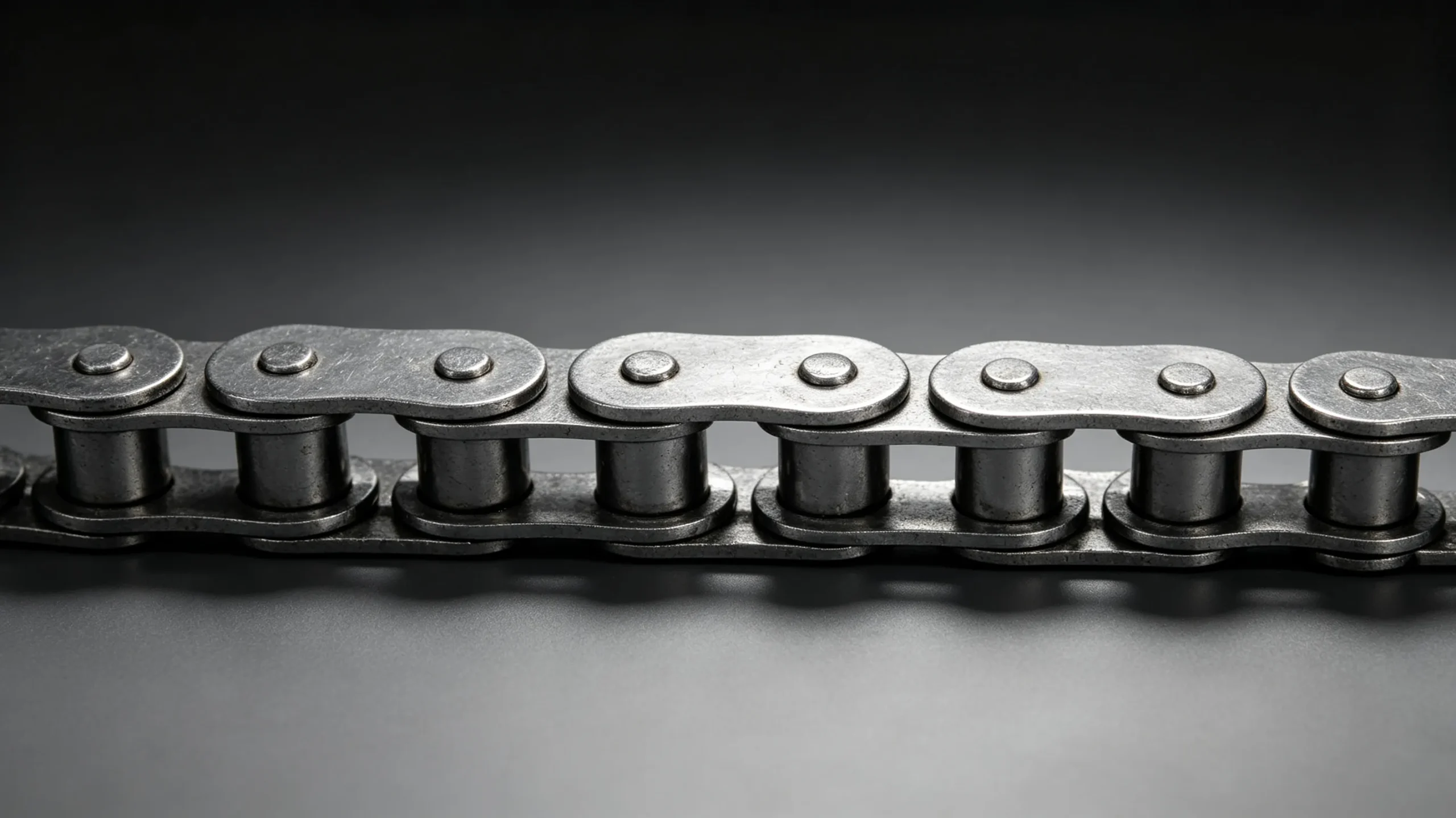
Positive Engagement: No Slip Under Any Load
The most fundamental advantage of roller chain over any form of friction belt drive is positive engagement. A chain engages sprocket teeth mechanically — there is no theoretical limit imposed by friction coefficient that determines the maximum torque transferable. A V-belt drive, by contrast, transmits torque through friction between the belt and pulley groove. When the transmitted torque exceeds the product of friction coefficient, normal force, and effective belt radius, the belt slips. This limiting mechanism means that belt drives must be designed with a tension ratio that keeps the belt tension high enough to avoid slip — which loads the shaft bearings significantly and limits the maximum transmissible torque for a given belt cross-section.
Roller chain has no equivalent slip mechanism. The chain teeth engage positively and transmit whatever torque is applied, up to the chain breaking load. In drives where the load is predictable and well within both belt and chain ratings, this distinction is less important. In drives where sudden load spikes occur — stone hits on agricultural machinery, material blockages in mining equipment, start-up under full load — the belt will slip at the moment of maximum load while the chain continues to transmit. For many industrial applications, this difference is decisive.
Mechanical Efficiency: Chain Outperforms Belts Under Load
| Drive Type | Efficiency (Well Maintained) | Efficiency Under Shock Load | Slip Potential |
|---|---|---|---|
| Roller chain (lubricated) | 97–99% | 97–99% (no slip) | None — positive engagement |
| V-belt (matched set) | 92–96% | 85–93% (partial slip under peaks) | Yes — under shock and overload |
| Flat belt (tensioned) | 90–95% | 82–90% (slip under peaks) | Yes — higher than V-belt |
| Synchronous/timing belt | 97–99% | 97–99% (no slip) | None — toothed engagement |
| Gear drive | 95–99% | 95–99% (no slip) | None — rigid engagement |
The efficiency advantage of roller chain over V-belt is 3 to 7 percent under steady load and significantly more under shock loading, where belt slip further degrades efficiency. On a 75 kW drive running 16 hours per day, a 5 percent efficiency improvement represents approximately 6 kW of recovered power — meaningful at Australian commercial electricity rates over a machine lifetime of 10 to 15 years.
Load Capacity: Chain Handles Higher Torque in Less Space
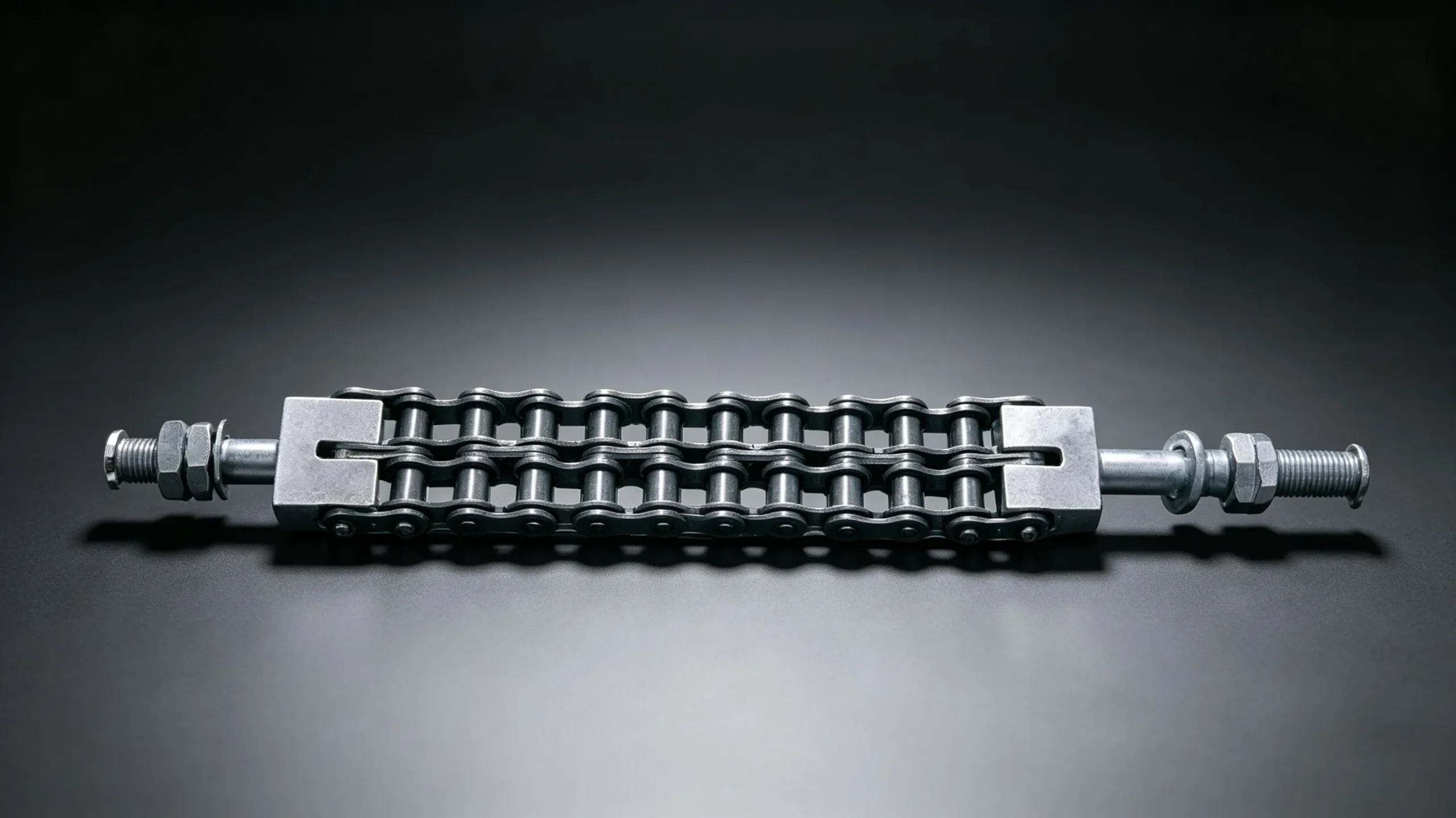
For a given centre distance and drive space envelope, roller chain transmits substantially higher torque than a V-belt drive. An ANSI 80 duplex roller chain with a working load of approximately 30 to 40 kN in a 25 mm pitch occupies a centre distance that would require three to four matched V-belt grooves and a significantly wider pulley to approach the same torque transmission — and the belt drive would still lack the positive engagement of the chain under shock conditions.
This load density advantage is particularly relevant in agricultural machinery, where drive component dimensions are constrained by the overall machine package and weight targets. A combine harvester main drive using roller chain transmits the full threshing drum power in a chain width of 25 to 50 mm; an equivalent belt drive would require a significantly wider pulley set and higher initial belt tension that loads bearings more heavily.
Shock Load Tolerance: Chain Is Fundamentally More Robust
Shock load tolerance is the characteristic that most clearly differentiates roller chain from belt drive for heavy industrial and agricultural applications. A V-belt under shock loading faces two damaging mechanisms simultaneously: the shock tension spike may exceed the belt rating (causing belt cord failure or delamination), and if the shock exceeds the friction limit, the resulting sudden slip generates heat in the belt cross-section (causing polymer degradation and accelerated wear). Repeated shock events progressively degrade the belt until it fails.
A correctly specified roller chain under the same shock loading experiences none of these mechanisms. The chain transmits the shock load positively through the pin-bushing-plate path, and the shock energy is absorbed elastically and distributed across multiple links in the engaged arc. Shock absorption is not unlimited — sustained overloading will cause fatigue — but the chain does not suffer the frictional heat damage that degrades belts under shock conditions. This is why mining conveyors, crusher drives, and agricultural main drives use roller chain rather than V-belt as a matter of standard engineering practice.
Centre Distance Flexibility
Both roller chain and belt drives offer flexible centre distance — unlike gear drives, neither requires fixed shaft spacing. However, chain and belt differ in how they accommodate centre distance changes. Belt drives require a specific range of tensions that limit the acceptable centre distance range for a given belt length. Chain drives accommodate a wider range of centre distances for the same chain loop length, and can be adjusted incrementally in steps of one pitch by adding or removing links — a practical advantage in machinery where shaft positions shift during maintenance.
Belt drives also require take-up adjustment as the belt stretches over its service life — a procedure that must be done carefully to avoid over-tensioning or under-tensioning. Chain drives require similar slack adjustment as the chain elongates, but the adjustment is more predictable (based on measurable elongation rather than feel) and the system is more tolerant of moderate sag without the efficiency penalty that over-slack belts incur through contact bounce.
Where Belt Drive Is Preferred
Belt drive is not universally inferior — there are applications where it is the better technical and economic choice. At very high speeds (above 15 m/s), belt drives are quieter and generate less vibration than roller chain because they do not produce the chordal action (polygon effect) that chain drives generate at sprocket engagement. In high-speed, low-torque drives — fan drives, centrifugal pump drives, light-duty conveyors — V-belt is more economical and quieter than chain.
Belt drives also require no lubrication — a significant maintenance advantage in clean-room environments, food processing clean zones, or drives that are genuinely inaccessible for chain maintenance. In these environments, the maintenance freedom of a belt drive can outweigh the efficiency and shock tolerance advantages of chain.
Prefer Roller Chain When…
High torque, shock loading, positive synchronisation required, low to medium speed (below 10 m/s), high mechanical efficiency critical, shaft must be prevented from slip under peak load.
Prefer Belt Drive When…
Very high speed (above 15 m/s), low torque, noise and vibration are critical, lubrication maintenance is impractical, drive power is modest and belt slip under occasional overload is acceptable.
EverPower Roller Chains Australia supplies industrial roller chain in ANSI and ISO sizes for heavy industrial, mining, and agricultural applications across New South Wales and Australia. Contact our Sydney team for chain specifications and matched sprocket sourcing for new and replacement drives.
+61 2 9708 3322 | [email protected] | 27 Harley Crescent, Condell Park NSW 2201