
The decision to specify heavy duty roller chain rather than standard chain is straightforward once you understand what heavy duty chain actually changes — and more importantly, what it does not change. Heavy duty chain uses the same pitch and roller dimensions as standard chain, so it fits the same sprockets and the same drives without any modification. What it does change are the link plate thickness and pin dimensions, which raise the fatigue endurance limit and the static breaking load significantly. For applications where link plate fatigue is the limiting failure mode, this change extends service life dramatically. For applications where it is not, the premium is unnecessary.
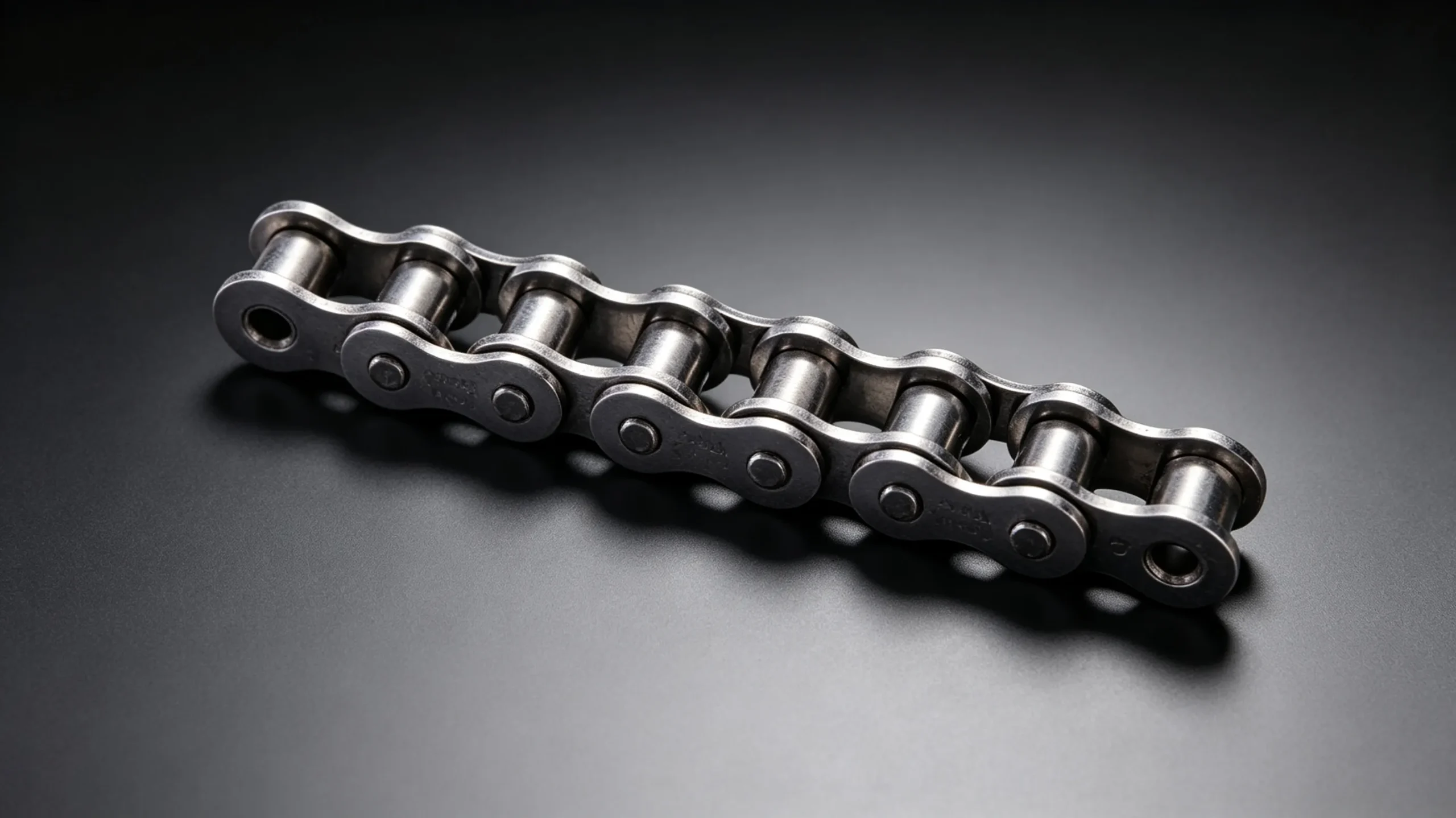
The Mechanical Difference: Same Pitch, Stronger Plates
Both heavy duty roller chain (designated with an H suffix in ANSI notation — 60H, 80H, 100H) and standard chain use the same pitch, roller diameter, bushing outer diameter, and inner link width. They run on identical sprockets. The difference is entirely in the link plate: heavy series plates are thicker and carry more cross-sectional area through the pin-hole region. For ANSI 60H, plate thickness increases from 2.40 mm (standard) to 3.20 mm — a 33 percent increase. For ANSI 80H, it increases from 3.20 mm to 4.00 mm. This seemingly modest dimensional change produces a 34 to 35 percent increase in minimum breaking load.
More importantly for most industrial applications, the thicker plate also raises the fatigue endurance limit — the maximum cyclic stress that can be sustained indefinitely without fatigue crack initiation. This is where heavy duty roller chain justifies its premium: not in static strength (which is rarely the limiting factor in properly designed drives) but in fatigue life under the cyclic loading that every chain experiences in service.
Six Applications That Require Heavy Duty Chain
Crusher and Shredder Drives
Impact loads from oversized material can reach 5–8x mean tension. Standard plates fail by fatigue within weeks. Heavy series provides the endurance margin needed for continuous shock-load operation.
Square Baler Plunger Drives
The compression-retraction cycle produces near-zero to peak tension on every stroke — the worst-case fatigue loading pattern. Heavy series is specified as OEM on most high-capacity balers.
Mining Conveyor Start-Stop Cycles
Repeated start-up under full load generates tension spikes 3–5x above running tension. Heavy series chain absorbs these infrequent but severe events without accumulating fatigue damage at standard plate rates.
Vibrating Screen Drives
Continuous high-frequency oscillation generates very high fatigue cycle counts per hour. Standard chain reaches its fatigue limit rapidly; heavy series extends the cycle count to failure by 50–80 percent.
Timber Processing Infeed Drives
Log engagement generates sharp tension spikes from variable log mass and density. Heavy series chain manages these irregular impacts through every processing shift.
Reciprocating Conveyor Drives
Any drive with forward-reverse cycling imposes high-amplitude fatigue loading at the chain reversal points. Heavy series provides the plate margin needed for reliable long-term operation.
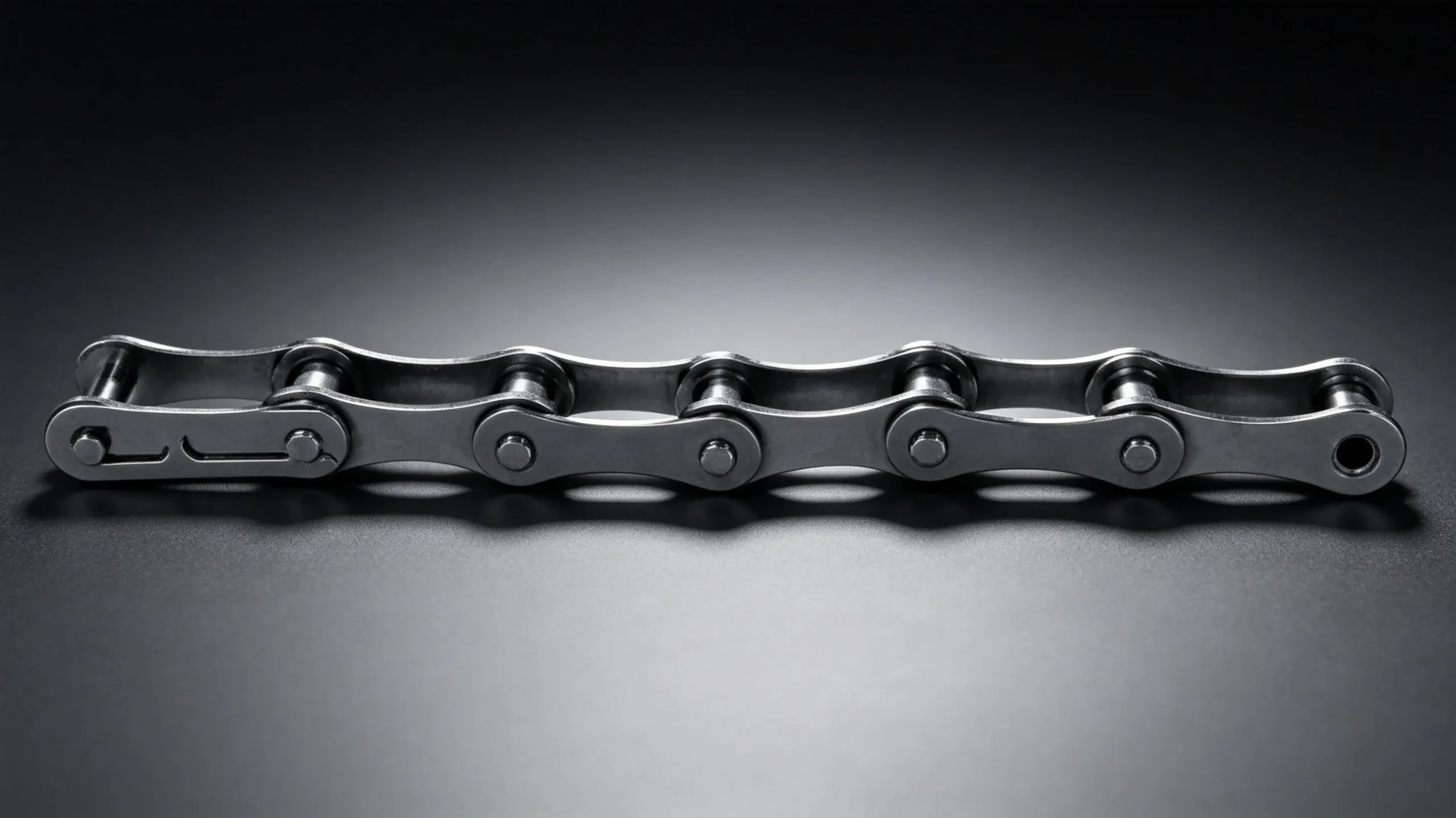
Breaking Load Comparison: Standard vs Heavy Series
| Chain Size | Standard Break Load (kN) | Heavy Series Break Load (kN) | Improvement | Plate Thickness Std (mm) | Plate Thickness H (mm) |
|---|---|---|---|---|---|
| ANSI 40 / 40H | 14.1 | 18.2 | +29% | 1.50 | 2.00 |
| ANSI 50 / 50H | 21.8 | 27.1 | +24% | 2.00 | 2.60 |
| ANSI 60 / 60H | 31.3 | 42.3 | +35% | 2.40 | 3.20 |
| ANSI 80 / 80H | 55.6 | 74.7 | +34% | 3.20 | 4.00 |
| ANSI 100 / 100H | 87.0 | 117.0 | +34% | 3.96 | 4.80 |
| ANSI 120 / 120H | 125.0 | 167.0 | +34% | 4.80 | 5.60 |
When Standard Chain Is the Right Choice
Specifying heavy duty roller chain in a drive where standard chain is adequate is not dangerous — the chain will run reliably, it will simply cost more than necessary. The economics matter because in large conveyor systems with many metres of chain, the unit cost premium of heavy series can be significant. For smooth, steady-state drives operating at less than 60 percent of rated working load with no significant shock component, standard chain will achieve its full rated fatigue life — which is typically well in excess of the 2 to 3 year replacement cycles typical of most industrial drives. Upgrading to heavy series on these drives buys nothing in terms of additional service life.
The service factor system in ANSI B29.1 handles moderate shock loads (service factor 1.3 for moderate shock) within the standard chain rating. Heavy series becomes necessary when the service factor approaches 1.7 or exceeds it, indicating that standard chain plate endurance is being exceeded even with the service factor adjustment applied. At this threshold, the fatigue life improvement from heavier plates is the most economical solution.
Heavy Duty Chain vs Larger Pitch: Which Is Better?
When a standard chain at a given pitch cannot meet the load requirements, the designer faces a choice: upgrade to heavy series at the same pitch, or move to the next larger pitch in standard series. The decision depends on speed. At moderate to high speeds, heavy series at the smaller pitch is almost always preferable — smaller pitch runs quieter, generates less chordal action, and allows higher sprocket speeds. At very low speeds and very high torques (below 0.5 m/s), the larger pitch in standard series may be more economical because the sprocket tooth count can be lower without creating chordal action problems.
Heavy series duplex chain — combining the thicker plates of heavy series with the additional strand of duplex — provides maximum load capacity at a given pitch. This is the correct specification for the main drives of large combine harvesters, heavy mining feeders, and continuous processing machinery where both fatigue resistance and high load capacity are simultaneously required. Duplex heavy series chain is not a catalogue item at all suppliers — contact EverPower to verify availability for your pitch size.
EverPower Roller Chains Australia stocks heavy duty roller chain in ANSI 60H, 80H, and 100H from our Sydney facility, with other sizes available to order. Contact our team to verify whether your application requires heavy series or whether standard chain with the correct service factor is appropriate.
+61 2 9708 3322 | [email protected] | 27 Harley Crescent, Condell Park NSW 2201