
Walk into any industrial chain supplier in Australia and ask for ANSI 80 roller chain, and the counter staff will likely ask a follow-up question: standard series or heavy series? For many buyers, this is an unexpected complication — they came to buy a chain and now face a specification decision they were not prepared for. This article removes that uncertainty by explaining precisely what separates standard from heavy series chain, when the distinction matters, and how to determine which one is right for a specific application without over-engineering or under-specifying.
The Same Pitch, Different Plate Geometry
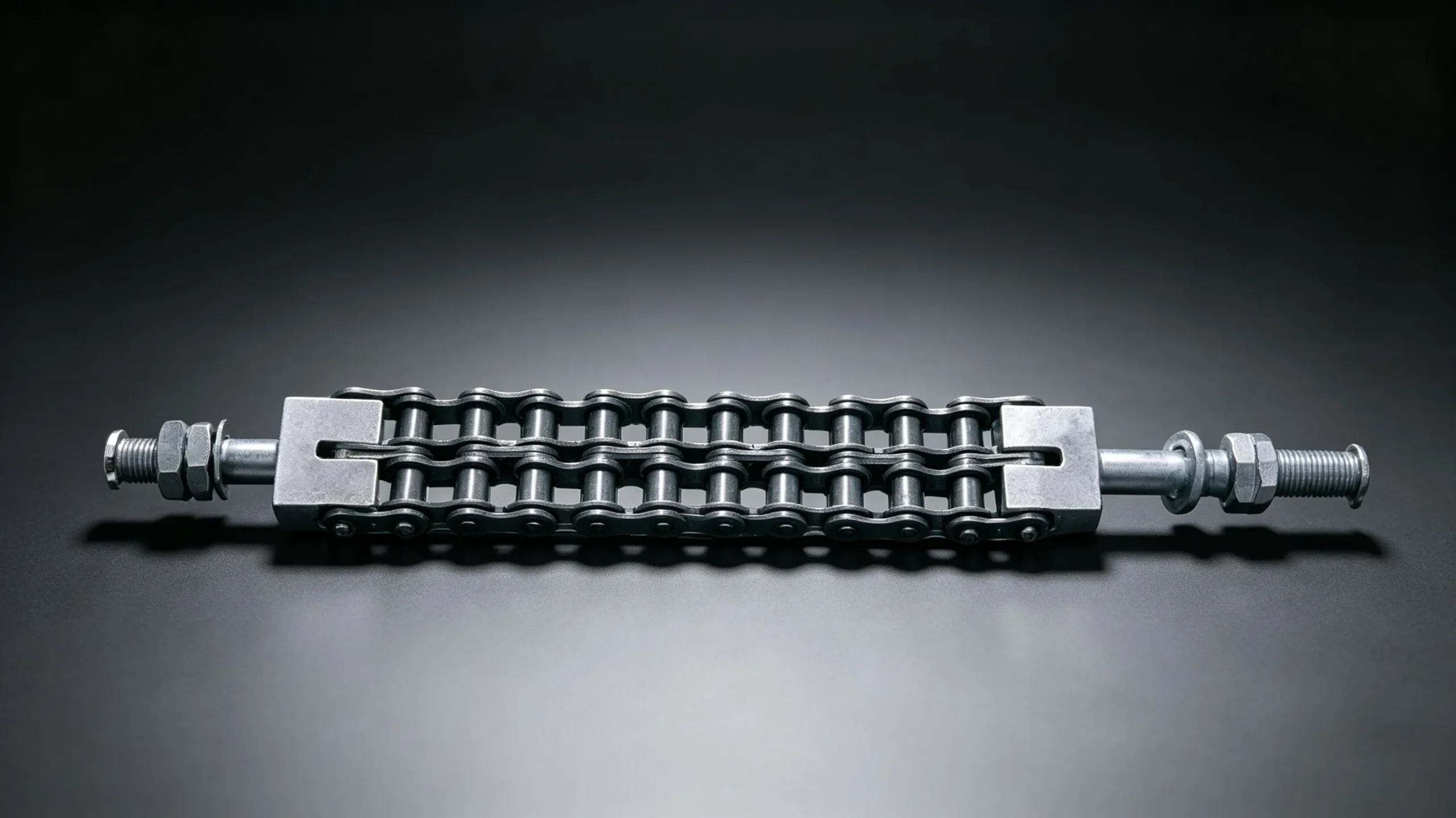
Standard series and heavy series roller chains of the same ANSI number are identical in pitch, roller diameter, and inner link width. They run on the same sprockets. A heavy series chain does not require any modification to the sprocket, the drive shaft, or the centre distance. The difference is entirely in the link plates: heavy series plates are thicker, wider in the transverse direction, and have a larger cross-sectional area through the pin hole.
This distinction matters because the pin hole is the stress concentration point where fatigue cracks initiate in any loaded link plate. Increasing plate thickness increases the cross-sectional area through the hole, which reduces the stress at the hole edge for a given applied load. Heavy series chains therefore have a higher fatigue endurance limit at the same pitch — they can sustain more load cycles before a fatigue crack initiates — without requiring any change to sprocket geometry.
| Specification | ANSI 60 Standard | ANSI 60H Heavy | ANSI 80 Standard | ANSI 80H Heavy |
|---|---|---|---|---|
| Pitch (mm) | 19.05 | 19.05 | 25.40 | 25.40 |
| Roller Diameter (mm) | 11.91 | 11.91 | 15.88 | 15.88 |
| Inner Width (mm) | 12.57 | 12.57 | 15.75 | 15.75 |
| Plate Thickness (mm) | 2.40 | 3.20 | 3.20 | 4.00 |
| Min. Break Load (kN) | 31.3 | 42.3 | 55.6 | 74.7 |
| Strength Increase vs Std | — | +35% | — | +34% |
Why Thicker Plates Make Such a Difference
The relationship between plate thickness and fatigue life is not linear. In fatigue testing, plate fatigue life scales approximately with the square of the stress amplitude at the pin hole. Increasing plate thickness reduces the net section stress for a given load, and even a modest reduction in stress amplitude can produce a disproportionately large increase in fatigue life. A 33 percent increase in plate thickness (as in ANSI 60 to 60H) reduces the net section stress by roughly 25 percent, which translates to a fatigue life improvement of approximately 50 to 80 percent under the same cyclic loading conditions.
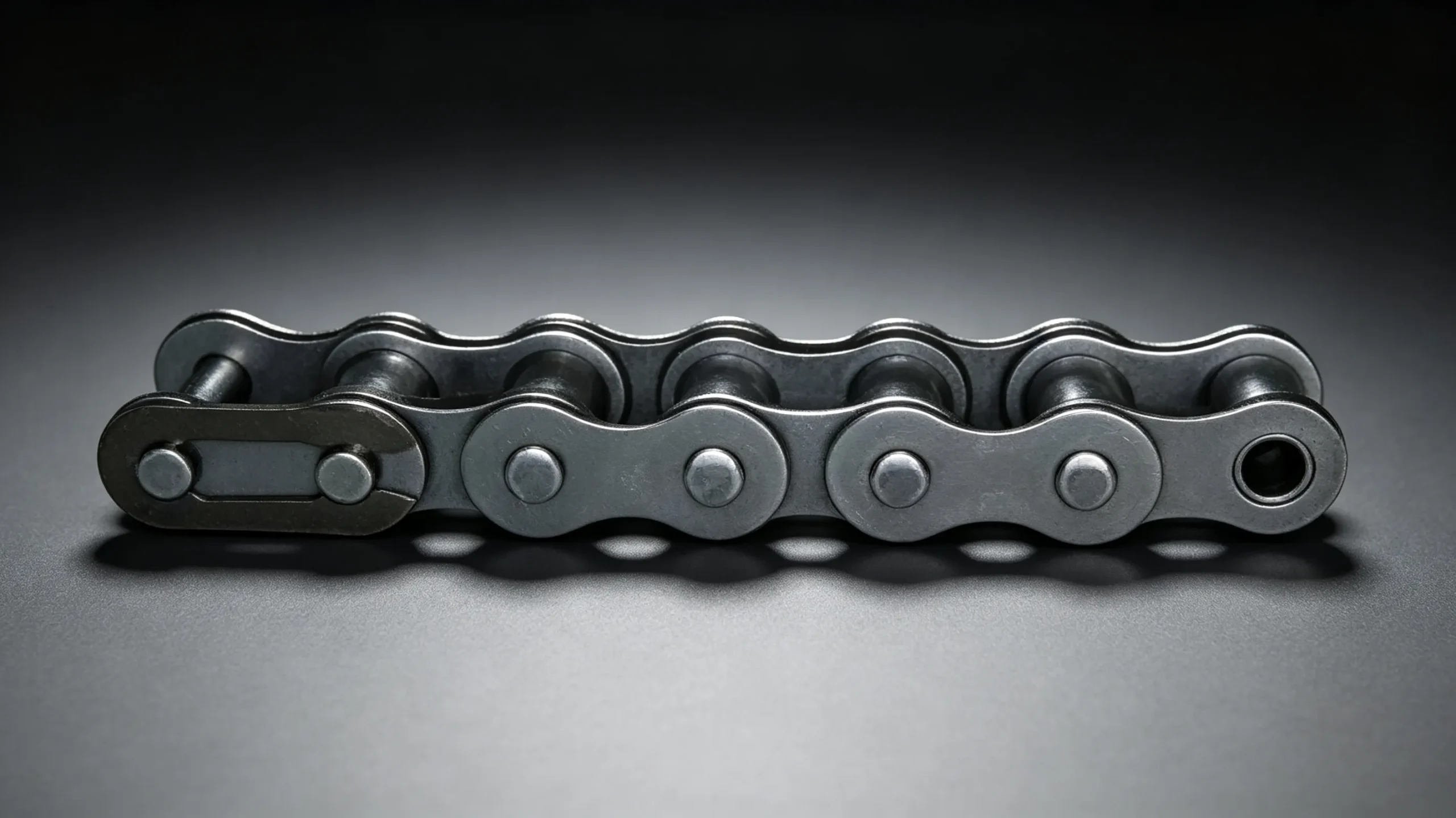
This is why heavy series chain is specified for shock and variable load applications: it is not that the peak breaking load is insufficient for standard chain, but that the cyclic stress amplitude is too high for the thinner standard plates to survive the required number of load cycles before a fatigue crack propagates to plate fracture.
Applications Where Heavy Series Is Required
Reciprocating and Cyclic Drives
Any drive where the chain load oscillates between low and high values repeatedly is a fatigue-dominated application. Hay baler plunger drives, reciprocating feeder conveyors, and vibrating screen drives all fall into this category. The combination of high peak load and frequent cycling — potentially tens of thousands of cycles per hour — makes fatigue life the limiting design parameter rather than static strength. Heavy series chain addresses the fatigue limit directly.
Start-Stop Operations With Full Load
Conveyors that start under full load — particularly in mining and bulk material handling — subject the chain to a start-up impulse that can reach three to five times the running tension. If start-stop cycles are frequent (multiple times per shift), these impulses accumulate fatigue damage at the standard series plate. Heavy series chain absorbs these infrequent high-amplitude events with less fatigue damage per cycle.
High-Speed Drives at High Load
At high speed and high load simultaneously, the dynamic loads from chordal action and chain inertia amplify the effective plate stress above what would be predicted from static chain pull alone. Heavy series chain provides additional margin for these combined loading conditions when operating near the upper end of the rated power range for a given pitch.
When Standard Series Is the Right Choice
For smooth, continuous drives with no significant shock loading — pump drives, fan drives, conveyor systems transporting uniform lightweight material at constant speed — standard series chain is appropriate and more economical. The service factor system in ANSI B29.1 already accommodates moderate shock (service factor 1.3) and uses the standard chain plate in the rating. Moving to heavy series chain on a smooth drive adds cost without improving reliability.
Standard series is also preferable where chain mass must be minimised — in high-speed drives where chain inertia is a design concern, the added weight of heavy series plates increases the dynamic load on the drive system and can partially negate the strength benefit. In such cases, using a smaller pitch duplex standard chain is often a better engineering solution than heavy series simplex.
Identifying Heavy Series Chain in the Field
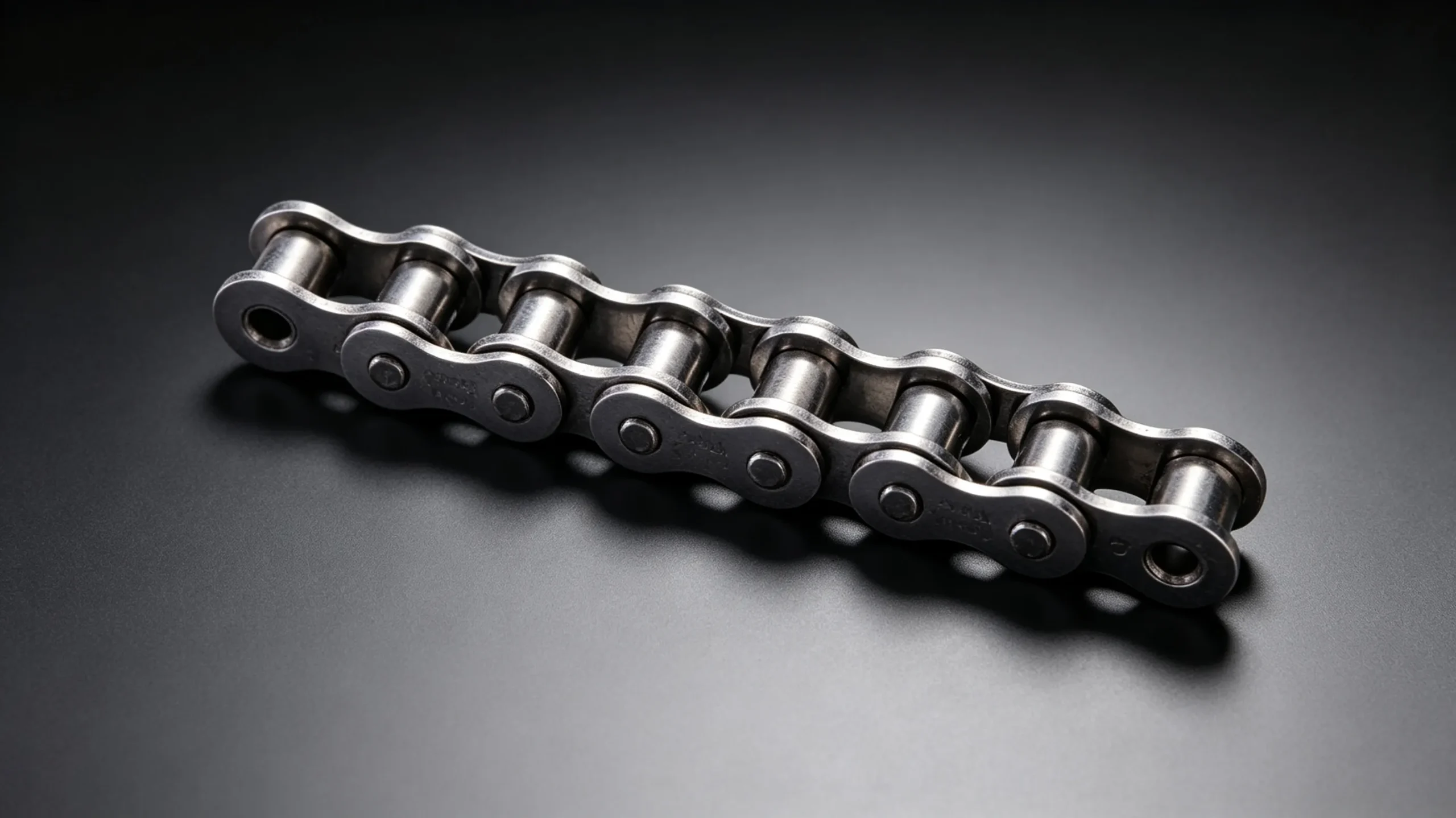
Without a vernier caliper, distinguishing standard from heavy series chain by eye is difficult — the plates look similar in profile. With a caliper, measure the plate thickness at the mid-plate location, away from both pin holes. For ANSI 60 standard, this should be approximately 2.40 mm; for ANSI 60H, approximately 3.20 mm. The measurement point matters: plate thickness near the pin hole varies due to the hole geometry and any surface deformation from the press-fit pin. Measure in the flat area between the two holes for a consistent result.
Chain markings are also useful when visible and legible. ANSI heavy series chains should be marked with the chain number followed by H (60H, 80H). If the chain is corroded or the marking is worn, the plate thickness measurement is the most reliable identification method. Ordering heavy series as a replacement when the original was standard is not harmful — the chain is stronger and dimensionally compatible. The reverse — ordering standard as a replacement for heavy series — can lead to premature failure if the application genuinely requires the fatigue resistance of heavy series plates.
Cost Comparison and Total Cost of Ownership
Heavy Series Unit Cost
Typically 20 to 35 percent higher than standard series at equivalent pitch, due to increased material in the thicker plates and slightly higher machining requirements.
Service Life in Shock Applications
In applications with genuine shock or variable loading, heavy series chain can outlast standard chain by 40 to 80 percent before fatigue replacement is required.
Total Cost Outcome
For shock-load applications, the higher unit cost of heavy series chain is usually recovered within the first replacement cycle through extended service life and reduced downtime costs.
For Smooth Drives
Standard chain remains more economical — the longer service life of heavy series chain is not realised when fatigue is not the limiting failure mechanism.
EverPower Roller Chains Australia stocks both standard and heavy series ANSI chain across the full pitch range. If you are unsure whether your application requires heavy series, send us your chain size, application description, and operating hours per day — our team will provide a specific recommendation.
+61 2 9708 3322 | [email protected] | 27 Harley Crescent, Condell Park NSW 2201