Description
Product Overview
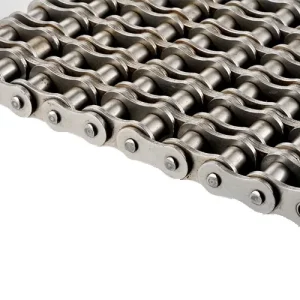
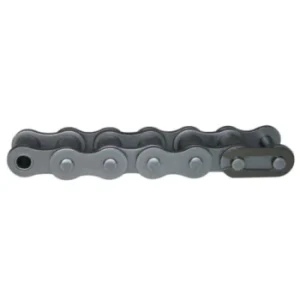
Double pitch transmission chains are produced to ANSI/ASME B29.3 and ISO 1275 standards, with the defining dimensional feature being a pitch exactly twice that of the equivalent short-pitch roller chain. A 208 chain, for example, carries the same roller and pin dimensions as a standard ANSI #40 (12.700mm pitch) chain, but has a pitch of 25.400mm — exactly double. This extended pitch reduces the number of links per unit of chain length by half compared to an equivalent standard chain, making double pitch chains lighter per metre, less expensive to produce, and simpler to maintain over long conveyor runs where the reduced link count means fewer potential wear points.
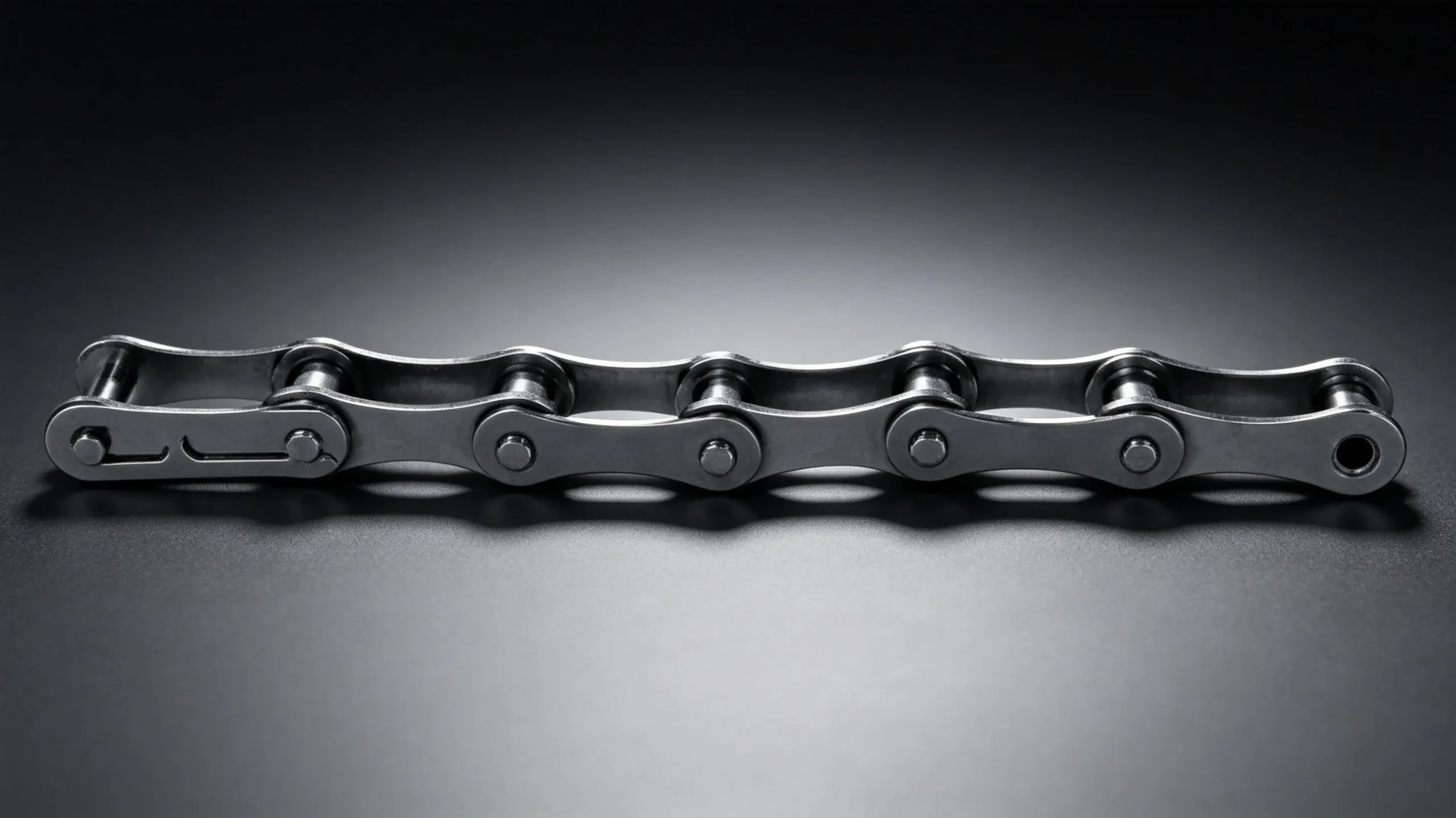
The 200-series designation follows ANSI B29.3 numbering: the first digit (2) indicates double pitch construction; the remaining digits identify the roller chain equivalent. So 208 = double pitch #40, 210 = double pitch #50, 212 = double pitch #60, 216 = double pitch #80, 220 = double pitch #100, 224 = double pitch #120, 228 = double pitch #140, and 232 = double pitch #160. Each number in the series is available in the standard small roller (R) configuration for sprocket-drive applications, and the large roller (S) configuration where the enlarged roller outer diameter is designed to carry products directly on the roller surface or to run on flat rail tracks instead of engaging toothed sprockets.
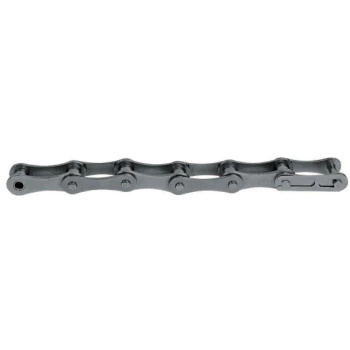
ANSI B29.3 double pitch transmission chains — 208 through 232 in small and large roller versions
Specification Table — 200-Series Double Pitch Chains
The table below covers the primary 200-series double pitch chain numbers. Small roller (R) and large roller (S) versions share the same pitch, inner width, and pin dimensions — only the roller outer diameter differs.
| Chain No. | Pitch P (mm) | Small Roller Ø (mm) | Large Roller Ø (mm) | Inner Width b1 (mm) | Pin Ø d2 (mm) | Plate Depth h2 (mm) | Plate Thick. t (mm) | Q min (kN) | Weight kg/m (R) |
|---|---|---|---|---|---|---|---|---|---|
| 208A / 208B | 25.400 | 7.95 | 15.88 | 7.85 | 3.96 | 12.00 | 1.52 | 14.10 | 0.45 |
| 210A / 210B | 31.750 | 10.16 | 19.05 | 9.40 | 5.08 | 15.09 | 2.03 | 21.80 | 0.68 |
| 212A / 212B | 38.100 | 11.91 | 22.23 | 12.57 | 5.94 | 18.00 | 2.39 | 31.30 | 1.10 |
| 216A / 216B | 50.800 | 15.88 | 28.58 | 15.75 | 7.92 | 24.00 | 3.18 | 55.60 | 2.10 |
| 220A / 220B | 63.500 | 19.05 | 39.68 | 18.90 | 9.53 | 30.00 | 3.96 | 87.50 | 3.30 |
| 224A / 224B | 76.200 | 22.23 | 44.45 | 25.22 | 11.10 | 35.70 | 4.78 | 125.60 | 4.90 |
| 228A / 228B | 88.900 | 25.40 | 50.80 | 25.40 | 12.70 | 41.40 | 5.59 | 170.00 | 7.30 |
| 232A / 232B | 101.600 | 28.58 | 57.15 | 31.75 | 14.27 | 47.80 | 6.35 | 222.00 | 9.60 |
Small Roller vs Large Roller: Choosing the Right Configuration
Applications Across Agriculture, Textiles, and Industry
Agricultural grain handling equipment is the single largest application segment for double pitch transmission chains. Grain elevators, bucket conveyors, drag floor systems in grain bins, seed cleaning equipment, and feed auger drives all operate at low speeds with moderate loads — precisely the conditions where double pitch chains provide optimum value. The 208A and 212A sizes are standard in most grain elevator designs; the larger 216A and 220A appear in high-capacity commercial grain handling terminals and export elevator facilities.
Textile machinery — specifically weaving looms, warp beam drives, and textile printing equipment — uses double pitch chains for their combination of low vibration (the larger pitch reduces sprocket tooth engagement frequency at equivalent chain speed), quieter operation, and the extended intervals between replacement that result from the wider pin-bushing contact area of the large-pitch joint. Printing and paper handling machinery specifies 208 and 210 series chains for feed roll drives and register-controlled indexing mechanisms where consistent pitch accuracy through the chain’s full service life is essential.
Construction equipment aggregate feeders, concrete batching plants, and quarry screening equipment use 212A through 220A double pitch chains in conveyor drives where the heavy duty cycle and abrasive material contact would shorten short-pitch chain service life disproportionately. In these applications, the larger pin-bushing contact area of the double pitch chain handles the conveyor drag loads without the pin-bushing wear rate that occurs in short-pitch chains at equivalent loads.
Attachment and Hollow Pin Variants
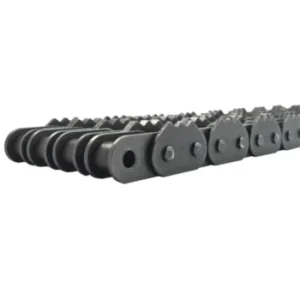
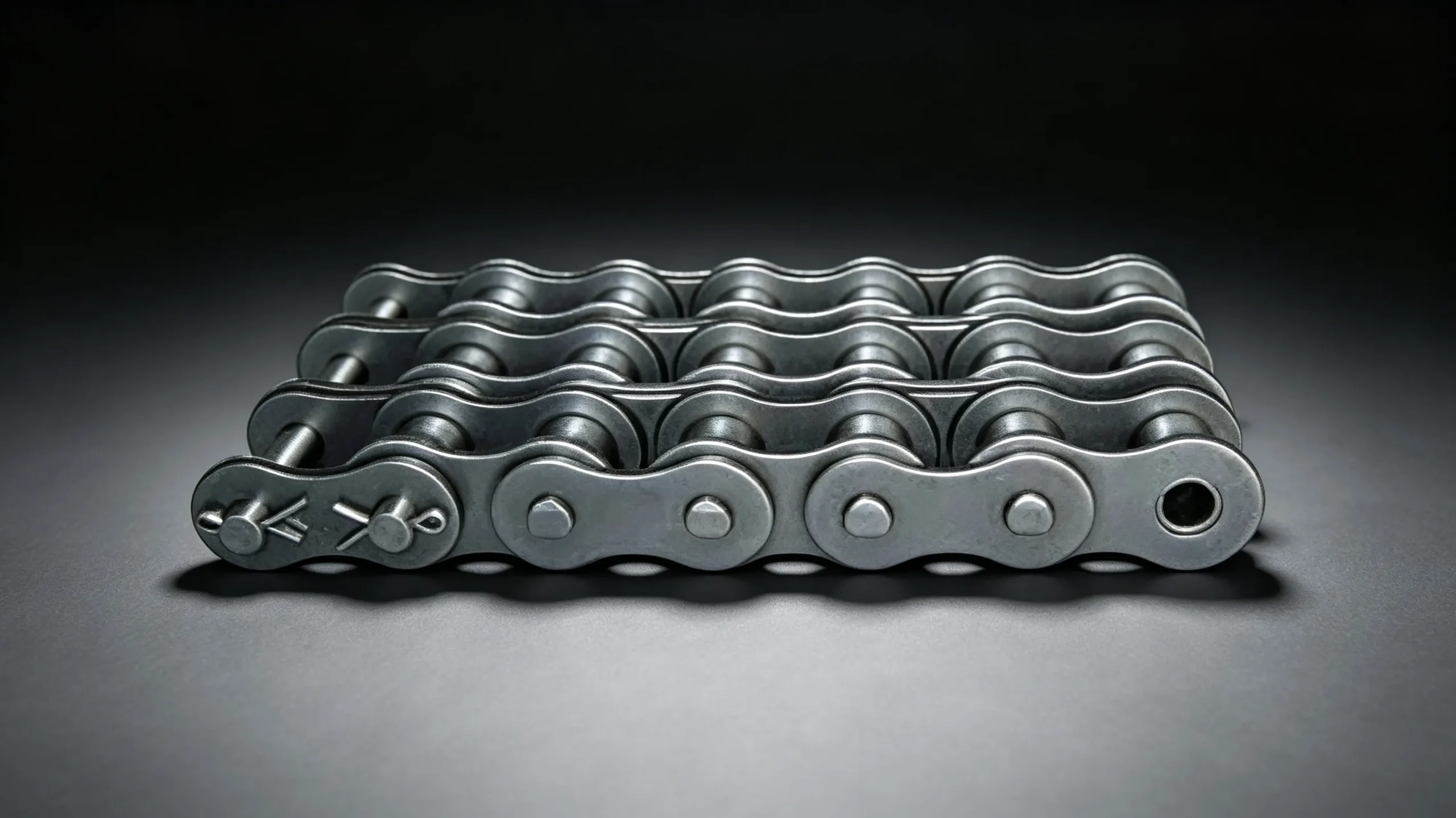
Double pitch transmission chains are produced with attachment links and hollow pin variants using the same conventions as standard roller chain. A1 attachments add a single tab on one side of selected outer link plates; K1 attachments project symmetrically to both sides; extended pins (EP) allow direct cross-bar bolting without bracket hardware. Hollow pin double pitch chains (with through-bores in every pin) accept cross rods for scraper flights and bucket elevator connections. Specify the attachment type, pitch interval between attachments, and chain size when ordering — we produce the assembly with attachments installed at the correct intervals.
Available in Stainless Steel and Nickel-Plated
Double pitch transmission chains are available in zinc-plated, nickel-plated, and 304/316L stainless steel specifications for applications requiring corrosion resistance. Stainless 208 and 210 series are used in food grain handling where FDA compliance for incidental grain contact is required. Nickel-plated versions suit outdoor agricultural installations where moderate corrosion resistance is needed without the cost of full stainless specification. Full compliance documentation is available with stainless steel orders.
Components and Matching Parts
Customer Reviews
“We spec 212A throughout our bucket elevator system — 14 elevators total. This supplier has been the most consistent on dimensional tolerances batch-to-batch of any we have tried. Pitch variation across the chain length is tight enough that we don’t get the resonance vibration we used to get from wider-tolerance chains at the elevator’s operating speed. Will continue ordering for our annual elevator rebuild programme.”
“We manufacture weaving looms that export globally. 208A is our standard for warp beam drives. The chain quality here is reliable and the specification data is accurate — important when our machines are serviced in 40 different countries and local replacement chain must match our OEM dimensions exactly.”
“Ordered 216A with K1 attachments for a concrete aggregate drag conveyor. The custom attachment configuration was produced correctly to our drawing without any back-and-forth. Lead time was 14 days for the attachment variant — acceptable for our project schedule. Chain quality is clearly better than the locally sourced alternatives we had been using.”
Frequently Asked Questions
Get in Touch
Ready to Place Your Order?
Send us your chain specification and annual volume. Standard enquiries receive a quotation within 2 business days.
See also our detailed guide to double pitch roller chains and how to select the right roller chain size for your conveyor.