Description
Self-Lubricating Roller Chain — No Maintenance Required
SLR Series self-lubricating roller chains eliminate the maintenance requirement that makes standard chains impractical in enclosed, inaccessible, or contamination-sensitive locations — the oil-impregnated sintered bushing supplies continuous lubrication from within the chain assembly throughout its service life.
The Self-Lubrication Mechanism Explained
Standard roller chains require external lubrication applied to the pin-bushing interface at regular intervals. In accessible, open drive locations this is straightforward — drip feed, bath, or spray lubrication systems maintain a continuous oil film without manual intervention. In enclosed machinery, inaccessible conveyor sections, cleanroom environments, and food processing zones, external lubrication is either impossible to apply effectively, prohibited for contamination reasons, or too labour-intensive to maintain at the required frequency. Self-lubricating chains address this fundamental limitation through a different approach to lubrication engineering.
The SLR series uses sintered bushing technology: the bushing — the cylindrical sleeve that surrounds the pin at each chain joint — is manufactured from a porous sintered metal (typically an iron-copper or bronze alloy) that is vacuum-impregnated with a specific lubricating oil during production. The sintered matrix holds the oil in the pore structure under no-load conditions. When the chain runs and the pin begins to articulate within the bushing, the localised pressure and temperature rise at the contact zone draws oil from the surrounding pores to the interface — exactly where lubrication is needed, exactly when it is needed. This process repeats continuously throughout the chain’s operating life without any external oil addition.
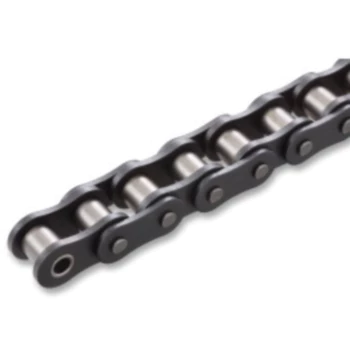
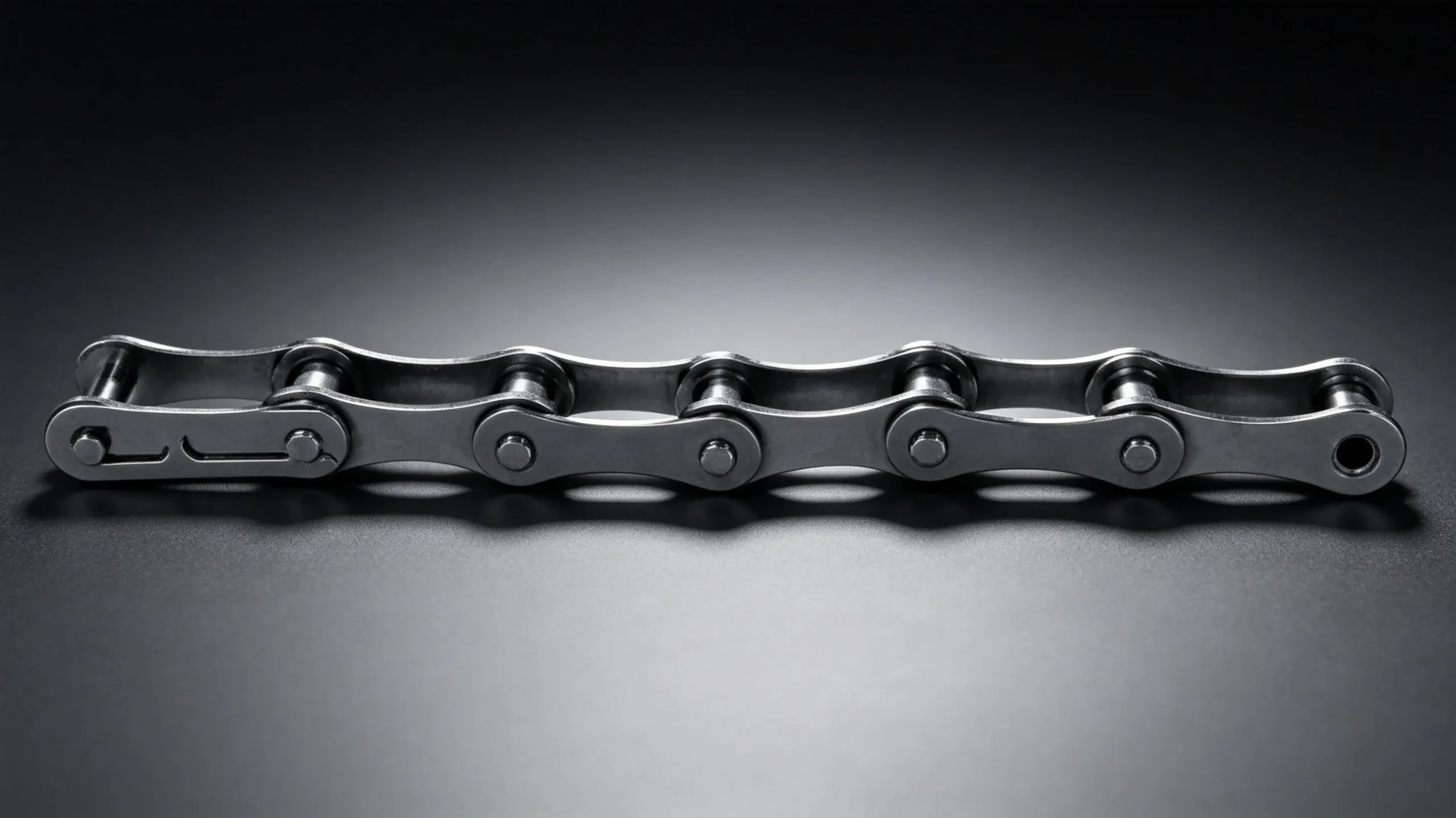
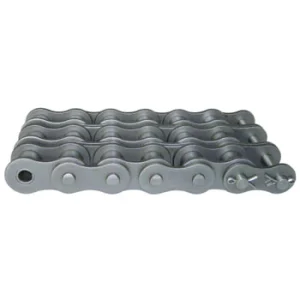
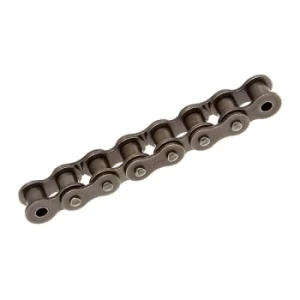
SLR Series — oil-impregnated sintered bushing for maintenance-free roller chain drives
SLR vs SL: Understanding the Difference
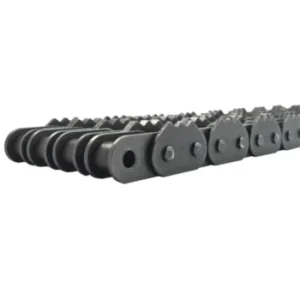
Two self-lubricating chain series serve different load requirements. The SL series is rollerless — the sintered bushing outer surface directly contacts the sprocket teeth. This construction increases the oil reservoir volume (the larger bushing holds more oil) but reduces the load rating compared to the SLR series because the bushing bears both the articulation load and the sprocket engagement load simultaneously.
The SLR series retains the standard external roller over the sintered bushing. The roller handles sprocket engagement in the same way as standard roller chain, while the sintered bushing at the pin-roller interface carries the self-lubrication function. This separation of functions allows the SLR series to achieve load ratings comparable to standard roller chains of the same pitch, making it the appropriate choice for drive applications with meaningful transmitted loads. The SL series is better suited to conveying applications with lower loads but higher oil reservoir requirements for extended maintenance intervals.
SLR Series Specifications
| Chain No. |
Pitch P (mm) |
Roller Ø d1 (mm) |
Inner Width b1 (mm) |
Pin Ø d2 (mm) |
Plate Depth h2 (mm) |
Plate Thick. t (mm) |
Q min (kN) |
Operating Temp (°C) |
| SLR25 |
6.350 |
3.30 |
3.18 |
2.31 |
6.00 |
0.76 |
3.33 |
−10 to +60 |
| SLR35 |
9.525 |
5.08 |
4.77 |
3.58 |
9.00 |
1.27 |
7.78 |
−10 to +60 |
| SLR40 |
12.700 |
7.95 |
7.85 |
3.96 |
12.00 |
1.52 |
14.10 |
−10 to +60 |
| SLR50 |
15.875 |
10.16 |
9.40 |
5.08 |
15.09 |
2.03 |
21.80 |
−10 to +60 |
| SLR60 |
19.050 |
11.91 |
12.57 |
5.94 |
18.00 |
2.39 |
31.30 |
−10 to +60 |
| SLR80 |
25.400 |
15.88 |
15.75 |
7.92 |
24.00 |
3.18 |
55.60 |
−10 to +60 |
| SLR100 |
31.750 |
19.05 |
18.90 |
9.53 |
30.00 |
3.96 |
87.50 |
−10 to +60 |
| SLR120 |
38.100 |
22.23 |
25.22 |
11.10 |
35.70 |
4.78 |
125.60 |
−10 to +60 |
Applications Where SLR Chain Is the Only Practical Choice
Several application categories make standard chain essentially non-functional through inadequate lubrication maintenance, and SLR chains are the engineering solution in each.
🏥
Cleanrooms and Semiconductor Facilities
Any standard chain lubricant — even light mineral oils — contaminates cleanroom air and deposits particles that damage semiconductor wafers, optical components, and pharmaceutical products. SLR chains operate without external lubricant, producing no contamination while maintaining the drive reliability that precision manufacturing processes require. Stainless steel SLR variants are available for Class 100 and Class 10 environments.
🍕
Food Processing Directly Above Product
Chain drives above open product conveyors or processing areas cannot use conventional lubricant without contaminating the food stream. SLR chains require no external lubrication and, when specified in food-grade materials with H1-rated oil impregnation, are approved for use directly above food contact zones — eliminating the drip shields and catch trays that complicate the hygiene management of standard chain installations.
⚙️
Enclosed Gearbox and Machine Drives
Drive chains inside enclosed machine cabinets or gearboxes are often inaccessible for maintenance without complete disassembly. SLR chains provide the full rated service life without any in-service lubrication — the oil reservoir in the sintered bushings is calculated to last the chain’s full service life under the specified load and speed conditions.
🌡️
High-Temperature Oven and Kiln Conveyors
In oven conveyor applications below 60°C, standard mineral oil lubricants applied externally evaporate rapidly and leave carbonised residues that accelerate wear. SLR chains with high-temperature oil impregnation supply a controlled oil release that matches the evaporation rate, maintaining lubrication over a longer period than external application. Above 60°C, specialist high-temperature sintered chain variants are required — contact us for details.
🔇
Noise-Sensitive Environments
Print rooms, library automation, museum environments, and residential building services often require quiet drive systems. SLR chains operate with lower noise than inadequately lubricated standard chains because the pin-bushing interface is always correctly lubricated — inadequate lubrication is a primary cause of roller chain noise, as metal-to-metal contact generates impact noise at each link articulation.
Service Life and Re-lubrication
SLR chains are not re-lubricated in service — when the sintered oil reservoir is depleted, the chain has reached the end of its useful life and should be replaced. The service life before depletion depends on three variables: the load on the pin-bushing interface (higher load extracts oil faster), the operating speed (higher speed increases oil extraction rate), and the ambient temperature (elevated temperature accelerates oil evaporation from the sintered pores). Under standard conditions — 50% of rated load, 300 RPM sprocket speed, 20°C ambient — SLR chains typically achieve 2,000–4,000 operating hours before replacement is required.
An important maintenance warning: never add external lubricant to SLR chains. External oil contaminates the sintered matrix and prevents the controlled release mechanism from functioning correctly — the chain then behaves unpredictably, with oil release that is either too fast (flooding the interface and causing slippage) or too slow (starving the interface after the external oil is depleted). The only correct maintenance action for SLR chains is replacement when they reach the elongation limit or the end of their calculated oil reservoir service life.
Components and Matching Parts
◆
Standard ANSI Sprockets — SLR Compatible
SLR chains run on standard ANSI sprockets of the same pitch — no special sprocket is required. The roller outer diameter matches standard specifications exactly. Hardened tooth sprockets extend SLR chain service life by reducing the roller wear that occurs at high sprocket speeds.
◆
SLR Connecting Links
Self-lubricating connecting links with sintered bushings at the pin positions, maintaining the self-lubricating property through the join point. Cotter-pin type for all applications.
◆
SL Series (Rollerless) — Complementary Product
Rollerless self-lubricating chains for lower-load conveying applications where a larger oil reservoir is the priority. Available in the same pitch range as SLR series.
◆
Stainless Steel SLR Chains
304 stainless outer plates and pins with food-grade H1 oil-impregnated sintered bushings for food contact zone drives. Full compliance documentation available.
Customer Reviews
★★★★★
“We replaced six standard chain drives in our tablet press room with SLR60 chains after the quarterly lubrication schedule was flagged as a contamination risk in our GMP audit. No external lubrication has been applied in 18 months and all six drives are running normally — zero contamination incidents and zero maintenance interventions in that period.”
Y
Yasmine Khalil
Facilities Engineer — Dubai Pharmaceutical Manufacturing
★★★★★
“Specified SLR50 in stainless with food-grade oil for our biscuit packaging line chain drives directly above the open product conveyor. The H1 oil documentation was complete and accepted by our customer audit without additional supplier questions. The chains have been running for 14 months without any lubrication-related maintenance.”
J
Jan Kowalski
Production Engineer — Krakow Food Packaging Plant
★★★★★
“We use SLR35 and SLR40 for board handling conveyor drives in our SMD assembly area. The chains produce no lubricant contamination that affects board soldering quality — a persistent problem with standard chains before we switched. Service life matches the manufacturer data; chains are replaced on schedule at 2,500 hours without unexpected failures.”
M
Mei Sasaki
Technical Buyer — Osaka Electronics Assembly
Frequently Asked Questions
Can SLR chains be used in the same sprockets as standard ANSI roller chains?+
Yes — SLR chains are dimensionally identical to standard ANSI roller chains of the same pitch. They run on the same sprockets without modification. The self-lubrication function is entirely contained within the chain assembly and does not affect any external dimension or the engagement geometry.
What is the operating temperature range for SLR chains?+
Standard SLR chains with mineral oil impregnation are rated from −10°C to +60°C. Below −10°C, the oil viscosity increases to the point where release from the sintered matrix becomes insufficient. Above +60°C, evaporation rate from the pores increases, shortening the oil reservoir service life. For applications between 60°C and 120°C, high-temperature oil impregnation variants are available — contact us with your operating temperature for a specific recommendation.
How do I know when an SLR chain needs replacement?+
Elongation measurement is the primary indicator — SLR chains should be replaced when they reach 1.5–2% elongation of nominal pitch length (slightly earlier than the 3% standard for external-lubricated chains, because self-lubricating chains are typically used in applications where downtime for replacement is difficult, and early replacement avoids unexpected failure). Additionally, if the chain begins to make dry clicking noises at the pin-bushing interface, the sintered oil reservoir is depleted and replacement is urgent.
Are SLR chains suitable for use in food direct contact applications?+
Standard SLR chains use mineral oil impregnation, which is not approved for direct food contact. For food contact applications, specify the food-grade H1 oil variant — the sintered bushing is impregnated with NSF H1 certified lubricant that is approved for incidental food contact per FDA 21 CFR regulations. Full compliance documentation is provided with every H1 SLR chain order.
Is there a speed or load limitation compared to standard roller chains?+
SLR chains have the same tensile rating as standard chains of the same pitch. Speed limitations are similar, with one caveat: at very high sprocket speeds (above 800 RPM for larger pitch sizes), the centrifugal effect on the sintered bushing pores reduces oil release to the interface, which can cause earlier-than-expected depletion. For applications above 600 RPM, contact us with the full operating specification for a service life estimate before ordering.
Get in Touch
Ready to Place Your Order?
Send us your chain specification and annual volume. Standard enquiries receive a quotation within 2 business days.
For more on chain lubrication, see our article on why roller chain lubrication is critical for wear life and what a self-lubricating roller chain is and where it is used.