
If you have ever tried to source a replacement roller chain from a different supplier and found it does not quite fit your sprocket — even though the pitch looks identical — you have most likely encountered the ANSI versus ISO dimension difference. These two international standards govern the majority of industrial roller chain produced worldwide, and while they look similar on paper, their dimensional tolerances diverge in ways that make cross-standard substitution a reliable recipe for premature failure. This guide breaks down exactly where the differences lie, why they exist, and how to identify which standard your equipment requires before placing an order.
Why Two Standards Exist at All
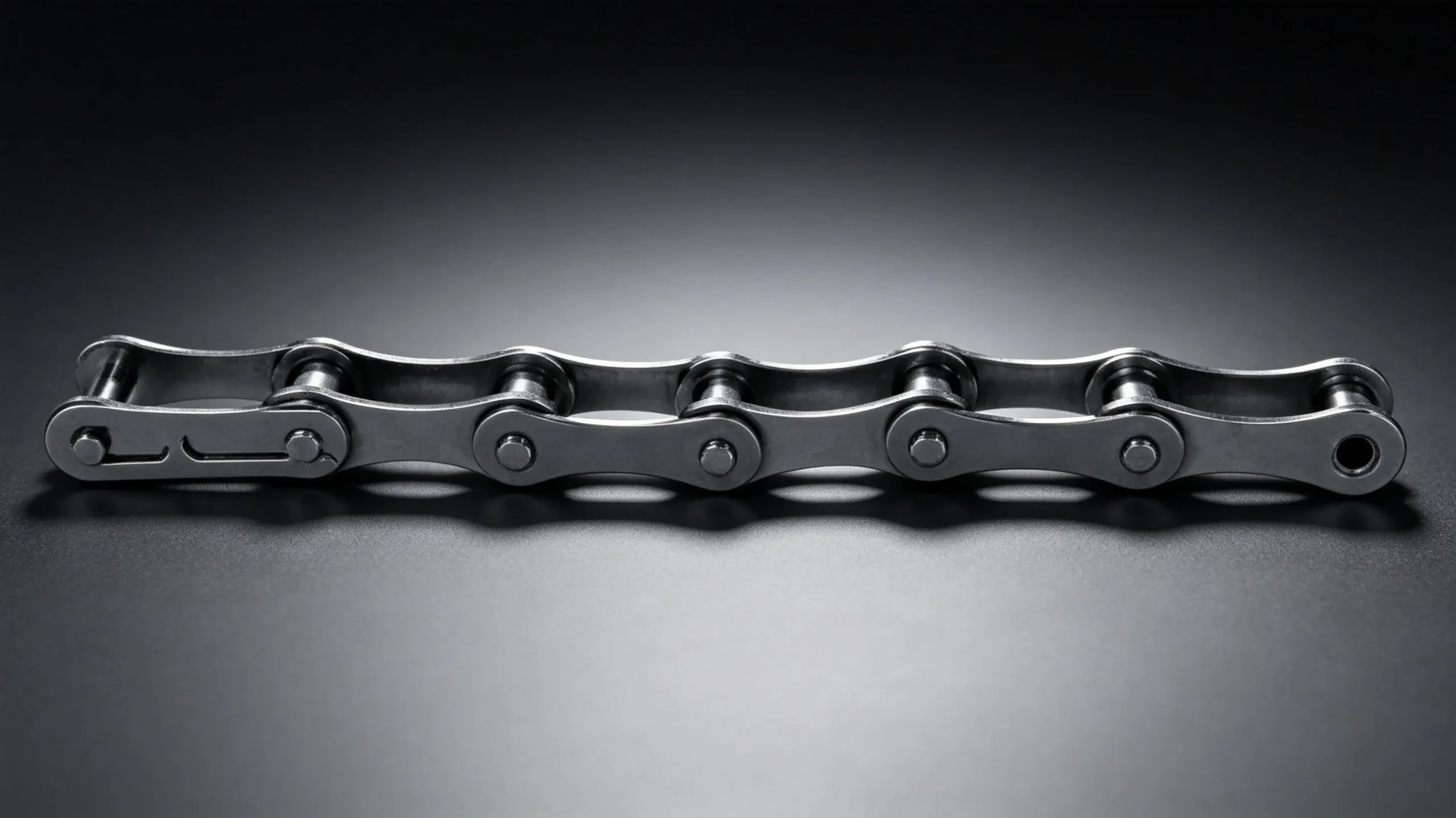
Roller chain standardisation developed on parallel tracks on opposite sides of the Atlantic during the early twentieth century. American industry coalesced around what became ANSI B29.1, a standard maintained by the American National Standards Institute and widely adopted across North America, Australia, and much of South America. European manufacturers — particularly in the UK, Germany, and Scandinavia — developed what became the British Standard BS 228, which was later harmonised into ISO 606 and adopted across the European region and much of Asia.
Both standards define roller chain by pitch, roller diameter, inner link width, plate thickness, pin diameter, and minimum breaking load. The critical point is that they define these dimensions differently for chains of the same nominal pitch. A chain described with a 12.7 mm pitch exists in both ANSI (No. 40) and ISO (06B) versions — and the two are not directly interchangeable, because the roller diameter, inner width, and breaking load specifications differ between them.
Understanding this distinction is not merely academic. Fitting an ISO chain to an ANSI sprocket, or vice versa, places the roller in a tooth pocket designed for a different roller diameter. The contact geometry shifts, concentrating load on a smaller arc of the roller surface and accelerating both roller and tooth wear. In high-load or high-speed drives, this mismatch can cause visible damage within a few hundred operating hours.
The Core Dimensional Differences Explained
The pitch — the centre-to-centre distance between adjacent pin holes — is the same for matched ANSI and ISO chain numbers. A 12.7 mm pitch is 12.7 mm in both systems. What diverges are the roller diameter and the inner link width. ANSI chains generally use a larger roller diameter relative to pitch than their ISO equivalents at the same pitch. For example, ANSI No. 40 (12.7 mm pitch) specifies a roller diameter of 7.92 mm, while ISO 06B (also 12.7 mm pitch) specifies a roller diameter of 6.35 mm — a difference of 1.57 mm, which is substantial at this scale.
Inner Link Width: The Other Key Divergence
Inner link width — the space between the inner plates through which the chain wraps around the sprocket tooth — also differs. ANSI No. 40 specifies an inner width of 7.85 mm; ISO 06B specifies 5.72 mm. This wider inner width in the ANSI chain means ANSI sprockets are dimensioned with wider tooth faces to suit. Attempting to run an ISO chain on an ANSI sprocket results in the chain riding off-centre on the tooth, which produces lateral plate wear and eventual plate fatigue cracking at the pin hole.
Breaking Load and Plate Thickness
At smaller pitches, ISO chains often carry a higher minimum breaking load than their ANSI counterparts at the same pitch. ISO 06B specifies a minimum breaking load of 9.0 kN for a simplex chain, while ANSI No. 40 simplex specifies 14.1 kN. At larger pitches the relationship reverses — ANSI 80 (25.4 mm pitch) specifies 55.6 kN minimum breaking load versus ISO 16B at 60.0 kN. These differences reflect different plate geometry philosophies rather than one standard being categorically stronger than the other.
| Dimension | ANSI No. 40 | ISO 06B | ANSI No. 60 | ISO 10B | ANSI No. 80 | ISO 16B |
|---|---|---|---|---|---|---|
| Pitch (mm) | 12.70 | 12.70 | 19.05 | 19.05 | 25.40 | 25.40 |
| Roller Dia. (mm) | 7.92 | 6.35 | 11.91 | 10.16 | 15.88 | 15.88 |
| Inner Width (mm) | 7.85 | 5.72 | 12.57 | 9.65 | 15.75 | 17.02 |
| Min. Break Load (kN) | 14.1 | 9.0 | 31.3 | 22.2 | 55.6 | 60.0 |
| Plate Thickness (mm) | 1.50 | 1.30 | 2.40 | 2.00 | 3.20 | 4.00 |
ANSI Chain Number Decoded: What the Numbers Actually Mean
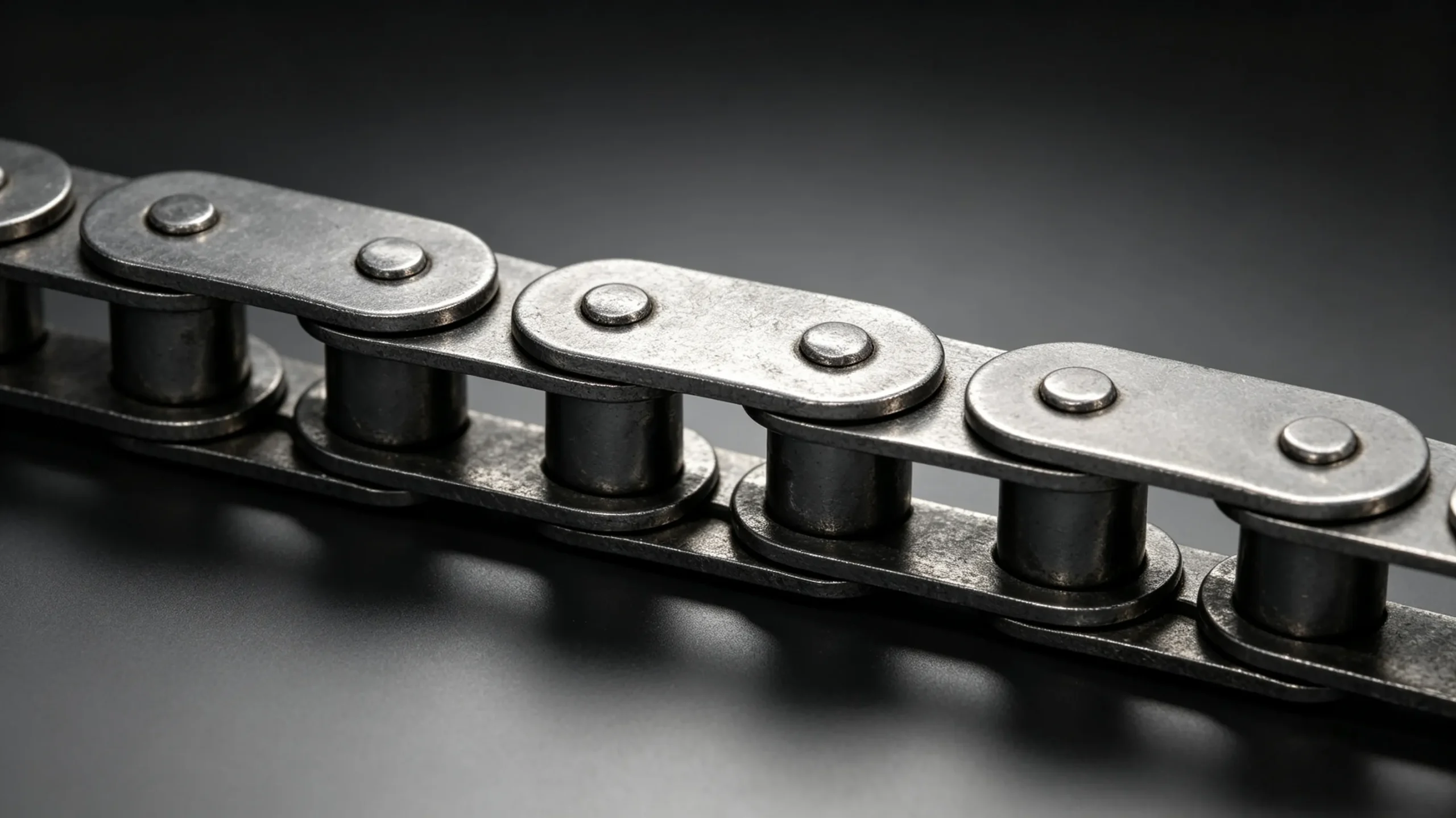
The ANSI chain numbering system encodes the pitch directly in the chain number. The first one or two digits represent the pitch in eighths of an inch. ANSI No. 40 therefore has a pitch of 4/8 inch = 0.5 inch = 12.70 mm. ANSI No. 60 has a pitch of 6/8 inch = 0.75 inch = 19.05 mm. ANSI No. 80 has a pitch of 8/8 inch = 1.0 inch = 25.40 mm. The suffix digit is also meaningful: a zero suffix (40, 60, 80) indicates standard rollers; a suffix of 1 (41, 61) indicates rollerless chain; a suffix of 5 (35, 55) indicates a lighter series with smaller rollers.
The ISO numbering system uses a letter-number format where the number represents pitch in sixteenths of an inch and the letter indicates the series. ISO 06B has a pitch of 6/16 inch = 0.375 inch = 9.525 mm — note this is a different pitch than ANSI No. 40 despite both being labelled with a 6 in their designation. ISO 10B (10/16 inch = 15.875 mm) is equivalent in pitch to ANSI No. 50. The B suffix denotes the standard European series; an A suffix would indicate a different geometry. This numbering divergence is itself a common source of ordering errors.
Sprocket Compatibility: The Most Practical Consequence
The roller diameter difference between ANSI and ISO chains directly determines sprocket tooth pocket geometry. A sprocket machined to ANSI specifications has a tooth gap profile calculated around the ANSI roller diameter. Placing an ISO chain (with its smaller roller at equivalent pitch) into that pocket means the roller does not seat fully at the tooth root — it rides higher and contacts a narrower arc of tooth surface. The effective contact stress increases proportionally, and the sprocket wears faster than designed.
The reverse scenario — an ANSI chain on an ISO sprocket — produces the opposite problem: the larger ANSI roller cannot seat properly in the narrower ISO tooth pocket, causing the chain to run on the tooth tips rather than the root. This produces characteristic tip wear on the sprocket teeth and peak bending loads in the chain link plates well above the design intent.
Practical rule: always replace chain and sprocket as a matched pair to the same standard. When taking over maintenance of an unknown machine, measure the roller diameter directly and cross-reference against both ANSI and ISO tables to determine which standard applies before ordering anything.
Which Standard Is Used in Australia?
Australia does not have a separate national roller chain standard — Australian industry uses both ANSI and ISO chains depending on the origin of the equipment. Agricultural machinery from North American manufacturers (John Deere, CNH Industrial, AGCO) almost universally uses ANSI chain. European-origin agricultural equipment (Claas, Fendt, Krone) typically uses ISO/BS chain. Japanese equipment brands (Kubota, Iseki, Yanmar) often use ISO but with their own component numbering systems that must be cross-referenced carefully.
Mining and construction equipment in Australia follows the same pattern: American brands use ANSI; European brands use ISO. Chinese-manufactured equipment — an increasingly significant category in the Australian market — is produced to ISO standards in most cases, though some manufacturers offer ANSI-dimension chains on request for export to markets where ANSI dominates.
For procurement managers sourcing replacement chain without the original equipment manual, the most reliable identification method is to physically measure three dimensions on the existing chain: pitch (pin centre to pin centre), roller outer diameter, and inner link width. These three figures uniquely identify both the standard and the size without ambiguity.
How to Identify Your Chain Standard in the Field
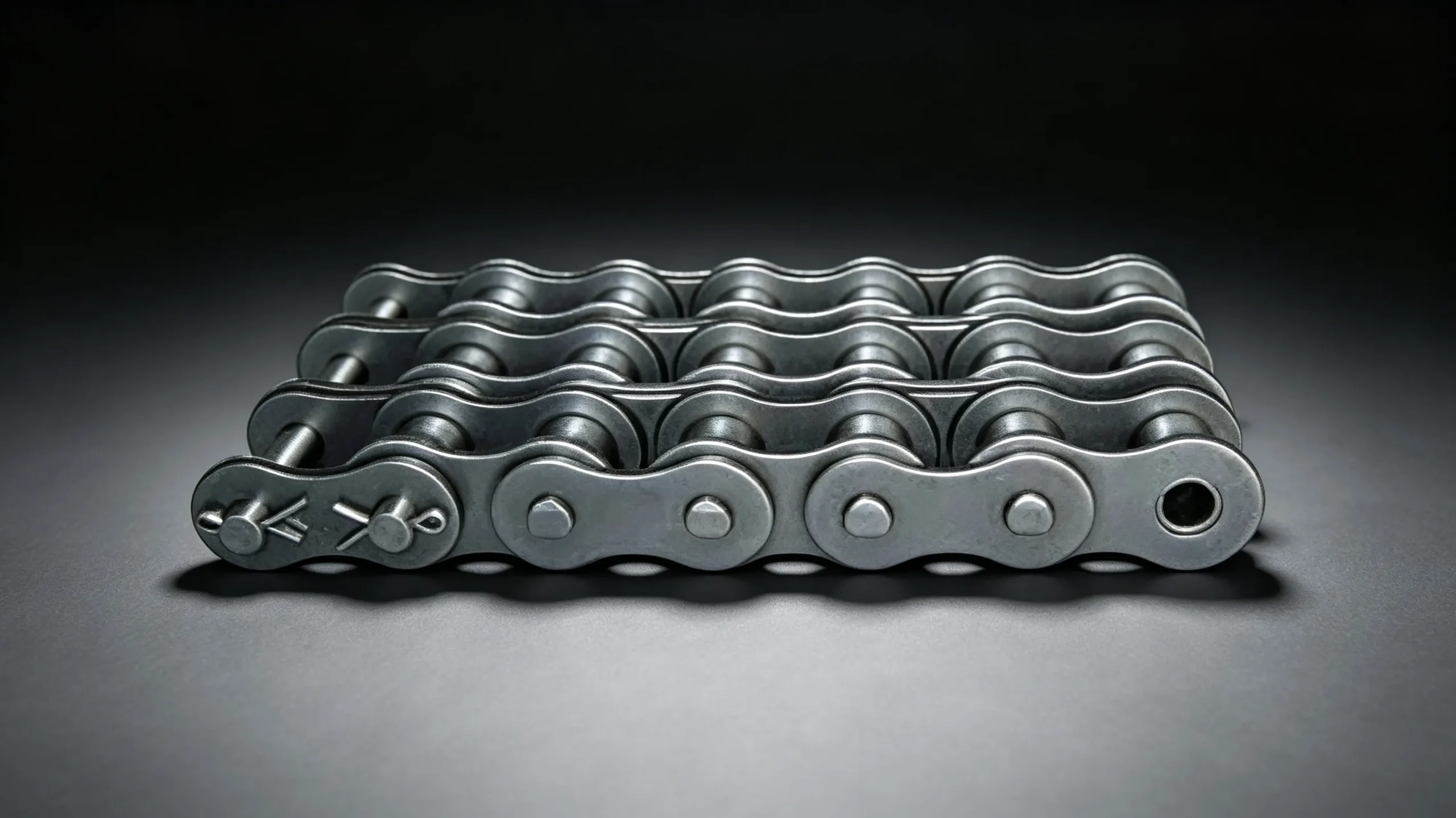
The fastest identification method requires only a vernier caliper and the tables above. First, measure pitch by placing the caliper across the outer edge of one pin to the outer edge of the pin two links away, then subtracting one pin diameter — or more accurately, measure across a span of ten links and divide by ten for an average that smooths out any wear elongation. Second, measure roller outer diameter directly. Third, measure inner link width by placing the caliper between the inner faces of the inner plates.
Checking the Chain Stamp
Most quality roller chain has its standard and size stamped or etched onto the outer link plates at regular intervals. ANSI chains will typically show markings such as 40, 50H, 60-2 (duplex), or similar. ISO chains may show 06B, 10B, 16B, or the manufacturer code plus pitch designation. Chinese-manufactured chains for export markets often carry dual markings indicating conformance to both ANSI and ISO standards — verify dimensions against the table rather than relying solely on the stamp when the source is uncertain.
When to Involve a Specialist
For custom attachment chains, chains with extended pins or special plates, and chains used in multi-strand assemblies where dimensional tolerances stack up, identification is more complex. Contact a specialist supplier with the pitch, roller diameter, inner width measurements, and photographs of both the chain and the sprocket teeth. A reputable supplier can identify the standard, verify the correct replacement specification, and advise whether a direct like-for-like replacement or an upgraded type — such as a sawtooth plate variant for improved fatigue life — is the better long-term procurement decision.
ANSI vs ISO: Performance and Application Tendencies
Beyond dimensional differences, the two standards reflect subtly different engineering priorities. ANSI chains — with their larger rollers relative to pitch — tend to perform better in shock-load applications because the larger roller distributes impact force over a greater contact area with the sprocket tooth. This characteristic suits agricultural machinery and construction equipment, where load spikes during soil engagement, material jamming, or sudden stops are routine.
ISO chains, with their relatively narrower inner link widths, run better in high-speed, low-shock drives where precision of engagement and smooth operation matter more than peak impact capacity. European conveyor and packaging machine designers favoured ISO chain partly for this reason, and partly because the narrower chain allowed tighter sprocket face widths in space-constrained equipment.
In practice, both standards produce high-quality chain when manufactured to specification and operated within their rated loads. The standard itself is less important than matching chain to sprocket, maintaining correct lubrication, and replacing at the correct elongation threshold. Engineers who understand both standards find it straightforward to specify correctly for any application — the confusion arises mainly when ordering without knowing which standard applies to a given piece of equipment.
ANSI Chain Strengths
- Larger roller — better shock absorption
- Wider inner link — suits wide sprocket faces
- Dominant in North American and Australian agricultural OEM supply chains
- Extensive availability across all pitch sizes in Australia
ISO / BS Chain Strengths
- Smaller roller — suited to higher-speed, lower-shock drives
- Higher breaking load at some larger pitches
- Dominant in European-origin machinery
- Preferred by Chinese equipment manufacturers for export
Common Ordering Mistakes and How to Avoid Them
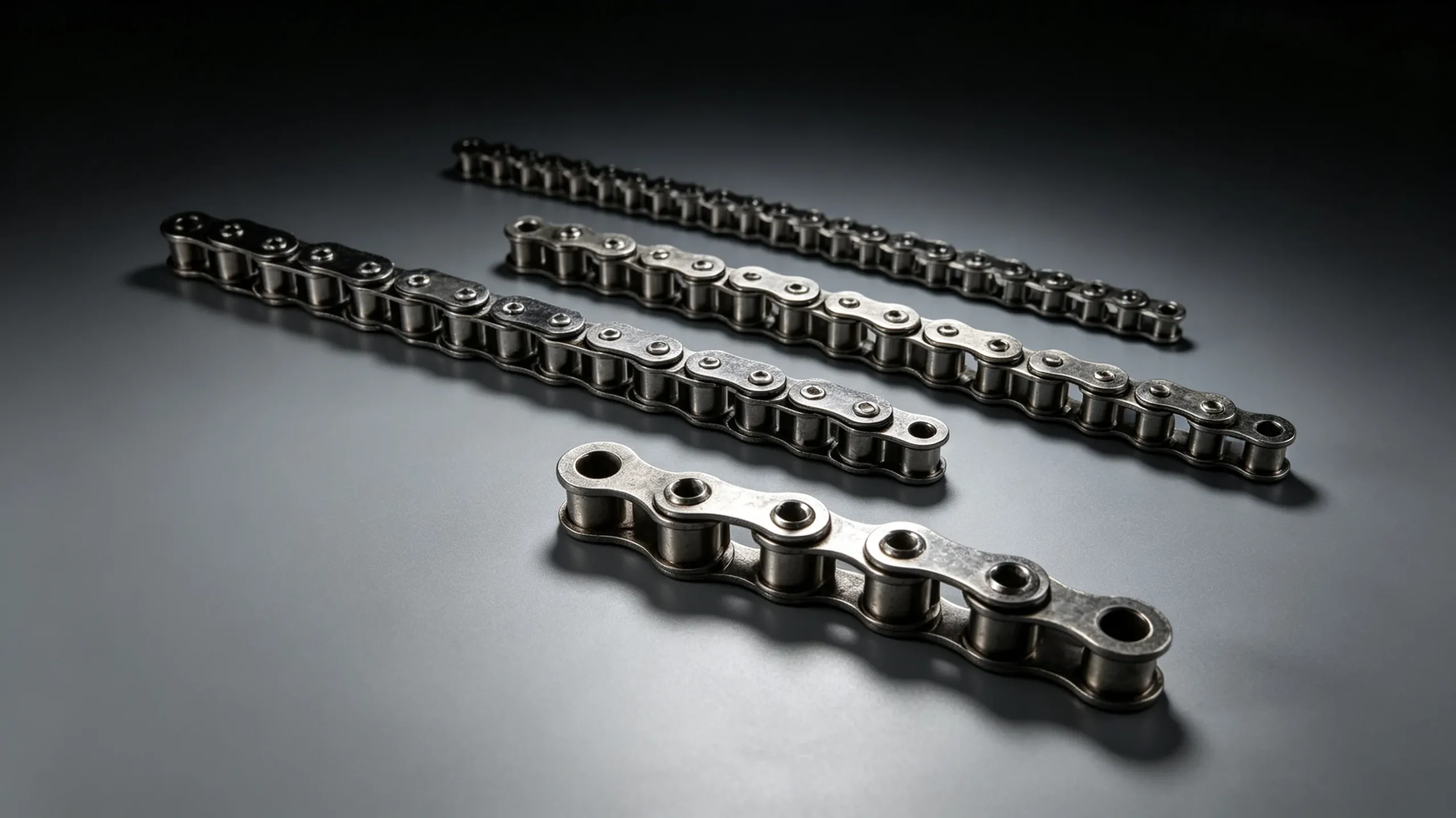
The most frequent error in roller chain procurement is ordering by pitch alone. A buyer measures the pitch on a worn chain, finds it is 19.05 mm, and orders ANSI No. 60 — but the original chain was ISO 10B, which also has a 19.05 mm pitch. The replacement chain arrives, appears to fit the sprocket loosely, and within two weeks the sprocket teeth show accelerated tip wear. Specifying by pitch plus roller diameter and inner width eliminates this error entirely.
A second common mistake is mixing ANSI and ISO chain in the same drive loop when making a partial replacement. Even if the pitch matches, the dimensional mismatch at every join between old and new chain creates uneven load distribution around the loop, causing the new links to carry disproportionate load. Always replace the full chain loop with chain of a single standard and, where the budget allows, replace sprockets at the same time.
Third, do not assume that a lower price necessarily indicates a lower standard — some Chinese manufacturers produce excellent ANSI-specification chain at competitive prices, and the quality difference between manufacturers within the same standard is often larger than the quality difference between the two standards themselves. Request material certificates and dimensional inspection reports when evaluating new suppliers for the first time.
Quick Reference: ANSI to ISO Equivalent Chain Sizes
| ANSI No. | ISO / BS Equiv. | Pitch (mm) | ANSI Roller (mm) | ISO Roller (mm) | Interchangeable? |
|---|---|---|---|---|---|
| ANSI 25 | 04C-1 | 6.35 | 3.30 | 3.30 | No |
| ANSI 40 | 06B-1 | 12.70 | 7.92 | 6.35 | No |
| ANSI 50 | 10B-1 | 15.875 | 10.16 | 10.16 | No |
| ANSI 60 | 12B-1 | 19.05 | 11.91 | 12.07 | No |
| ANSI 80 | 16B-1 | 25.40 | 15.88 | 15.88 | Dim. Check |
| ANSI 100 | 20B-1 | 31.75 | 19.05 | 19.05 | No |
Recommended Product
EverPower Roller Chains Australia supplies both ANSI B29.1 and ISO 606 series chains from stock in Sydney, with same-week despatch available for standard pitch sizes. If you are unsure which standard applies to your equipment, send us the three key measurements — pitch, roller diameter, and inner width — and our technical team will identify the correct chain and issue a written specification for your records before any order is placed.
+61 2 9708 3322 | [email protected] | 27 Harley Crescent, Condell Park NSW 2201