
Standard roller chain and O-ring roller chain can both be purchased in ANSI 60, both fit on the same sprockets, and both are available from Australian suppliers. The price difference between them is substantial — 30 to 80 percent premium for O-ring chain — and the question of when this premium is justified has a specific, measurable answer. It is not about quality preference or conservative engineering instinct; it is about whether the specific operating conditions of your drive generate the problems that O-ring chain is designed to solve, and whether the service life improvement those conditions enable makes the premium cost-effective.
What Problems O-Ring Chain Actually Solves
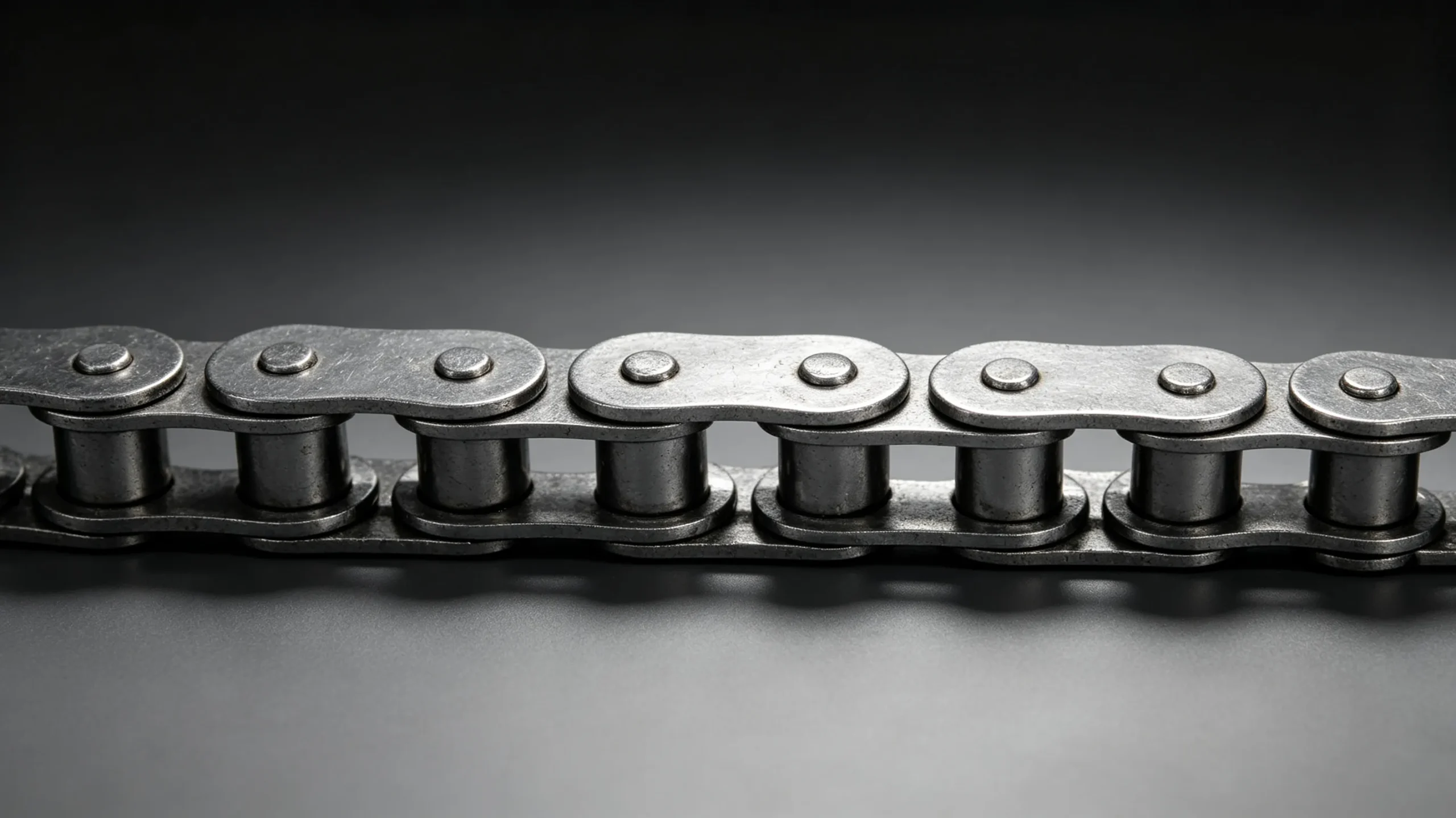
O-ring roller chain solves two problems simultaneously. First, it protects the pre-packed grease inside the pin-bushing joint from external contamination — dust, grit, water, and chemicals cannot penetrate the rubber seal to reach the contact surface. Second, it retains the grease inside the joint for the chain service life — the lubricant cannot be centrifugally thrown off, washed away by rain, or evaporated in a hot environment. If your drive is experiencing neither of these problems — if the chain is operating in a clean environment with a consistent external lubrication programme — O-ring chain solves nothing and the premium adds no value.
The converse is also true: if your drive consistently experiences either contamination of the pin-bushing interface from external particles, or rapid depletion of external lubricant from the chain surface, O-ring chain addresses these problems at the root rather than trying to manage them through more frequent maintenance. In contamination-dominated wear applications, field comparisons consistently show O-ring chain lasting 2 to 5 times longer than standard chain before reaching the 3 percent elongation threshold.
Condition 1: Heavily Contaminated Operating Environment
The most clear-cut case for O-ring roller chain is a drive operating in a severely contaminated environment where abrasive particles — grain dust, mineral fines, construction dust, quarry material — continuously penetrate standard chain joints and accelerate pin-bushing wear by three-body abrasion. In these environments, standard chain with aggressive lubrication can slow the wear but cannot eliminate the contamination problem because there is no physical barrier preventing particles from reaching the pin-bushing contact surface.
O-ring chain solves this by introducing a physical barrier. The rubber O-ring seal at each joint prevents external particles from entering the pin-bushing clearance regardless of how contaminated the surrounding environment is. Once the grease is pre-packed inside the sealed joint at manufacture, it remains in place and uncontaminated for the service life of the chain. The O-ring seal is the engineering solution to contamination-driven wear; increased lubrication frequency is only a partial mitigation.
Condition 2: Drive Where Lubrication Is Frequently Missed or Difficult
Standard chain that is not lubricated at its required interval wears at 10 to 50 times the correctly lubricated rate. In drives where the lubrication interval is frequently missed — due to remote location, access difficulty, or production pressure — O-ring chain provides a substantial safety margin. Because the grease is sealed inside the joint and does not need external replenishment, the chain continues to operate with adequate pin-bushing lubrication even through extended periods without external maintenance.
This is not permission to ignore O-ring chain maintenance entirely — the outer surface of the chain still benefits from periodic oil application to prevent surface corrosion and reduce roller-to-sprocket friction — but the critical pin-bushing lubrication is independent of external maintenance. For remote agricultural equipment, infrequently visited machinery, or drives in difficult-to-access locations, this sealed lubricant reserve provides substantially better minimum-maintenance performance than standard chain.
When O-Ring Chain Is Not the Right Choice
Clean, Well-Maintained Drives
For drives operating in clean, sheltered environments with a disciplined external lubrication programme, standard chain will achieve comparable elongation life to O-ring chain at a substantially lower cost. The O-ring seal provides no benefit if external contamination is not a significant factor and the external lubrication is being applied correctly. The 30 to 80 percent premium for O-ring chain in this scenario is purely additional cost without performance return.
High-Speed Drives Above 3 m/s
The compressed rubber O-rings that seal each joint introduce articulation friction — they resist the bending movement as the chain wraps around a sprocket. At speeds above approximately 3 to 4 m/s, this articulation friction generates enough heat at the O-ring contact faces to progressively degrade the elastomer. O-ring roller chain has a maximum recommended operating speed of 3 to 4 m/s for most configurations. For contamination-protection in drives above this speed, self-lubricating roller chain with sintered bushing is the appropriate alternative.
Food Processing Applications
The rubber O-ring compounds used in standard O-ring chain are not typically food-grade materials — neither are the greases pre-packed inside the joints. For food processing drives where the chain is in or adjacent to a food contact zone, O-ring chain is not the correct specification. Stainless steel roller chain with NSF H1 food-grade lubrication, or self-lubricating stainless chain with food-grade oil impregnation, is the appropriate food-safe specification.
| Condition | Standard Chain | O-Ring Chain | Self-Lubricating Chain |
|---|---|---|---|
| Clean indoor environment, regular lubrication | Excellent — full life achieved | Unnecessary premium | Unnecessary premium |
| Moderately dusty environment, regular lubrication possible | Good — adequate with correct lubrication | Better — but premium may not be fully recovered | Good alternative to O-ring |
| Heavily contaminated (grain dust, mineral fines), regular lubrication difficult | Poor — rapid wear from abrasive contamination | Best choice — sealed joint excludes contamination | Good — oil flush mechanism helps but less effective than seal |
| Remote location, lubrication frequently missed | Poor — dry running accelerates wear rapidly | Good — sealed grease independent of external maintenance | Good — internal reservoir provides lubrication without external supply |
| High speed above 3 m/s, contaminated | Poor | Not suitable — speed exceeds O-ring limit | Best choice — no speed limitation from seals |
| Food processing zone | Not compliant | Not compliant — O-ring and grease not food-grade | Best choice if stainless + food-grade oil specified |
The Cost-Benefit Calculation
The premium for O-ring roller chain is recovered through extended service life in contamination-dominated applications. If standard chain achieves 400 hours before reaching 3 percent elongation in a contaminated agricultural drive, and O-ring chain achieves 1,000 hours in the same drive, the O-ring chain is more economical per operating hour despite a 50 percent higher unit price. The break-even analysis is straightforward: if O-ring chain costs 1.5 times standard chain and lasts 2.5 times as long in your specific application, the total cost of ownership is 40 percent lower for O-ring chain.
The key variable in this calculation is the life improvement ratio, which depends on how contamination-dominated the wear is in your specific application. In extremely contaminated environments (continuous mineral dust, wet mud, abrasive crop residue), the improvement can be 4 to 5 times — making O-ring chain dramatically more economical. In mildly contaminated environments, the improvement may be only 1.3 to 1.5 times — making the cost-benefit marginal. Trialling O-ring chain on one drive while running standard chain on an adjacent identical drive is the most reliable way to determine the actual life improvement ratio for your specific conditions.
EverPower Roller Chains Australia supplies O-ring roller chain in ANSI and ISO series for agricultural, mining, and construction applications. Our Sydney team can help evaluate whether O-ring chain is cost-effective for your specific drive conditions and contamination environment. Contact us at +61 2 9708 3322 or [email protected].
+61 2 9708 3322 | [email protected] | 27 Harley Crescent, Condell Park NSW 2201