
Specifying heavy duty roller chain for a mining conveyor is a higher-stakes engineering exercise than most industrial chain selection decisions. Mining conveyors run continuously, often in contaminated and difficult-to-access environments, and the cost of an unplanned chain failure — production downtime, maintenance access, potential safety implications — typically exceeds the annual cost of the chain supply many times over. Getting the specification right the first time, with appropriate safety margin and correct sealing for the environment, is the most economical approach even when it means a higher initial chain cost.
Define the Mining Conveyor Drive Parameters
Before any roller chain dimension can be specified, four parameters must be established for the mining conveyor drive: the chain pull at the drive sprocket (in kN), the chain speed (in m/s), the operating duty cycle (hours per day, days per year), and the contamination environment (dry dust, wet slurry, or mixed). Each of these parameters contributes to a different aspect of the specification — chain pull drives the breaking load requirement, speed drives the pitch limit, duty cycle drives the service factor and inspection interval, and contamination drives the material and sealing specification.
Chain pull for a mining conveyor is calculated from: total material weight on the conveyor (tonnes per metre × carrying length), conveyor structure weight on the carrying strand, the coefficient of friction of the conveyor support system, and any incline gravity component. For a coal conveyor carrying 5 tonnes per metre across a 50-metre carrying strand on a 15-degree incline, with a coefficient of friction of 0.20 and chain weight of 25 kg/m (ANSI 100 simplex): the approximate chain pull from material load friction = (5,000 × 50 + 25 × 50) × 0.20 × cos(15°) × 9.81 / 1000 = approximately 49 kN; plus the incline component = (5,000 × 50 + 25 × 50) × sin(15°) × 9.81 / 1000 = approximately 65 kN. Total chain pull approximately 114 kN for this example. This confirms a heavy series large pitch chain is required.
Applying the Correct Service Factor for Mining Applications
Mining conveyor drives almost never qualify for the smooth loading (service factor 1.0) category. The realistic service factor for most mining conveyor applications is:
| Mining Conveyor Type | Loading Character | Service Factor |
|---|---|---|
| Overland flat conveyor, uniform coal | Moderately uniform with occasional surge | 1.3 |
| Underground coal feeder conveyor | Variable — dense coal sections, blockage risk | 1.5 |
| Surface ore conveyor, variable ore grade | Significant density variation | 1.5–1.7 |
| Crusher feeder conveyor | Heavy shock from irregular rock impact | 1.7 |
| Vibrating screen drive | Continuous cyclic loading at screen frequency | 1.5–1.7 |
| Bucket elevator (ore) | High shock on bucket engagement | 1.5 |
Calculating the Required Chain Breaking Load
Apply the service factor to the calculated chain pull, then multiply by the required safety factor to obtain the minimum chain breaking load. For the example above: design chain pull = 114 × 1.5 = 171 kN. Minimum breaking load = 171 × 10 (safety factor) = 1,710 kN — this is a very large chain pull requiring either very large pitch chain or a multi-strand configuration. This example illustrates why long, steep mining conveyors often use specialised mining chain or cable drives rather than standard ANSI roller chain. For typical shorter underground conveyors with chain pulls in the 20 to 80 kN range, the ANSI heavy series covers the requirement.
| ANSI Heavy Series Chain | Min. Break Load (kN) | Working Load at SF10 (kN) | Max Speed (m/s) | Suitable Chain Pull Range |
|---|---|---|---|---|
| ANSI 60H | 42.3 | 4.2 | 5.0 | Up to 4.2 kN design pull |
| ANSI 80H | 74.7 | 7.5 | 3.5 | Up to 7.5 kN design pull |
| ANSI 100H | 117.0 | 11.7 | 2.5 | Up to 11.7 kN design pull |
| ANSI 120H | 167.0 | 16.7 | 2.0 | Up to 16.7 kN design pull |
| ANSI 80H-2 (duplex) | ~130 | ~13 | 3.5 | Up to 13 kN design pull |
| ANSI 100H-2 (duplex) | ~204 | ~20 | 2.5 | Up to 20 kN design pull |
Sealing Specification for Mining Environments
Standard carbon steel heavy duty roller chain is the base specification for mining conveyor drives in clean or dry conditions. For the contaminated environments typical of underground coal mining and mineral processing, the sealing specification is as important as the load specification.
Dry Dust Environment (coal dust, mineral fines)
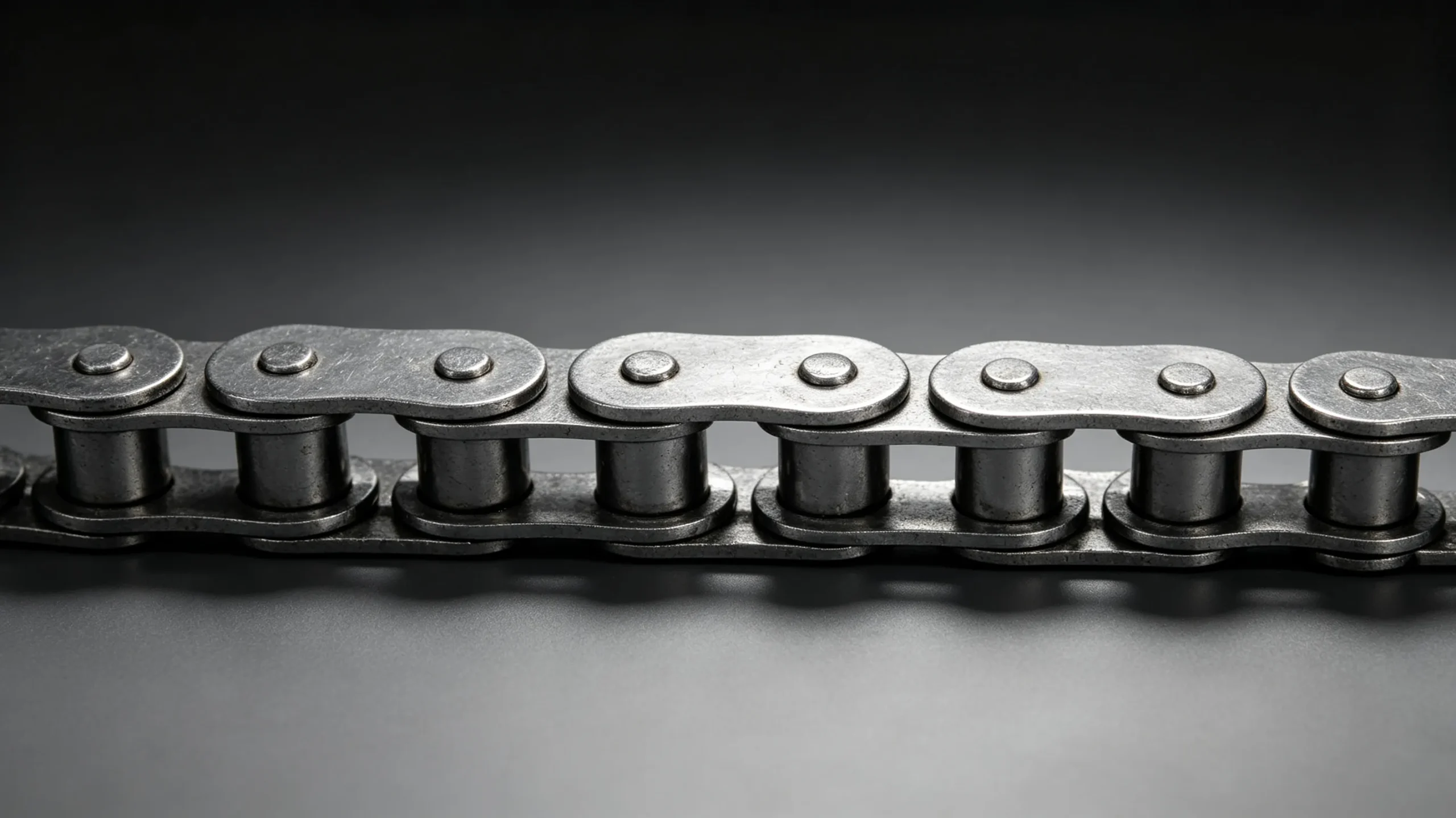
O-ring sealed heavy duty chain is the recommended specification. The rubber O-ring seals the pre-packed grease inside the pin-bushing joint against coal and mineral dust penetration. Field comparisons consistently show 2 to 4 times longer chain life than standard chain in the same dusty mining environment.
Wet or Slurry Environment
Carbon steel chain in wet slurry requires aggressive re-lubrication to displace moisture from the pin-bushing interface. O-ring chain is preferable but the seals must be verified as compatible with the specific chemicals in the slurry. For acidic slurries, consult the O-ring elastomer chemical compatibility data.
Underground Coal (flame-resistant requirement)
Some underground mining regulations require chain components to meet flame-resistant standards. Verify compliance with the relevant state mining regulation (NSW Mine Health and Safety Act, Queensland Coal Mining Safety and Health Act) for the specific application before specifying chain type.
High-Temperature Applications
For chain drives near hot material streams, verify the O-ring elastomer temperature rating matches the operating environment. Standard nitrile O-rings are rated to approximately 120 degrees Celsius; fluoroelastomer O-rings extend this to 200 degrees Celsius for high-temperature applications.
Sprocket Specification for Mining Heavy Duty Chain
Sprockets for heavy duty roller chain mining applications should be specified in case-hardened alloy steel (tooth surface hardness 50 to 60 HRC) rather than mild steel. Hardened sprockets outlast mild steel sprockets by 2 to 4 times in mining conveyor applications, reducing the total number of combined chain and sprocket replacement events and the associated production shutdowns. The cost premium for hardened sprockets is typically 30 to 60 percent over mild steel, recovered within the first replacement cycle through extended service life.
For mining conveyors with difficult access — underground or at elevated positions in surface plants — specifying hardened sprockets at the time of initial installation prevents the common scenario where sprockets need replacement at a subsequent chain change, requiring a second shutdown that could have been avoided.
Documentation Requirements for Mining Chain Supply
Mining operations in Australia operating under relevant Work Health and Safety regulations require documented evidence that maintenance materials meet the specified requirements. For heavy duty roller chain in mining applications, request from your supplier: a dimensional inspection report confirming ANSI B29.1 heavy series compliance for plate thickness and breaking load; a tensile test report for the specific batch; and a material certificate confirming steel grade and heat treatment specification. EverPower Roller Chains Australia provides these documents as standard for chain supplied to mining maintenance programmes.
EverPower Roller Chains Australia supplies heavy duty roller chain in ANSI 80H, 100H, and 120H for underground and surface mining conveyor applications. We provide batch-specific quality documentation for mining maintenance compliance requirements. Contact our Sydney team at +61 2 9708 3322 for specifications and pricing.
+61 2 9708 3322 | [email protected] | 27 Harley Crescent, Condell Park NSW 2201