
Pitch selection for high-load roller chain drives is one of the more consequential engineering decisions in mechanical power transmission — consequential because the chain pitch determines the sprocket size, the maximum operating speed, the chain weight, and the fatigue life behaviour of the drive system. For high-load applications, the instinct to specify the largest available pitch for maximum load capacity is often wrong: larger pitch chains run at lower maximum speeds, generate more chordal action, and can be outperformed by smaller-pitch multi-strand configurations at equivalent load capacity. Working through the selection logic systematically produces a better outcome than defaulting to the largest available pitch.
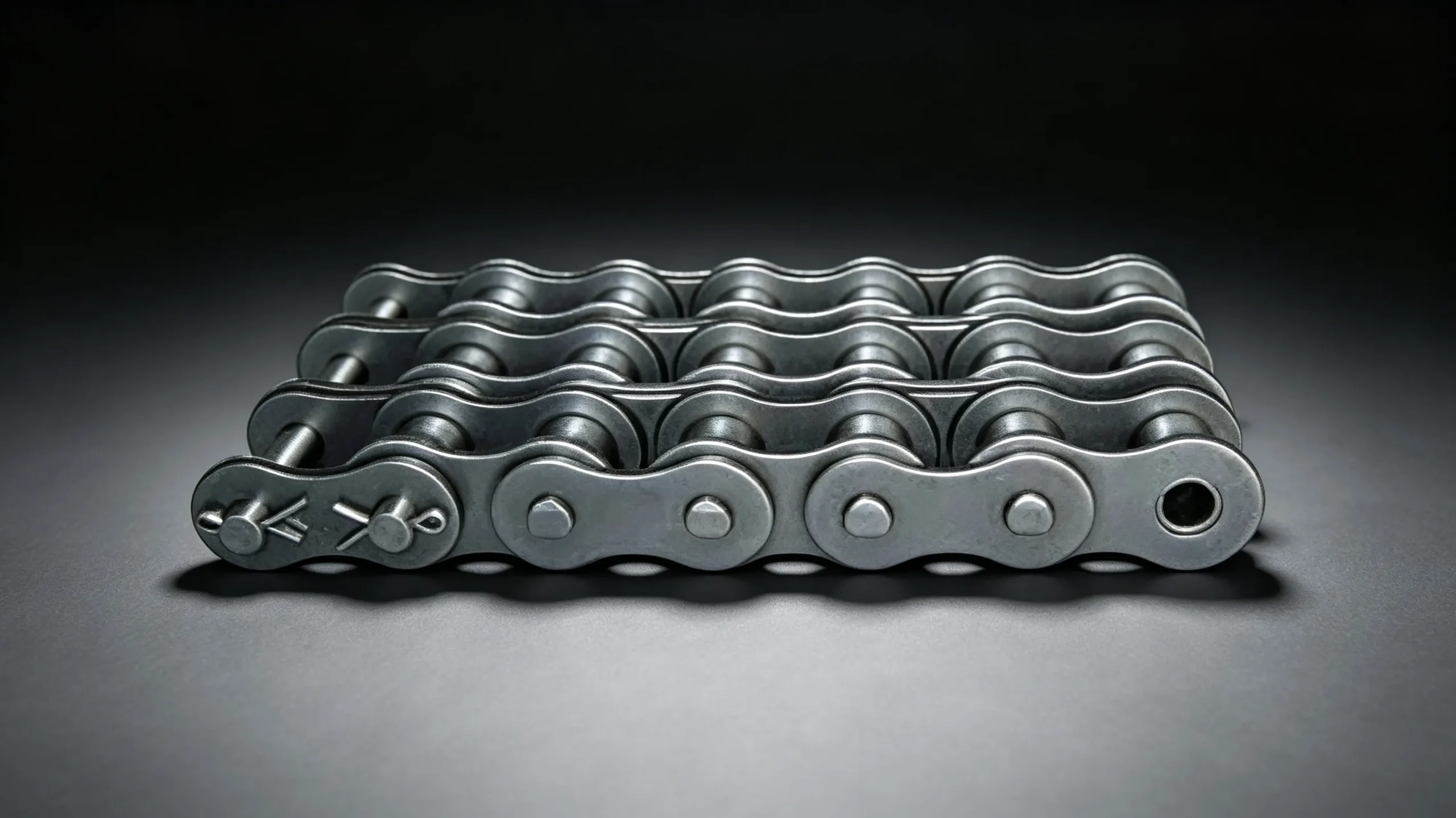
Why Larger Pitch Is Not Always Better for High Loads
The relationship between roller chain pitch and load capacity is not simply “larger pitch = higher capacity.” While larger pitch chains do have higher breaking loads than smaller pitch chains, the maximum operating speed decreases with increasing pitch — and this speed limitation affects the practical power transmission capacity more than the raw breaking load.
The power transmitted by a chain drive is: Power (kW) = Chain pull (kN) × Chain speed (m/s). For a given design power requirement, a larger pitch chain at lower speed may transmit the same power as a smaller pitch chain at higher speed. But the larger pitch chain requires larger sprockets, generates more chordal action noise and vibration, and has less flexibility in centre distance compared to the smaller pitch option. In many high-load applications, two strands of a medium pitch chain outperform one strand of the next larger pitch — at lower total cost and with better dynamic performance.
The Three-Step Pitch Selection Process
Design power (kW) = Shaft power (kW) × Service factor. The service factor accounts for the shock level of the application: 1.0 for smooth drives, 1.3 for moderate shock, 1.7 for heavy shock. A 15 kW drive with heavy shock (service factor 1.7) has a design power of 25.5 kW. This is the figure that enters the chain rating table.
Use manufacturer power rating tables for your drive sprocket speed and tooth count. Start with ANSI 60 and check whether it handles the design power at the required RPM with at least 17 teeth on the small sprocket. If not, move to ANSI 80 or consider duplex ANSI 60. The smallest pitch that satisfies the requirement is usually the best choice.
Chain speed = (pitch × sprocket teeth × RPM) / 60,000 (for pitch in mm). Verify this is below the maximum for the selected pitch. If speed exceeds the pitch limit, move to a smaller pitch with more strands rather than a larger pitch at lower speed.
When Multi-Strand Is Better Than Larger Pitch
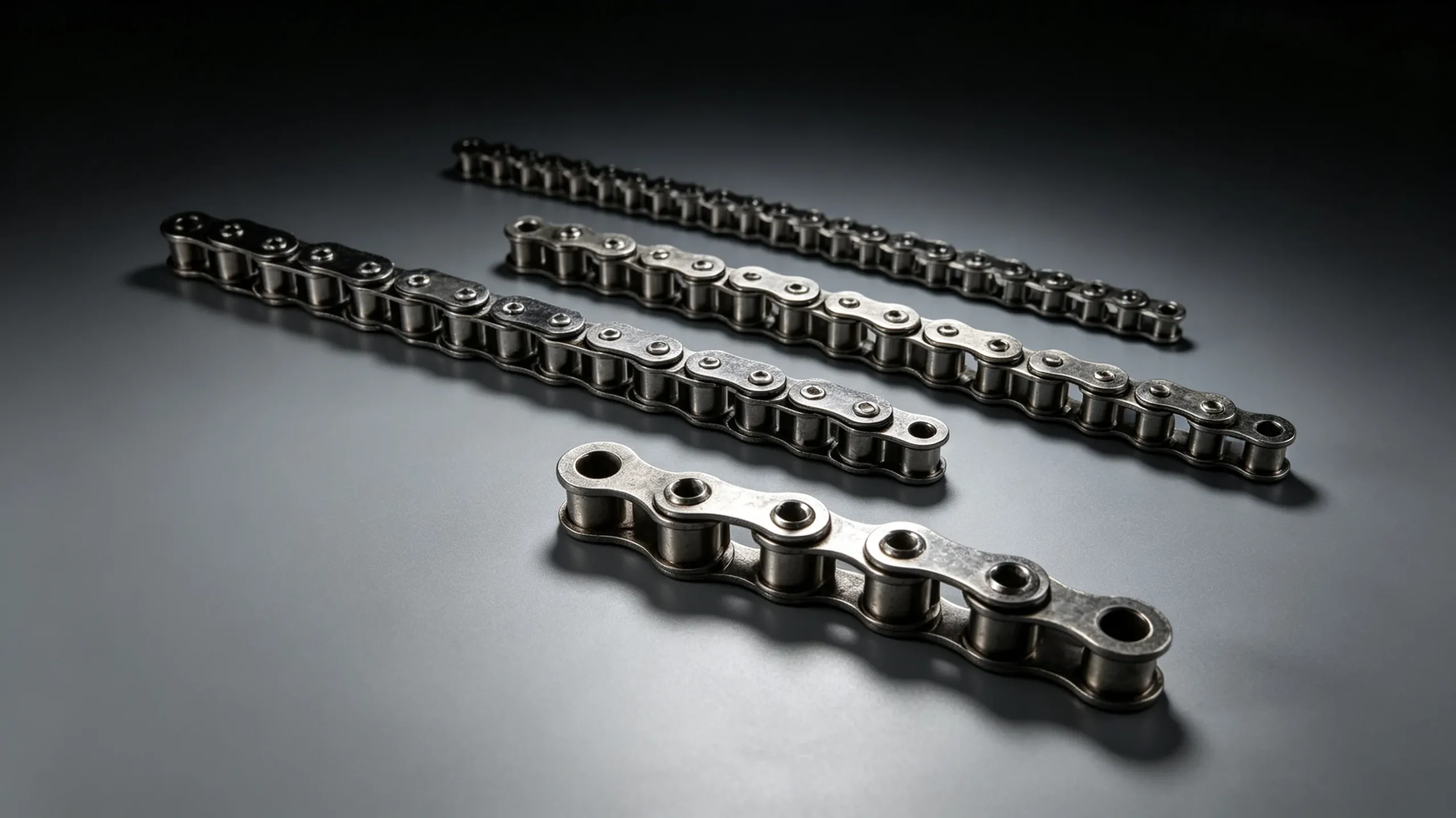
For high-load applications where chain speed is moderate to high (above 1.5 m/s), duplex or triplex chain at a medium pitch is often the better engineering choice than simplex chain at a large pitch. The reasons are practical: smaller pitch chain runs more quietly, generates less chordal action, allows lighter sprockets, and is more forgiving of minor misalignment. The multi-strand load capacity — approximately 1.75 times simplex for duplex, 2.49 times for triplex — is sufficient for most high-load industrial drives when combined with the correct pitch for the speed.
| Design Power (kW) | Speed (m/s) | Option A — Large Pitch | Option B — Small Pitch Multi-Strand | Recommended |
|---|---|---|---|---|
| 20 | 1.0 | ANSI 80 simplex | ANSI 60 duplex | Either — ANSI 60 duplex is quieter and lighter |
| 20 | 3.0 | ANSI 80 simplex (near speed limit) | ANSI 60 duplex (within speed range) | ANSI 60 duplex — ANSI 80 at speed limit is marginal |
| 40 | 1.0 | ANSI 100 simplex | ANSI 80 duplex | Either — ANSI 80 duplex gives flexibility |
| 40 | 2.5 | ANSI 100 simplex (at speed limit) | ANSI 80 duplex | ANSI 80 duplex — safer operating margin |
| 60 | 1.5 | ANSI 120 simplex | ANSI 80 triplex or ANSI 100 duplex | ANSI 100 duplex — better balance of size and load |
| 80 | 1.0 | ANSI 120 simplex | ANSI 100 duplex | Both viable — space and alignment constraints determine choice |
Heavy Series vs Standard Series at the Selected Pitch
Once the pitch is identified, the choice between standard and heavy duty roller chain (H series) is determined by the failure mode of the application. For smooth drives at less than 60 percent of the standard chain working load, standard series is adequate and more economical. For shock-load applications where the service factor exceeds 1.5, or where existing standard chain fails by plate cracking rather than elongation, heavy series at the same pitch provides the additional fatigue endurance without requiring a pitch increase.
Heavy series ANSI 60H provides 35 percent more breaking load than standard ANSI 60 and substantially improved fatigue endurance, at a 25 to 35 percent unit cost premium. When the alternative is moving from ANSI 60 to ANSI 80 — which requires larger, heavier sprockets, a wider sprocket face, and potentially a different drive geometry — the ANSI 60H option is often more practical and more economical for the total drive system.
Practical Worked Example: Selecting Pitch for a Baler Plunger Drive
A square baler plunger drive requires 22 kW at the chain drive input shaft. The driving sprocket runs at 120 RPM. The loading is heavy shock from the compression stroke (service factor 1.7). Desired minimum sprocket tooth count is 17.
Design power = 22 × 1.7 = 37.4 kW. Chain speed at 120 RPM with a 17-tooth sprocket: for ANSI 60 (19.05 mm pitch): speed = (19.05 × 17 × 120) / 60,000 = 0.64 m/s. Check ANSI 60H power rating at 120 RPM, 17 teeth: this size typically handles 15 to 20 kW at this speed in heavy series — insufficient for 37.4 kW design power. Check ANSI 80H at same speed: ANSI 80H at 120 RPM, 17 teeth typically handles 35 to 45 kW — this covers the 37.4 kW requirement. Check ANSI 60-2 duplex standard: duplex provides approximately 1.75× simplex rating — ANSI 60 duplex would need to rate at 37.4 / 1.75 = 21.4 kW, which is achievable at this speed. Conclusion: both ANSI 80H simplex and ANSI 60-2 duplex are viable; space constraints determine the final choice.
Sawtooth Plate Chain in High-Load Applications
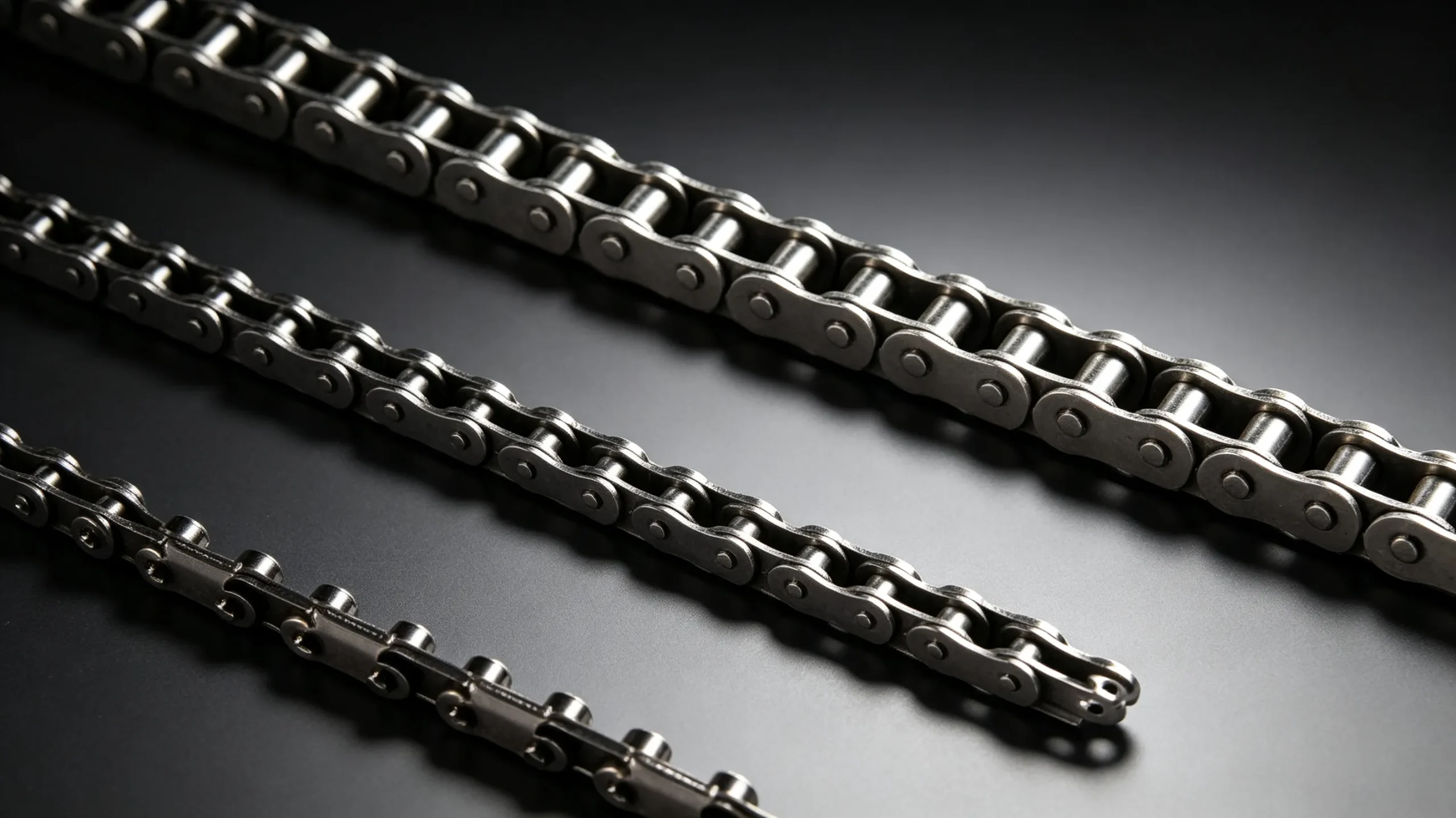
For high-shock, high-load drives where fatigue life is the primary concern — baler plunger drives, crusher feeders, vibrating screen drives — sawtooth plate roller chain in the correct pitch and series provides an additional fatigue life improvement beyond what the correct service factor calculation alone achieves. The sawtooth plate geometry reduces pin-hole peak stress by 8 to 13 percent, extending fatigue life by 20 to 40 percent compared to flat plate chain of identical specification. For these demanding applications, sawtooth plate heavy series chain represents the highest performance configuration available at a given pitch.
EverPower Roller Chains Australia can assist with roller chain pitch calculations for high-load drives. Provide your shaft power, drive speed, and application type and our Sydney team will work through the pitch and strand count calculation with you. Stock of ANSI 60H, 80H, and sawtooth plate chain is maintained for immediate despatch.
+61 2 9708 3322 | [email protected] | 27 Harley Crescent, Condell Park NSW 2201