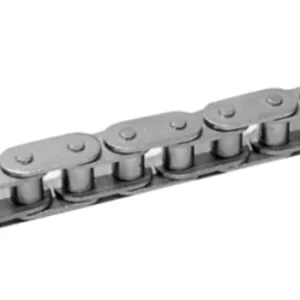
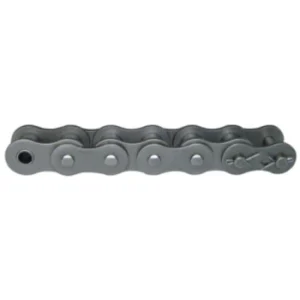
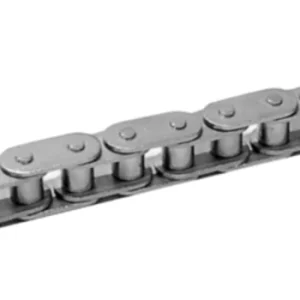
Description
Product Overview
Sharp top roller chains occupy a specialist position within the broader roller chain market — they are not simply standard chains with a serrated attachment, but purpose-engineered assemblies where every component is selected and treated for the unique demands of wood processing. The defining structural element is the machined tooth profile on the outer link plates: rather than conveying timber by friction or gravity alone, the teeth physically grip the bark or sawn face of each piece and hold it positively against lateral movement as it travels down the conveyor run.
Two tooth patterns cover the vast majority of sawmill applications. The 3-points-per-2-pitch pattern provides consistent grip on softwood and mixed-species infeed conveyors, where bark texture gives the teeth adequate purchase without deep penetration. The 4-points-per-pitch pattern doubles the contact density for smooth-surfaced green cants, finished boards, and high-speed outfeed sections where reduced surface texture would otherwise allow slippage. Our engineering team selects between these — or specifies a custom geometry — based on your conveyor speed, product species, and surface condition at the point of engagement.
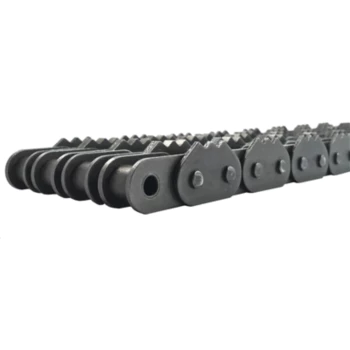
Sharp top chain — standard stock configuration for single and double strand forestry conveyors
Key Engineering Features
Every sharp top chain we produce goes through the same multi-stage manufacturing process, regardless of whether it is ordered as a standard catalogue item or a custom-geometry build. The result is a chain that performs predictably from the first metre of service rather than requiring a break-in period to stabilise.
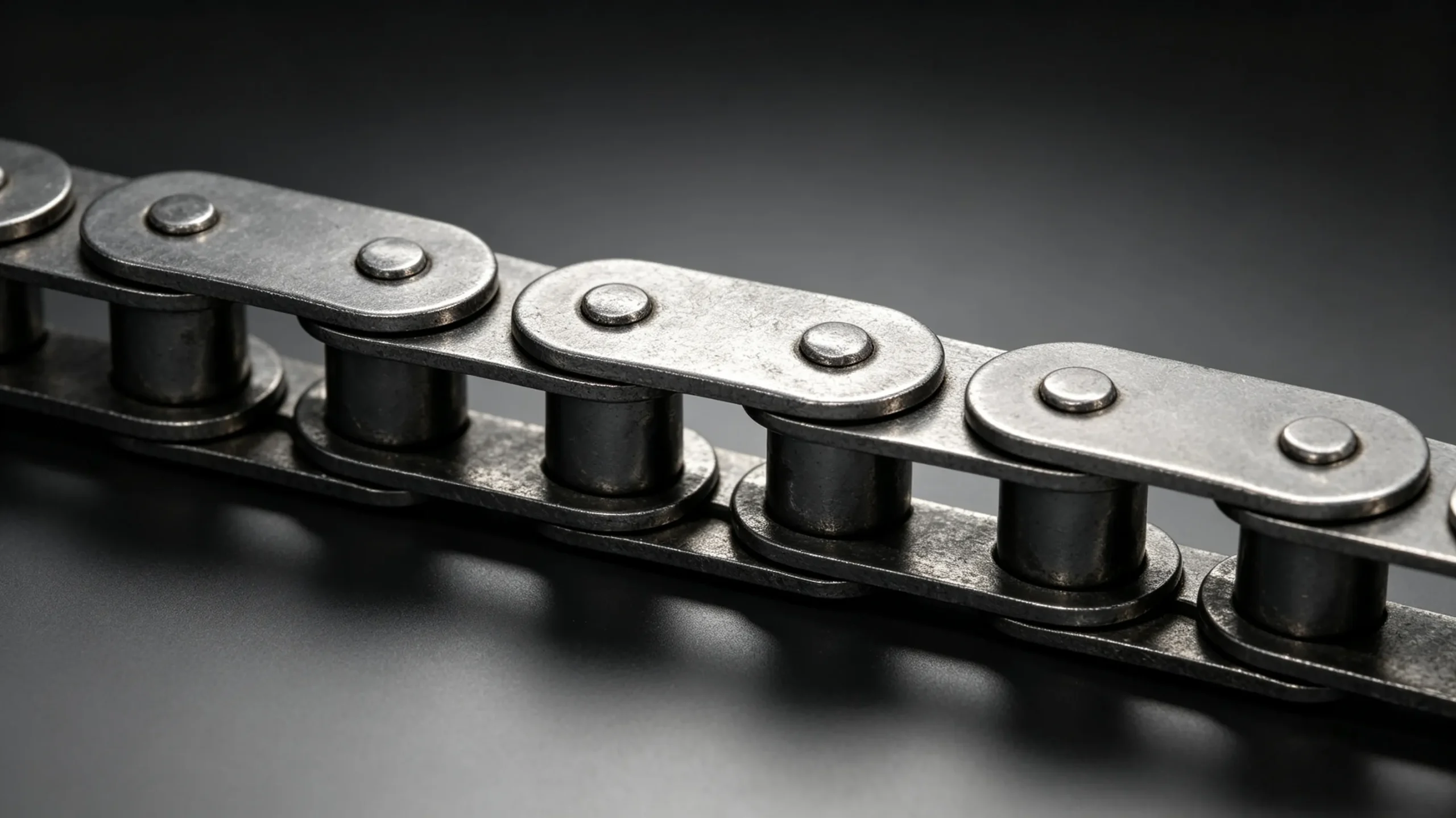
Precision component assembly under quality-controlled conditions
Specifications — Single Strand (3-Points Per 2 Pitches, ANSI)
The table below covers the four most commonly ordered ANSI single-strand sizes. Full tables for double, triple, and quad-strand configurations, as well as ISO metric sizes (16B through 32B), are available on request from our sales team.
| Chain Size | Pitch (P) | Roller Ø (B) | Inner Width (C) | Pin Ø (D) | Pin Length (F) | Tooth Tip (I) |
|---|---|---|---|---|---|---|
| 60-1 | 0.750″ | 0.850″ | 0.512″ | 0.689″ | 0.878″ | 1.000″ |
| 80-1 | 1.000″ | 1.140″ | 0.685″ | 0.914″ | 1.130″ | 1.275″ |
| 100-1 | 1.250″ | 1.325″ | 0.750″ | 1.142″ | 1.374″ | 1.544″ |
| 120-1 | 1.500″ | 1.594″ | 0.909″ | 1.370″ | 1.750″ | 1.942″ |
Timber Industry Applications
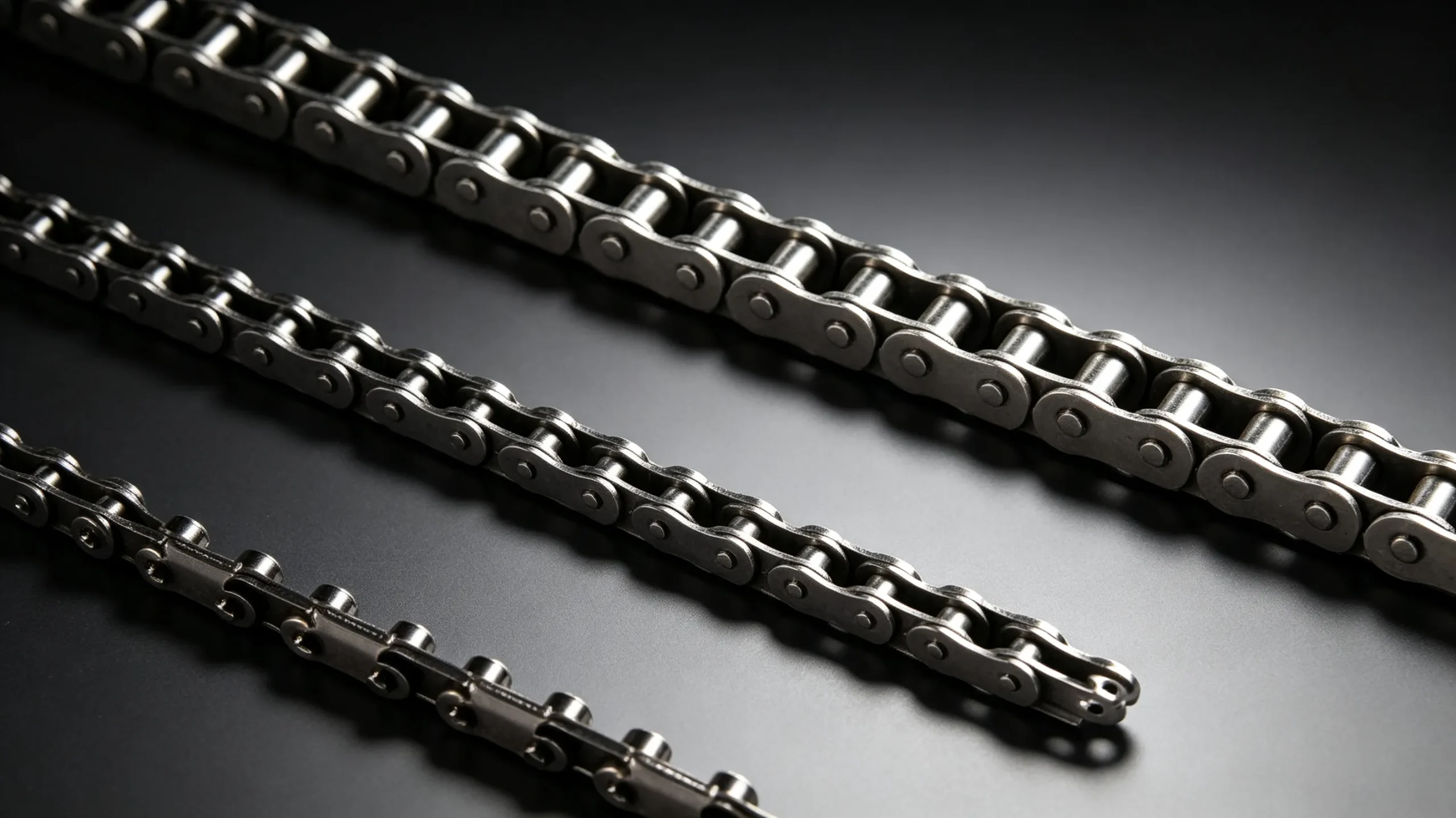
Sharp top chains appear at nearly every mechanical conveying point in a modern sawmill or timber processing facility. Their ability to handle irregular load shapes, maintain speed under lateral forces, and operate through environments saturated with fine wood debris makes them the default choice wherever standard chain solutions have previously failed. Typical installation points include log infeed from the debarker deck, where logs of varying diameter and bark roughness must be positioned accurately for the primary breakdown saw; green chain outfeed sections, where freshly sawn boards are sorted and stacked at line speeds above 1,000 fpm; chipper conveyors transporting slash and slab offcuts; edger and trim saw feeding lines; and automated lumber sorter and stacker systems that cycle through frequent start-stop duty.
Plywood and panel plant applications represent a further use case, where the challenge is not raw log weight but glue contamination and heat from press lines — conditions under which untreated standard chains rust rapidly at the plate surfaces. Sharp top chains with ProCoat™ or stainless-pin options address this without requiring a full stainless-steel chain specification.
Custom Build and Special-Order Options
Standard catalogue sizes handle the majority of replacement and new-build requirements. For equipment with unusual pitch combinations, OEM-specific dimensional constraints, or environmental conditions that require treatment beyond the standard factory lubrication, the following options can be incorporated into any order:
Induction-Hardened Teeth — selective hardening of tooth tips to above 58 HRC while maintaining tough, ductile link plate cores. Extends tooth service life significantly in abrasive bark-on-log applications.
Precision-Ground Flat Bottom — a machined flat surface on the center plate underside that distributes load evenly across the chain bed and reduces chain bed wear, extending the service life of both the chain and the equipment below it.
ProCoat™ Anti-Corrosion Treatment — a multi-layer barrier coating for outdoor log yards, green timber facilities, and coastal mill operations.
Solid Lubrication (MoS₂ or Graphite) — applied at pin-bushing interface for kiln-adjacent areas where conventional oil lubrication presents fire risk, or wash-down zones where oil is immediately flushed away.
Chrome Pins — for non-standard pitch or OEM rebuilds where original pin specifications fall outside the standard carbon-steel range.
Components and Matching Parts We Also Supply
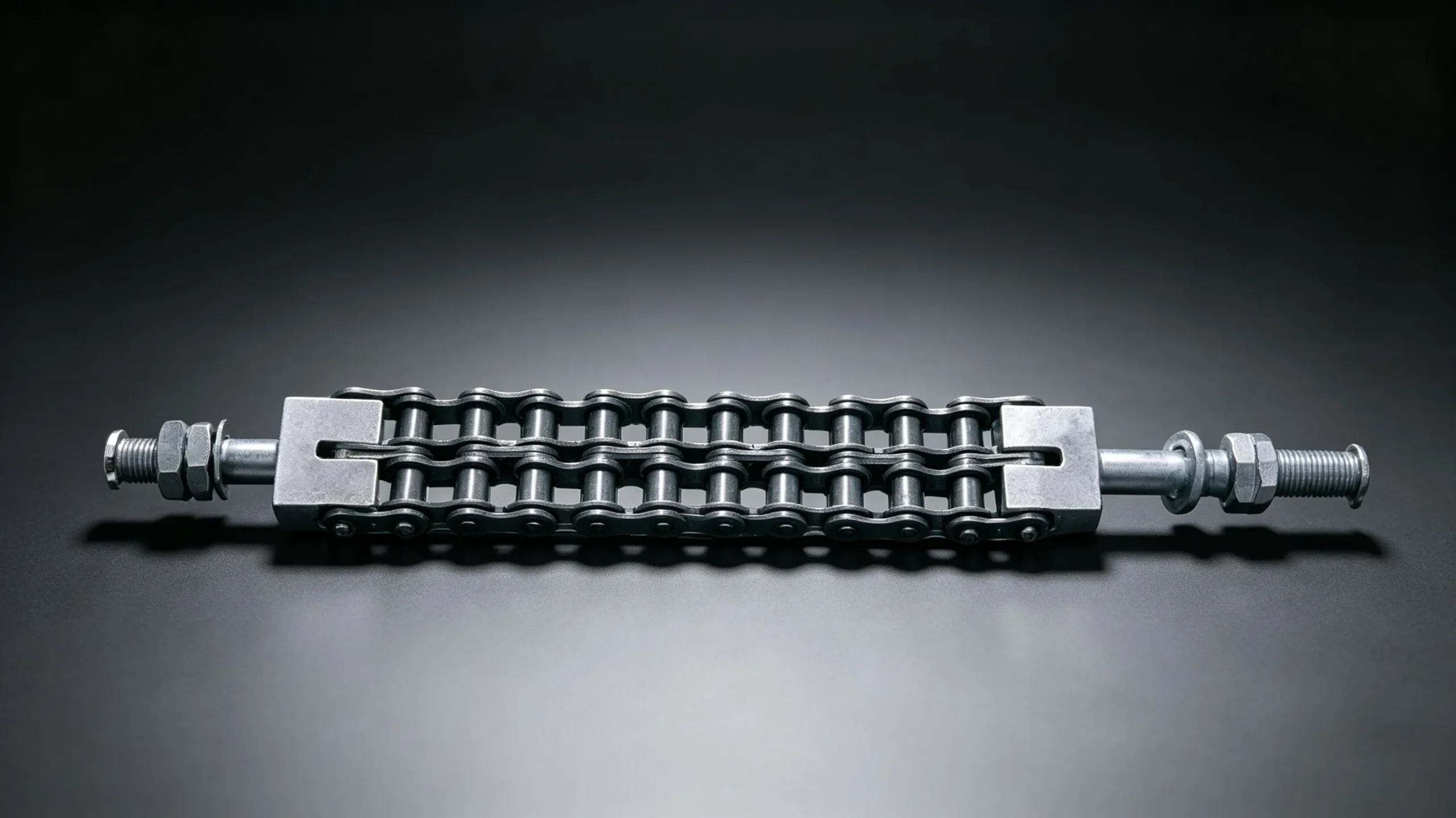
Supplying the chain alone covers only part of what a running conveyor system needs. We stock and manufacture the following matching components, which can be ordered alongside any sharp top chain to simplify procurement and ensure dimensional compatibility:
Installation and Maintenance Notes
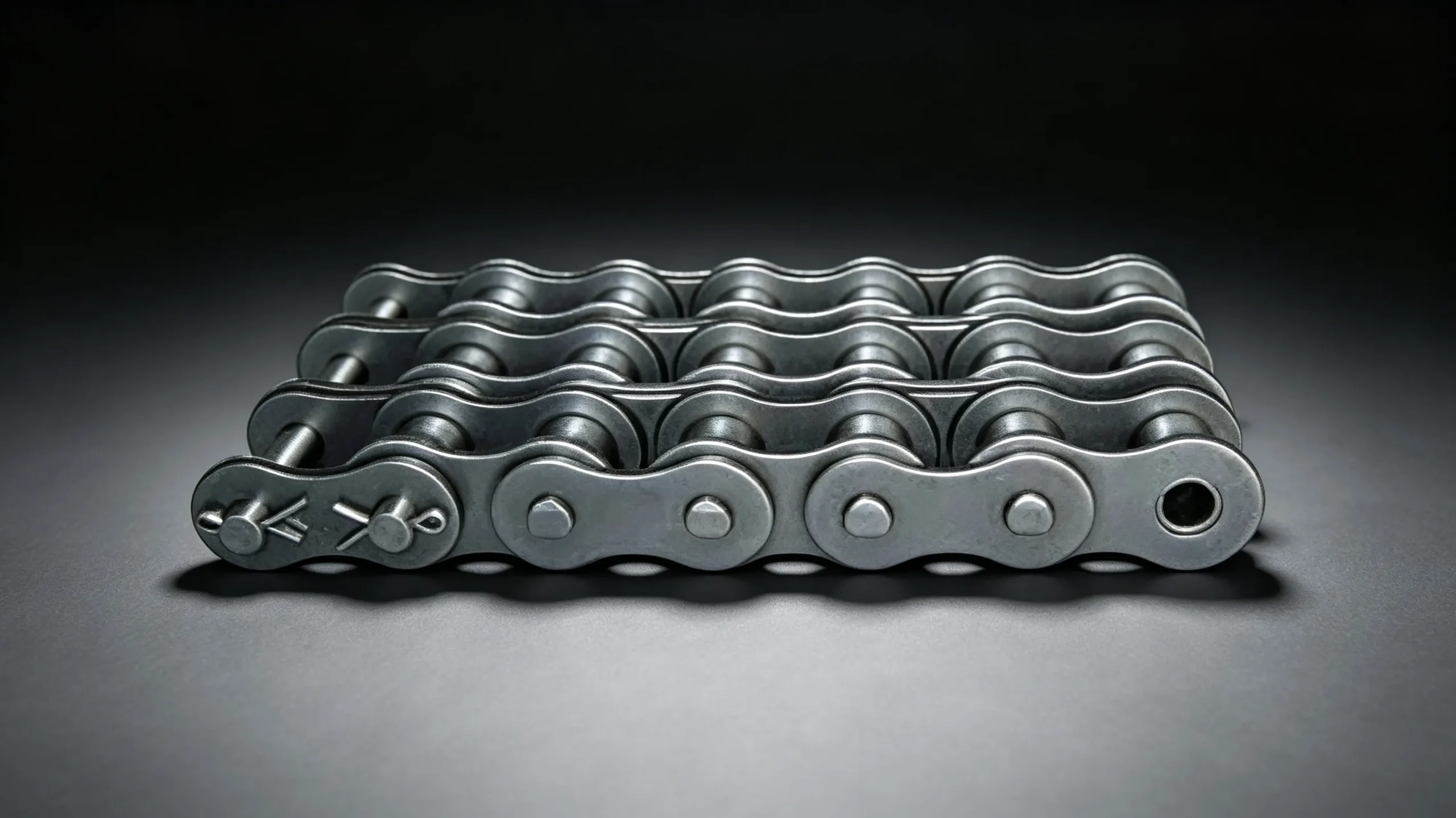
Sharp top chains arrive factory-lubricated and can be installed directly without additional pre-treatment. The most critical installation variable is tension: for sawmill conveying applications, target 2–3% deflection of the center-to-center span at the slack side. Over-tight chains load bearings excessively; under-tight chains cause skipping and uneven tooth wear. Re-tension when elongation reaches 1.5% of nominal pitch length — a lower threshold than the 3% figure used for power transmission chains, reflecting the higher shock loading in timber applications.
When replacing chain, always inspect sprocket tooth profiles at the same time. Worn sprocket teeth alter the effective pitch at the engagement point, causing the new chain to wear at an accelerated rate from the first shift. Replacing both simultaneously delivers a service life up to 60% longer than fitting new chain to worn sprockets. Full maintenance guidance is available in our technical support documentation — contact us for a copy.
For a deeper understanding of the failure mechanisms that sharp top chains are designed to address, see our technical article on why sawtooth plate roller chain is preferred in agricultural and timber machinery and our guide on what causes roller chain to stretch prematurely.
Customer Reviews
“We switched to these sharp top chains on our green chain outfeed two seasons ago. The solid center plate design has completely eliminated the sawdust packing failures we were dealing with every 6–8 weeks on the previous supplier’s chain. We’re now running over 14 months on the current set with no re-tensioning issues.”
“Ordered the 16B-1 metric series for our log infeed conveyor. Delivery was fast, the specification documentation was complete, and the chains dropped straight in without any fitting issues. Tooth profile matches the originals exactly. Will be ordering the double-strand set for the second line next quarter.”
“We’ve been through three or four chain suppliers over the years trying to find a replacement for Renold that doesn’t require constant babysitting. These are the first chains where we haven’t had to call in a maintenance crew mid-shift. The induction-hardened tooth option on our chipper conveyor has made a measurable difference to tooth longevity.”
Frequently Asked Questions
Get in Touch
Ready to Place Your Order?
Send us your specifications and annual volume. Standard enquiries receive a full technical quotation within 2 business days.