
When a single strand of roller chain is not enough to transmit the required power — but increasing the chain pitch would produce unacceptable chordal action or drive noise — the answer is to run multiple strands in parallel. Simplex, duplex, and triplex roller chains share identical pitch and roller geometry; what changes is the number of parallel strands running side by side on matched multi-row sprockets. Understanding when and why to move from one strand count to the next is a practical skill that saves cost and extends drive life.
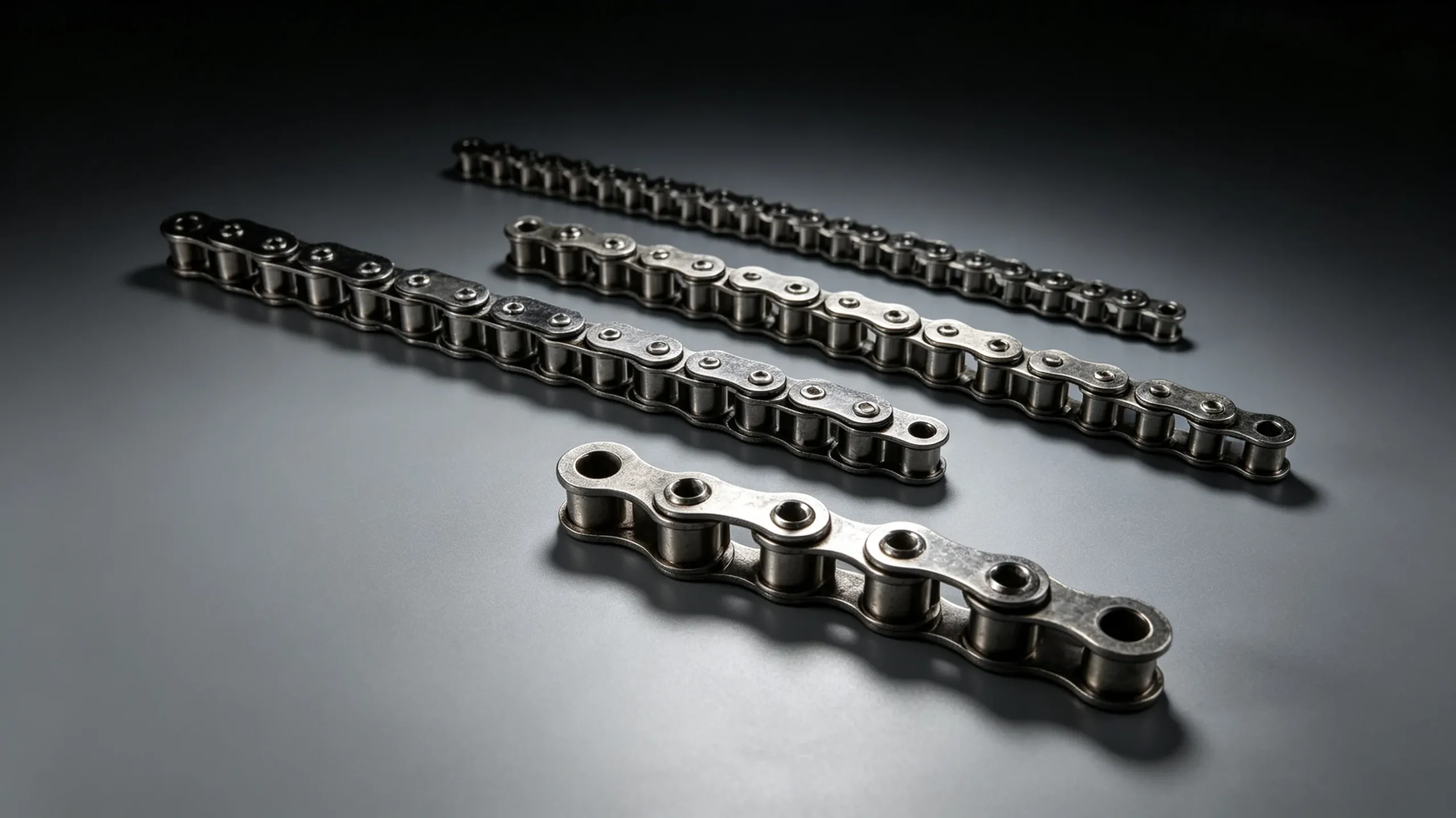
What Simplex Chain Is and Where It Is Used
Simplex chain — also written as single-strand or 1-strand chain — is the baseline configuration. One pair of inner link plates, one pair of outer link plates, one pin, one bushing, one roller per pitch: nothing more. Simplex chain is the most widely stocked, lowest-cost, and easiest-to-source configuration and is appropriate for the majority of industrial and agricultural roller chain applications.
In terms of load capacity, simplex chain carries the breaking load and working load as specified by ANSI B29.1 or ISO 606 for the given pitch size. ANSI No. 60 simplex, for example, has a minimum breaking load of 31.3 kN and a recommended working load (accounting for service factors) of approximately 8–10 kN for a smooth drive at moderate speed. Simplex chain is the correct starting point for any new drive calculation — only move to multi-strand if simplex cannot meet the required capacity at the available pitch.
Duplex Chain: Double the Strands, Not Quite Double the Capacity
Duplex chain (double-strand, or -2 suffix in ANSI notation, e.g. 60-2) adds a second strand in parallel, sharing the same pins. The outer dimensions increase in width; the pitch, roller diameter, and inner width per strand remain identical to simplex. The rated breaking load increases by approximately 1.75 to 1.8 times the simplex value — not 2.0 times — because load distribution across two strands in a real assembly is never perfectly equal. Manufacturing tolerances, minor misalignment, and chain elongation differences between strands cause one strand to carry slightly more load than the other at any given moment.
Duplex chain requires duplex sprockets — sprockets machined with two parallel tooth rows spaced to match the duplex chain inner and outer plate positions. These are not interchangeable with simplex sprockets. Always specify sprockets and chain together when moving to a duplex configuration.
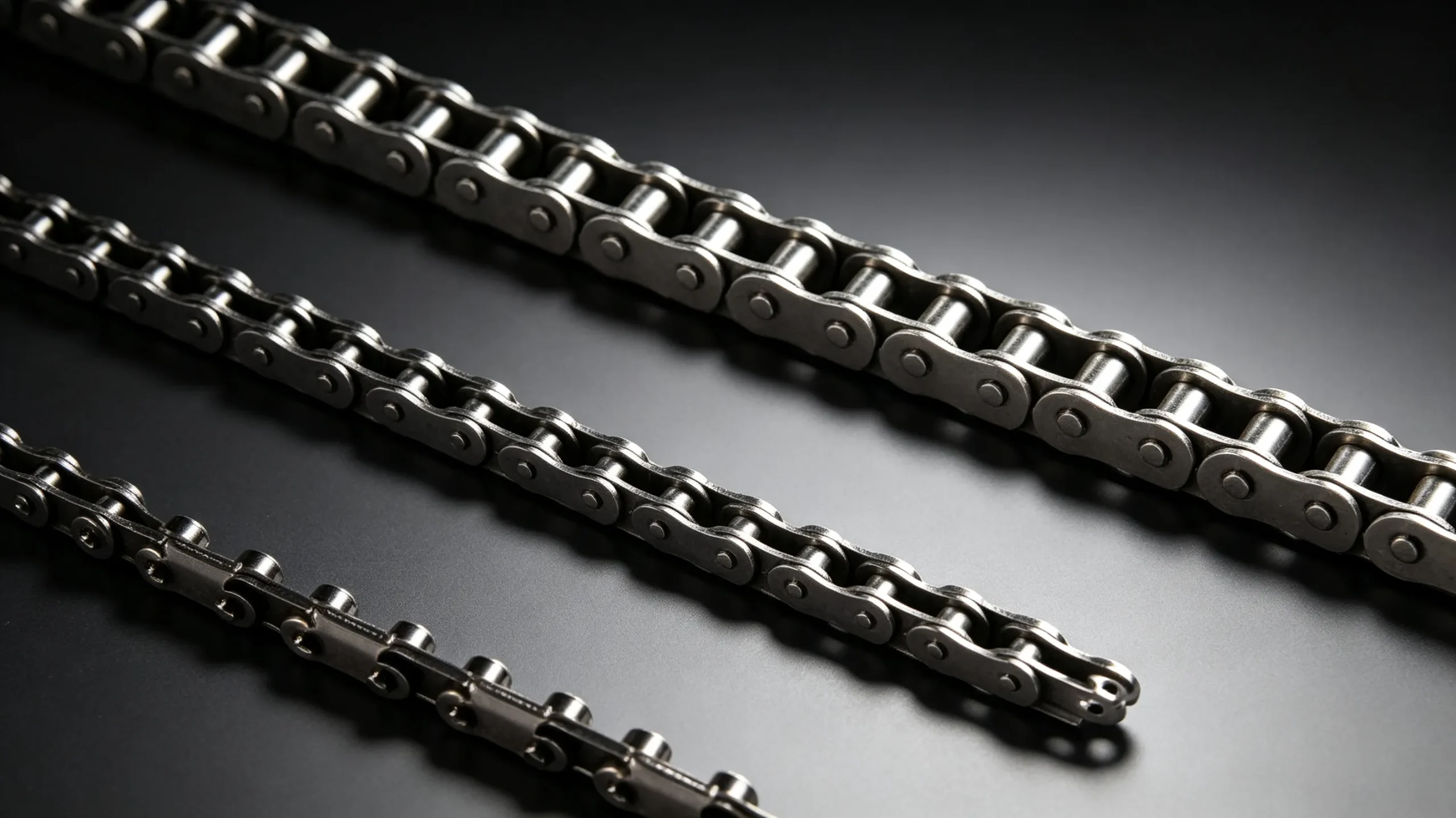
Triplex Chain: Maximum Load in a Compact Pitch
Triplex chain (triple-strand, or -3 suffix, e.g. 60-3) adds a third strand alongside the duplex configuration. Breaking load increases to approximately 2.5 times the simplex value, and working load scales proportionally after applying strand efficiency factors. Triplex chain is used where the combination of high power and space constraints prohibits both a larger pitch and a wider single chain. Common applications include heavy industrial conveyors, steel plant drives, and the main drives of large agricultural harvesting equipment where shaft-to-shaft distance is fixed and the available pitch range is limited.
Triplex chain is significantly heavier and more expensive than simplex. It requires precise alignment between drive and driven shafts, as any lateral offset places unequal loading on the three strands — the outer strands taking more load than the centre strand in a misaligned assembly. Alignment precision for triplex drives should be within 0.5 mm lateral offset and 0.3 degrees angular misalignment for reliable long-term operation.
Strand Count vs Pitch: How to Choose
| Scenario | Recommended Approach |
|---|---|
| Load exceeds simplex capacity at current pitch | Move to duplex before increasing pitch — smaller pitch runs quieter |
| Speed is high and chordal action is a concern | Reduce pitch and add strands rather than using large-pitch simplex |
| Centre distance is short and sprockets are small | Increase pitch rather than adding strands to maintain minimum tooth count |
| Shaft alignment is difficult to maintain precisely | Prefer simplex or duplex over triplex — fewer strands are more tolerant of minor misalignment |
| Drive must fit within a fixed width envelope | Use heavy-series simplex or duplex before resorting to triplex |
| OEM replacement with existing sprockets | Match existing strand count exactly — never upgrade strand count without replacing sprockets |
Load Capacity Comparison Across Strand Counts
| Chain Type | ANSI 60 Break Load (kN) | ANSI 80 Break Load (kN) | ANSI 100 Break Load (kN) |
|---|---|---|---|
| Simplex (1-strand) | 31.3 | 55.6 | 87.0 |
| Duplex (2-strand) | ~54.5 | ~96.5 | ~151.0 |
| Triplex (3-strand) | ~78.0 | ~138.0 | ~217.0 |
Note: duplex and triplex working loads assume a strand efficiency factor of 0.87 and 0.83 respectively, per standard drive design practice. These figures are minimum values based on ANSI B29.1 simplex breaking loads scaled by empirical multi-strand efficiency data.
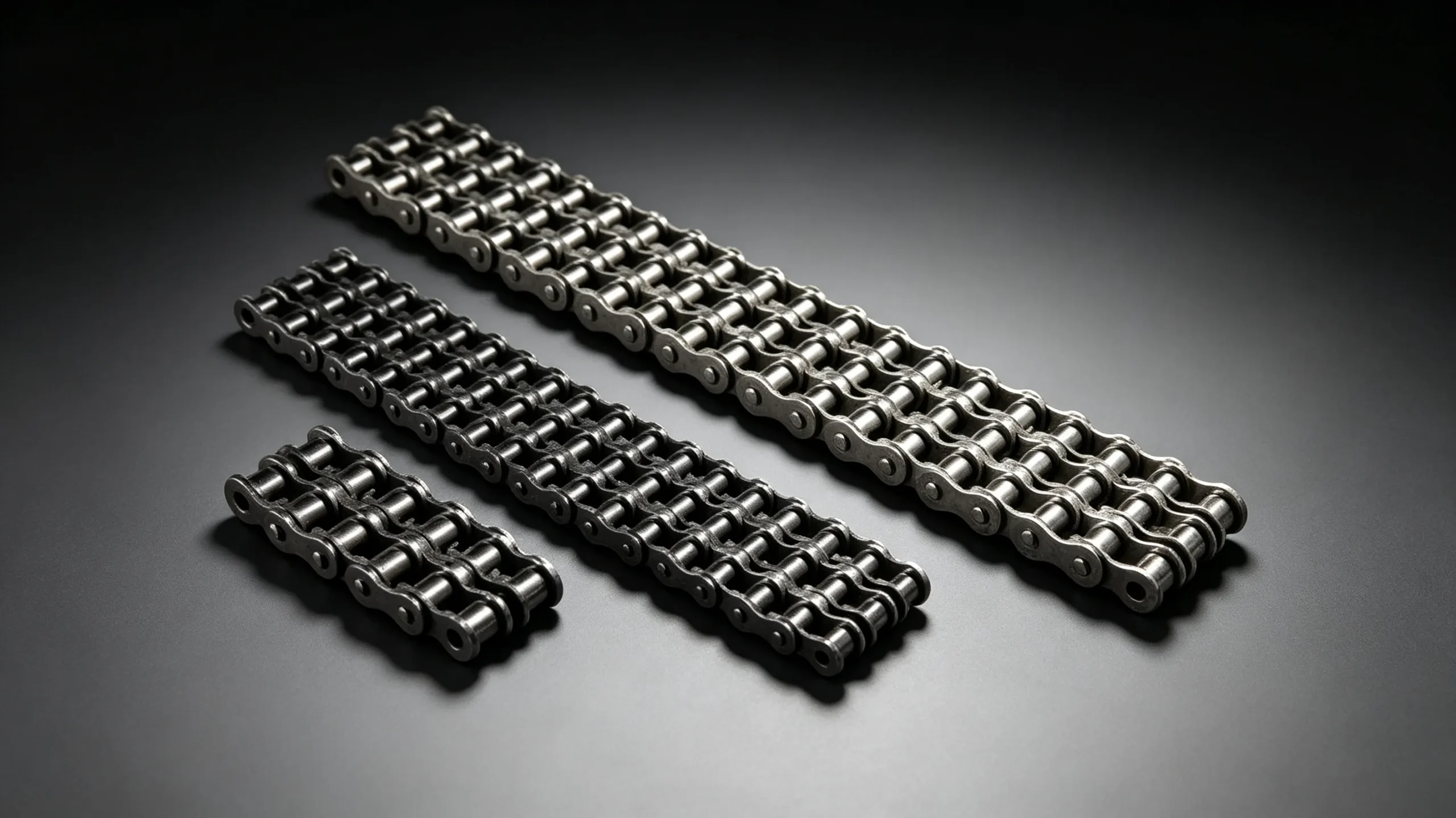
Connecting Links and Assembly for Multi-Strand Chain
Each strand in a duplex or triplex assembly requires its own connecting link (master link). These are designed with the correct pin spacing to span the full width of the multi-strand chain. Spring clip connecting links are adequate for low-speed, low-shock applications; cotter pin connecting links are required for heavy loads or shock-load drives. Never use a simplex connecting link in a duplex or triplex assembly — the pin length will be wrong and the link will not be retained correctly.
When cutting and joining multi-strand chain, ensure all strands are cut at the same link position to maintain equal length across strands. A difference of even one pitch between strands in the same loop will produce a permanent load imbalance that cannot be corrected by tensioning.
Cost Comparison: Is Duplex Cheaper Than Larger Pitch Simplex?
At equivalent power transmission capacity, duplex ANSI 60 chain is generally more economical than simplex ANSI 80 chain because the smaller-pitch drive runs at higher speed with smaller, less expensive sprockets. The chain itself costs more per metre, but the total drive package cost — chain plus sprockets plus installation — often favours the duplex option when speed is moderate to high. At very low speeds and very high torques, large-pitch simplex may become more economical because the sprocket tooth count can be lower without creating chordal action problems.
EverPower Roller Chains Australia stocks ANSI and ISO simplex, duplex, and triplex roller chain across the full pitch range. Our technical team can assist with strand count calculations and matched sprocket sourcing for new and replacement drives throughout New South Wales and nationally.
+61 2 9708 3322 | [email protected] | 27 Harley Crescent, Condell Park NSW 2201