Description
Rubber Top Roller Chain — 10B-G2F5
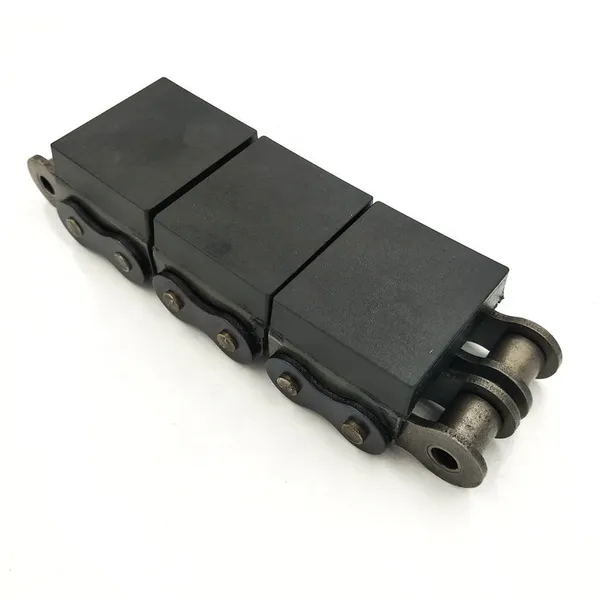
10B-G2F5 rubber top chain extends the G2 wide profile with lateral flange projections that contain products laterally and prevent rollback on inclined sections — the most comprehensive rubber top configuration in the 10B series for demanding product containment and inclined conveying requirements.
Product Overview
The G2F5 designation adds a dimensional layer to the G2 wide rubber profile: the ‘F5’ suffix identifies a 5mm-high flanged projection that rises from each lateral edge of the G2 rubber pad. These flanges extend above the product contact surface, creating a low-height retention wall on both sides of the chain that contains products laterally and prevents sideways displacement during conveyor transitions, curves (where a separate guide rail might otherwise be needed), and inclined sections where lateral product drift is a risk.
This flanged configuration is most valuable in two specific scenarios. The first is inclined conveying of products with curved bases — bottles, cans, round containers — where gravity-induced rolling would cause the product to migrate laterally and fall off the chain edge without a restraining surface. The F5 flanges contain the rolling without requiring side guides, which simplifies conveyor design and reduces installation hardware. The second is open conveyor sections without side rails, where the F5 flanges substitute for guide rails on the chain surface itself, keeping products aligned through the full conveyor run without external guide infrastructure.
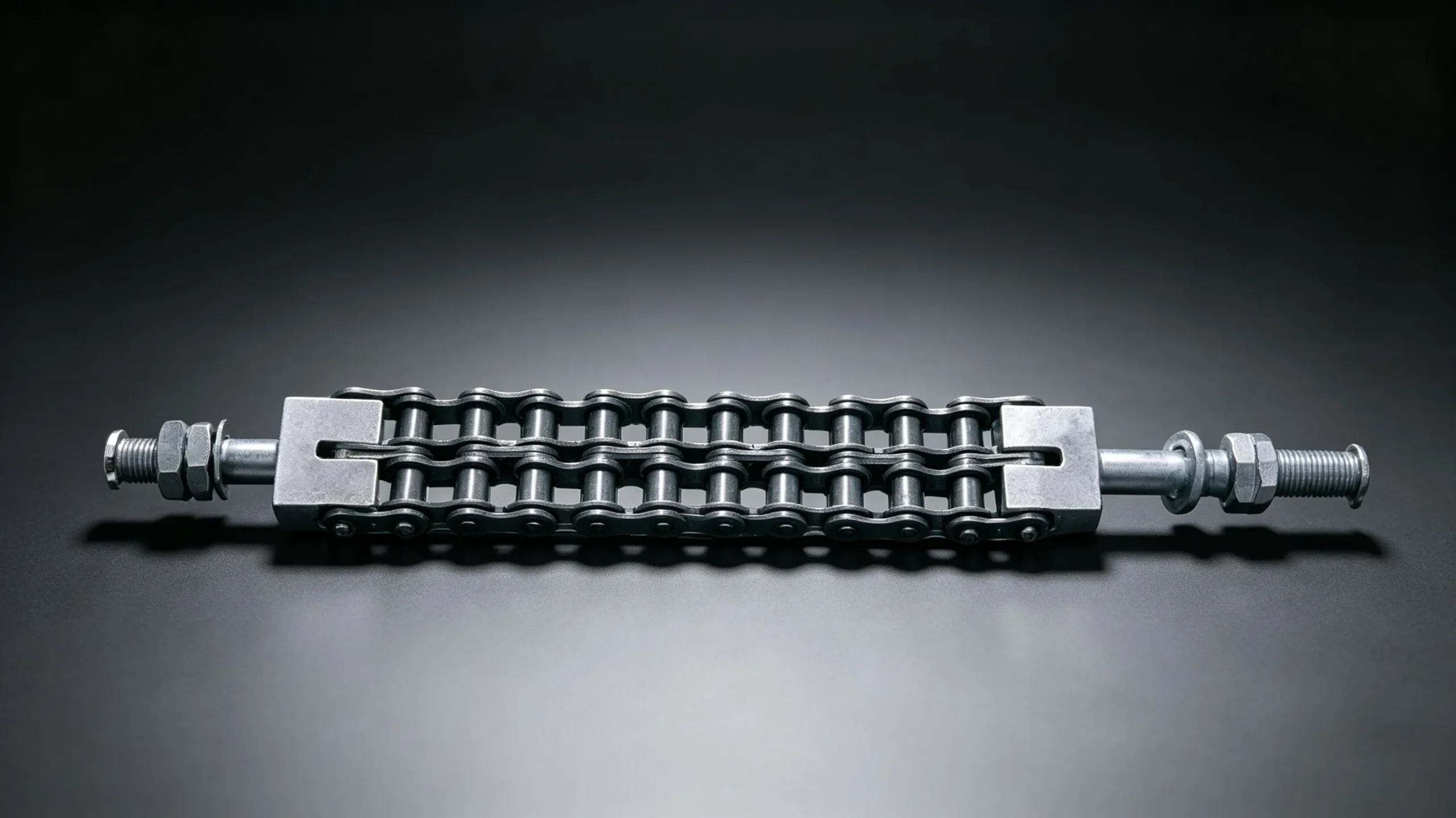
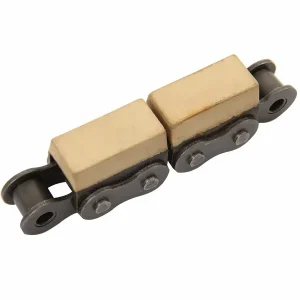
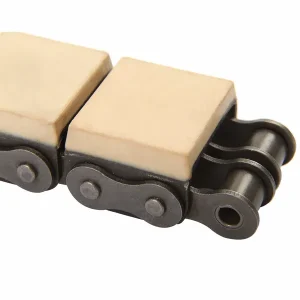
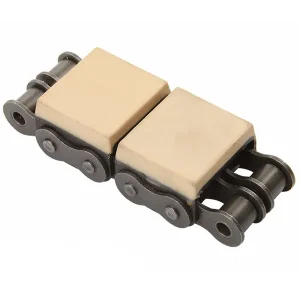
10B-G2F5 rubber top chain — wide rubber top with 5mm lateral flange extensions attachment type
Dimensions and Specifications — 10B-G2F5
| Chain No. |
Pitch P (mm) |
Roller Ø (mm) |
Inner Width (mm) |
Pin Ø (mm) |
Pin Length (mm) |
Plate Depth (mm) |
Rubber Width W (mm) |
Rubber Height H (mm) |
Flange H F (mm) |
Overall Width (mm) |
Q min (kN) |
Weight (kg/m) |
| 10B-G2F5 |
15.875 |
10.16 |
9.65 |
5.08 |
19.50 |
14.70 |
46.0 |
11.5 |
5.0 |
54.0 |
22.2 |
1.18 |
Rubber top chain conveying system — G2F5 attachment profile
Rubber Top Profile and Material
The G2F5 rubber profile is produced in a single-step vulcanisation using an extended extrusion die that simultaneously forms the flat top surface, the lateral flanges, and the bonding surface against the steel outer link plate. The flanges are an integral part of the rubber extrusion — they share the same material and Shore A hardness (80 Shore A standard) as the flat top surface. This integral construction means the flanges cannot separate independently from the main rubber body; any wear or delamination failure involves the full profile rather than just the flange. For food applications, G2F5 profiles are available in food-grade NBR compound with H1 lubricant and FDA/EU food contact certification. The F5 flange height of 5mm is suitable for most standard container and component containment requirements — custom flange heights (F3, F8, F10) are available on request for applications requiring different containment heights.
Key Performance Benefits
🤚
Non-Slip Product Control
The vulcanised rubber surface maintains positive product contact through acceleration, deceleration, and inclined conveying — applications where smooth-surface chains allow products to slip and misalign.
🔇
Vibration and Noise Damping
The rubber profile absorbs micro-impacts at sprocket engagement and at product loading points, measurably reducing conveyor noise in production environments where operator comfort and noise regulations apply.
🛡️
Surface Protection for Delicate Products
Rubber’s natural cushioning prevents surface marking on bottles, cans, glass panels, electronics, and finished consumer goods that would be scratched or dented by direct contact with bare steel chain surfaces.
⚙️
Interchangeable with Standard Chain
The base chain dimensions match the standard ISO B or ANSI A series specification for the same pitch. Rubber top chains run on standard matched sprockets without modification — no special tooth form or hardware change required.
Applications
🍾
Inclined Bottle and Can Conveying
Beverage containers on inclined conveyors are contained laterally by the F5 flanges without requiring separate side guide rails. This eliminates the container-to-guide rail contact that causes label damage and container surface scratching on high-speed inclined conveyor sections between filling and packaging floors.
🍊
Produce and Round Item Sorting
Round fruits, vegetables, and containers of varying diameter are retained on the G2F5 surface through sorting and grading equipment. The F5 flanges prevent rollout at transfer points where open conveyor edges would otherwise require closely spaced side guides that contact and bruise produce.
🔩
Loose Component Containment
Small machined components, fasteners, and hardware parts are conveyed without spillage on G2F5 chains through automated counting and packaging systems. The flanges function as product containment walls that eliminate the need for a separate chain-width enclosure trough.
🏭
Multi-Lane Conveyor Merging
In multi-lane to single-lane merging conveyors, G2F5 chains on the merge section prevent product from sliding between lanes by providing individual product lanes defined by the flange geometry.
Matching Components We Also Supply
◆
Matched Sprockets for ISO 10B (B-series) Pitch
Standard ISO 10B (B-series) series sprockets in the pitch matching 10B-G2F5. Full range from 9 to 90 teeth in simplex and duplex bore. No special tooth form required for rubber top chains.
◆
Rubber Top Connecting Links
Connecting links with the same rubber top profile as the main chain, maintaining a continuous and smooth conveying surface at the join point — critical for delicate product handling applications.
◆
Replacement Rubber Top Outer Link Sets
Individual outer link plate assemblies with pre-vulcanised rubber profiles for field repair of damaged rubber sections without full chain replacement.
◆
UHMWPE Chain Guide Profiles
Low-friction polyethylene guide rails in standard widths for rubber top chain conveyor systems. Smooth guide surface reduces lateral wear on the rubber profile edges on curved or side-loaded conveyor runs.
Customer Reviews
★★★★★
“We use 10B-G2F5 on our inclined conveyor between the pasteurisation tunnel and the labelling machine — a 15° incline that previously required stainless steel side guides that were scratching our glass labels. The F5 flanges contain the bottles without any lateral contact, zero scratching since the installation 11 months ago. We are now planning to retrofit G2F5 to two more conveyor sections.”
A
Andrea Russo
Plant Manager — Naples Beverage Bottling Plant
★★★★★
“We specified G2F5 for a produce sorting conveyor where round citrus fruit was rolling off the standard G2 surface at transfer points. The F5 flanges solved the problem completely. The food-grade rubber documentation was complete and matched our customer’s audit requirements. Will specify G2F5 as standard for our next produce conveyor project.”
Y
Yuki Tanaka
Conveyor Systems Engineer — Osaka Packaging Equipment
★★★★★
“We build single-lane merging conveyors for distribution centres. 10B-G2F5 on the merge section eliminated the lateral guide structure we previously needed and reduced our bill of materials per unit. The chain quality is consistent and the rubber flange geometry is uniform across batches — important for our standardised machine design.”
T
Thomas Kowalczyk
Technical Director — Warsaw Logistics Equipment Mfr.
Frequently Asked Questions
What is the F5 flange height and what does ‘F5’ mean?+
‘F5’ denotes a 5mm-high rubber flange projection rising from each lateral edge of the G2 rubber pad. The F designation indicates a flanged profile; the number indicates the flange height in millimetres. F5 is the most common standard flange height — it provides effective containment for containers up to approximately 25mm diameter at the base. For larger containers or deeper containment requirements, F8 (8mm) and F10 (10mm) flange heights are available on request. For applications where even F5 flanges are unnecessary, the standard G2 (no flange) is the appropriate choice.
How do F5 flanges affect sprocket engagement?+
The F5 flanges are on the outer link plates, which do not engage the sprocket. The sprocket tooth engages the inner link roller at the underside of the chain — the flanges are on the top side, pointing away from the sprocket. The flanges pass through the sprocket wrap without any contact issue, provided the sprocket guard and conveyor frame provide adequate clearance above the flange height. Check that drive and take-up sprocket housings are set with at least 15mm clearance above the top of the flange to allow passage without contact.
Can G2F5 chains convey products with base widths narrower than the flange spacing?+
The usable product width between flanges is the G2 rubber surface width minus the flange base widths — approximately 36–40mm for the 10B-G2F5. Products narrower than this will seat between the flanges and may tip if the product height-to-width ratio is high. For very narrow products, the G1 profile without flanges provides better stability than a G2F5 where the product rattles between the containment walls.
What is the maximum incline angle for 10B-G2F5?+
The F5 flanges prevent lateral rollout but do not increase the chain’s friction with the product base — the incline limit for preventing product slide-back remains the same as for G2 without flanges: approximately 20° for stable products on 80 Shore A rubber. For inclines above 20°, cleated rubber variants with raised transverse cleats are more appropriate than flanged profiles, as cleats provide positive anti-rollback stops rather than lateral containment.
Are custom flange heights available?+
Yes — flange heights from 3mm to 20mm are available on the 10B-G2 base profile. Custom flange dimensions require a custom extrusion die, which typically involves a minimum order of 50 metres and a lead time of 20–25 working days. For standard F5 height, no minimum order applies for stock sizes. Specify the required flange height (e.g. F8, F10) when enquiring about non-standard configurations.
Get in Touch
Ready to Place Your Order?
Send us your chain specification and annual volume. Standard enquiries receive a quotation within 2 business days.
See also: how specialist chain profiles outperform standard flat-plate designs.