Description
Rubber Top Roller Chain — 10B-G2
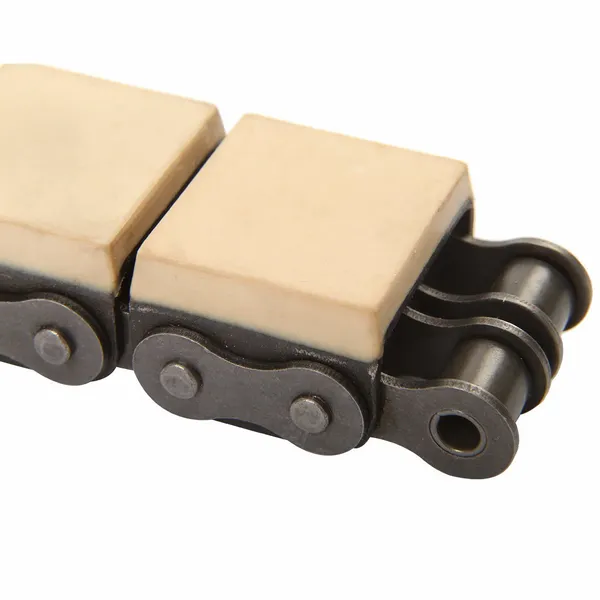
10B-G2 rubber top chain widens the rubber contact zone across the full ISO 10B outer link plate — providing a broad, stable product support surface for wide-bottomed containers, trays, and flat-base packaging on European-standard 15.875mm pitch conveyor systems.
Product Overview
The 10B-G2 chain uses the same ISO 10B-1 roller chain base as the 10B-G1, with the distinction that the G2 rubber profile spans the full width of the outer link plate and extends slightly beyond it in both directions. This wide profile configuration provides roughly 40% more rubber contact surface per link than the G1 narrow profile at the same pitch, delivering greater lateral stability for wide-bottomed products and reducing the unit pressure on delicate product surfaces by distributing the contact load across a larger area.
In European food processing and packaging installations — where ISO B-series chain is standard — the 10B-G2 is specified whenever the product geometry is too wide for the G1 profile to provide stable conveying. This includes rectangular food trays, clamshell containers, multi-pack cartons, and industrial component carriers that would rock or tip on the narrower G1 contact zone. The wider rubber footprint also improves performance on inclined conveyor sections where the product’s tendency to slide down the incline is counteracted by the larger friction area the G2 surface provides.
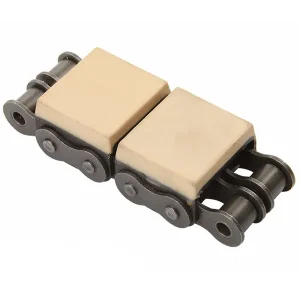
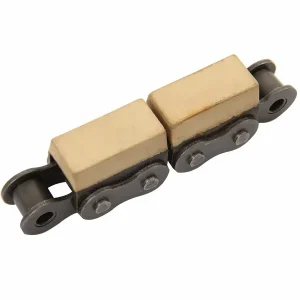
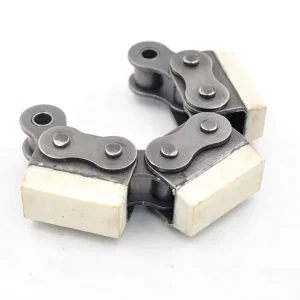
10B-G2 rubber top chain — wide rubber pad spanning full outer plate attachment type
Dimensions and Specifications — 10B-G2
| Chain No. |
Pitch P (mm) |
Roller Ø (mm) |
Inner Width (mm) |
Pin Ø (mm) |
Pin Length (mm) |
Plate Depth (mm) |
Rubber Width W (mm) |
Rubber Height H (mm) |
Overall Width (mm) |
Q min (kN) |
Weight (kg/m) |
| 10B-G2 |
15.875 |
10.16 |
9.65 |
5.08 |
19.50 |
14.70 |
46.0 |
11.5 |
54.0 |
22.2 |
1.12 |
Rubber top chain conveying system — G2 attachment profile
Rubber Top Profile and Material
10B-G2 chains use 80 Shore A NBR/SBR rubber compound in standard specification, with the same vulcanisation process as the G1 series. The wider extrusion die used in G2 production creates a broader rubber-to-steel bonding interface across the full outer link plate face, providing proportionally greater delamination resistance than the narrower G1 profile when lateral scrubbing forces — from product diverting or accumulation pressure — act on the rubber surface. The wide profile’s greater rubber mass also provides superior vibration damping compared to G1, measurably reducing conveyor noise at the product contact points in high-throughput facilities where accumulated conveyor noise across multiple parallel lines can exceed noise regulation thresholds. Food-grade G2 specification with H1 lubricant and food-contact-approved rubber compound is available as a standard option.
Key Performance Benefits
🤚
Non-Slip Product Control
The vulcanised rubber surface maintains positive product contact through acceleration, deceleration, and inclined conveying — applications where smooth-surface chains allow products to slip and misalign.
🔇
Vibration and Noise Damping
The rubber profile absorbs micro-impacts at sprocket engagement and at product loading points, measurably reducing conveyor noise in production environments where operator comfort and noise regulations apply.
🛡️
Surface Protection for Delicate Products
Rubber’s natural cushioning prevents surface marking on bottles, cans, glass panels, electronics, and finished consumer goods that would be scratched or dented by direct contact with bare steel chain surfaces.
⚙️
Interchangeable with Standard Chain
The base chain dimensions match the standard ISO B or ANSI A series specification for the same pitch. Rubber top chains run on standard matched sprockets without modification — no special tooth form or hardware change required.
Applications
🥩
Meat and Poultry Processing
Trays and vacuum-packed portions of meat and poultry products require wide, stable conveyor support through cutting, trimming, and packing stages. 10B-G2 food-grade chains provide the broad contact needed for irregular-shaped products while the rubber surface prevents tray sliding at the high conveyor speeds typical of poultry processing plants.
🫙
Wide-Mouth Jar and Container Conveying
Large-diameter jars, food containers, and catering packs have wide bases that benefit from the G2’s broader support footprint. The rubber surface prevents glass and plastic container sliding during accumulation and buffer sections where conveyor back-pressure would cause containers to slip on bare-steel chain.
📬
Postal and Parcel Sorting
Flatbed sorting conveyors in postal and distribution facilities convey parcels of varying weight and base dimensions across rubber top chain surfaces. The G2 profile’s wider contact reduces pressure points on soft packaging and prevents parcel edge-loading that causes bag handle tearing on narrow-profile chain.
🏭
Industrial Component Assembly
Machined components, sub-assemblies, and tooling carriers travel between production cells on 10B-G2 chains in manufacturing plants. The wide rubber surface provides stable support for components with irregular base profiles and prevents surface scratching on precision-machined faces.
Matching Components We Also Supply
◆
Matched Sprockets for ISO 10B (B-series) Pitch
Standard ISO 10B (B-series) series sprockets in the pitch matching 10B-G2. Full range from 9 to 90 teeth in simplex and duplex bore. No special tooth form required for rubber top chains.
◆
Rubber Top Connecting Links
Connecting links with the same rubber top profile as the main chain, maintaining a continuous and smooth conveying surface at the join point — critical for delicate product handling applications.
◆
Replacement Rubber Top Outer Link Sets
Individual outer link plate assemblies with pre-vulcanised rubber profiles for field repair of damaged rubber sections without full chain replacement.
◆
UHMWPE Chain Guide Profiles
Low-friction polyethylene guide rails in standard widths for rubber top chain conveyor systems. Smooth guide surface reduces lateral wear on the rubber profile edges on curved or side-loaded conveyor runs.
Customer Reviews
★★★★★
“We specified 10B-G2 food-grade for our tray conveyor through the portioning line. The wide rubber surface keeps the trays stable even at 1.2 m/s — no tipping at the transfer between conveyor sections that we experienced with the G1 profile. The H1 lubrication certificate and food contact compliance document arrived with the chains without needing to request them separately.”
H
Henrik Larsen
Equipment Engineer — Danish Poultry Processing Plant
★★★★★
“We build packing line conveyors for the food industry and have been specifying 10B-G2 for tray handling for four years. This supplier is the most consistent on rubber hardness uniformity across batches — important for our machine calibration process that sets conveyor speed based on known friction coefficients.”
C
Camille Dupont
Technical Manager — Lyon Packaging Machinery SAS
★★★★★
“We switched our parcel conveyor sections from bare-steel chain to 10B-G2 after damage complaints from customers receiving soft parcels with chain contact marks. The wide rubber surface eliminated the problem. Conveyor noise also dropped noticeably — the rubber damping effect is real.”
M
Marcus Webb
Operations Manager — Bristol Distribution Centre
Frequently Asked Questions
What is the width difference between 10B-G1 and 10B-G2?+
On the same 10B base chain: G1 rubber width is approximately 28mm; G2 rubber width is approximately 46mm. The G2 overall chain width (across rubber profile) is approximately 54mm versus 36mm for G1. This 18mm difference in rubber width provides roughly 65% more rubber contact surface per link, which is significant for product stability on wide-base containers and trays.
Does the wider G2 profile affect conveyor guide rail spacing?+
Yes — conveyor side guides must be spaced to clear the G2 profile’s wider rubber surface. Guides set for G1 chains would contact the G2 rubber profile edges, causing accelerated rubber wear and potentially pushing the chain laterally. When retrofitting G1 to G2 in an existing conveyor, check and adjust side guide clearance before running. The wider G2 profile also requires that any inner side guides are set with adequate clearance from the chain centreline.
Can 10B-G2 be used in frozen food conveying applications?+
Standard NBR rubber compound loses flexibility below −20°C. For frozen food conveying in blast freezer temperatures (−30°C to −40°C), specify the low-temperature rubber compound rated to −40°C. The base chain also requires consideration for cold environments — standard mineral oil lubricant becomes highly viscous below −15°C, potentially starving the pin-bushing interface. Low-temperature synthetic lubricant rated to −40°C should be specified simultaneously with the low-temperature rubber compound.
Is 10B-G2 compatible with 10B-G1 connecting links?+
No — G2 chains require G2-profile connecting links to maintain the wide rubber surface at the join point. Using a G1 connecting link in a G2 chain creates a narrow gap in the conveying surface at the join, which can cause product tipping or snagging at high conveyor speeds. Always order the same profile type for connecting links as the main chain.
What is the maximum product weight per contact point for 10B-G2?+
The rubber profile compression limit for 80 Shore A NBR is approximately 0.2 MPa contact pressure before permanent deformation begins. For a G2 profile with 46mm rubber width and one link pitch (15.875mm) of contact length, the maximum product load per link contact is approximately 14–18 kg, depending on contact geometry. For heavier products, use a longer chain section in contact with the product (e.g., by slowing the conveyor) or specify the G2 profile in a harder rubber compound (90 Shore A) for higher load resistance.
Get in Touch
Ready to Place Your Order?
Send us your chain specification and annual volume. Standard enquiries receive a quotation within 2 business days.
See also: the difference between ANSI and ISO roller chain.