Description
Rubber Top Roller Chain — 10B-G1
10B-G1 rubber top chain provides non-slip product conveying on the ISO 10B pitch base — the European standard counterpart to the ANSI 10A-G1, designed for machinery originally built to BS/DIN/ISO chain standards across the UK, Europe, and Australasia.
Product Overview
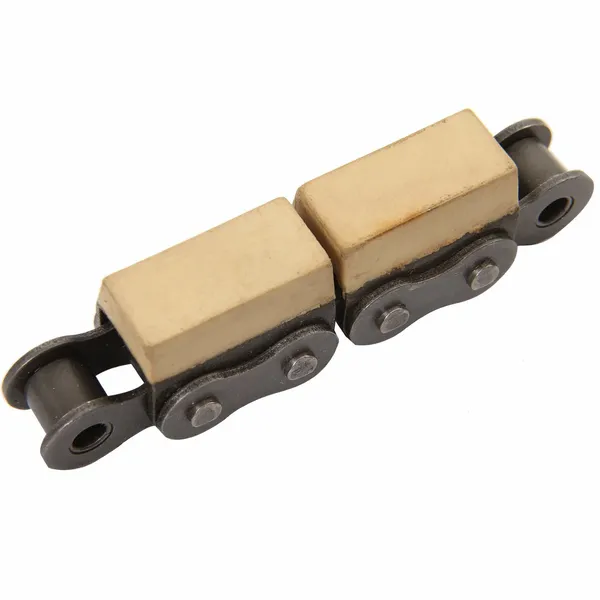
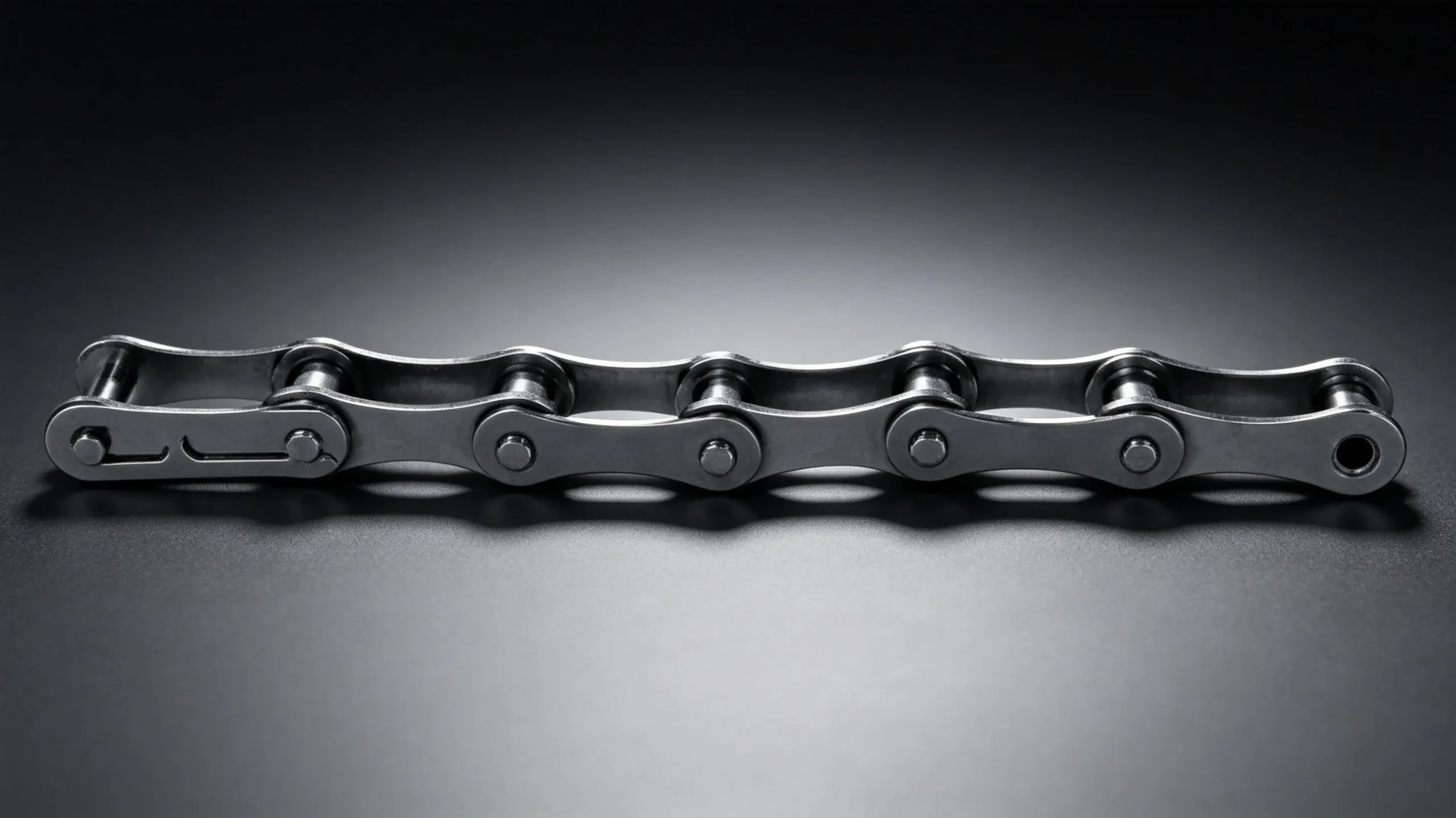
The 10B-G1 chain combines an ISO 606 / BS 228 10B-1 roller chain base (15.875mm pitch) with a G1 rubber top profile bonded to each outer link plate. While the pitch value is identical to the ANSI #50 chain used in 10A-G1, the ISO 10B base has different roller diameter (10.16mm vs ANSI’s same dimension, but inner width and pin dimensions differ slightly by standard). The practical significance is that 10B-G1 chains are the correct specification for machinery designed to BS/DIN/ISO standards — using ANSI-base rubber top chains on ISO-specified sprockets creates engagement mismatches at the roller-tooth interface that generate noise, vibration, and accelerated wear.
Within the European food and beverage equipment market, 10B-G1 is the standard rubber top chain specification for bottling line conveyors, dairy product handling, and confectionery production lines. The ISO B-series base is standard in all these European OEM equipment designs, and the G1 rubber profile’s narrow contact width suits the bottle and container sizes common in European beverage and food packaging formats. The chain is available in food-grade rubber compound with H1-rated lubricant for direct food contact zone applications.
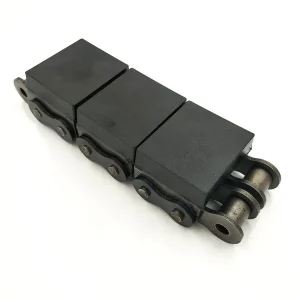
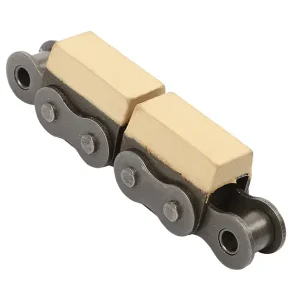
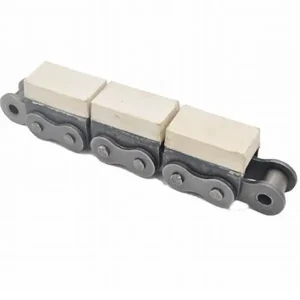
10B-G1 rubber top chain — single narrow rubber pad, ISO B-series base attachment type
Dimensions and Specifications — 10B-G1
| Chain No. |
Pitch P (mm) |
Roller Ø (mm) |
Inner Width (mm) |
Pin Ø (mm) |
Pin Length (mm) |
Plate Depth (mm) |
Rubber Width W (mm) |
Rubber Height H (mm) |
Overall Width (mm) |
Q min (kN) |
Weight (kg/m) |
| 10B-G1 |
15.875 |
10.16 |
9.65 |
5.08 |
19.50 |
14.70 |
28.0 |
11.5 |
36.0 |
22.2 |
0.98 |
Rubber top chain conveying system — G1 attachment profile
Rubber Top Profile and Material
10B-G1 chains use the same vulcanised NBR/SBR rubber compound as the 08B and 10A rubber top series — 80 Shore A hardness in standard specification. The ISO 10B base’s slightly wider inner plate (relative to ANSI #50) provides a marginally larger outer plate width, giving the G1 rubber pad a somewhat wider bonding footprint per link. This increased bonding area contributes to longer rubber delamination life in high-cycle bottling and filling line applications where the chain makes hundreds of thousands of sprocket engagements per production shift. European food equipment manufacturers typically specify the food-grade rubber variant as standard — H1-rated lubricant at the pin-bushing interface and food-contact-approved rubber compound on the top surface. Full documentation for BRC, IFS, and FSSC 22000 audit purposes is available.
Key Performance Benefits
🤚
Non-Slip Product Control
The vulcanised rubber surface maintains positive product contact through acceleration, deceleration, and inclined conveying — applications where smooth-surface chains allow products to slip and misalign.
🔇
Vibration and Noise Damping
The rubber profile absorbs micro-impacts at sprocket engagement and at product loading points, measurably reducing conveyor noise in production environments where operator comfort and noise regulations apply.
🛡️
Surface Protection for Delicate Products
Rubber’s natural cushioning prevents surface marking on bottles, cans, glass panels, electronics, and finished consumer goods that would be scratched or dented by direct contact with bare steel chain surfaces.
⚙️
Interchangeable with Standard Chain
The base chain dimensions match the standard ISO B or ANSI A series specification for the same pitch. Rubber top chains run on standard matched sprockets without modification — no special tooth form or hardware change required.
Applications
🍺
Beverage Bottling and Can Lines
European bottling lines handling glass bottles, PET containers, and aluminium cans specify 10B-G1 as the standard rubber top chain for conveyors between filling, capping, labelling, and packaging stations. The chain’s positive product grip prevents container rotation and lateral drift at high line speeds.
🧀
Dairy and Chilled Product Handling
Cheese blocks, yoghurt pots, and chilled ready-meal trays require gentle conveying at temperatures near 4°C — conditions where rubber hardness and flexibility must remain consistent. 10B-G1 with low-temperature NBR compound maintains its grip performance through refrigerated conveyor sections.
🍫
Confectionery Production
Chocolate bars, praline boxes, and confectionery assortments travel through coating, cooling, and wrapping machines on 10B-G1 chains. The gentle rubber contact prevents box corner deformation and wrapper wrinkling that bare-steel chain contact causes.
💊
Pharmaceutical Blister Pack Conveyors
European pharmaceutical packaging lines convey sealed blister packs on 10B-G1 chains through inspection, printing, and cartoning stations. FDA and EU Annex 1 compliance for food-grade rubber and lubricant is available on request.
Matching Components We Also Supply
◆
Matched Sprockets for ISO 10B (B-series) Pitch
Standard ISO 10B (B-series) series sprockets in the pitch matching 10B-G1. Full range from 9 to 90 teeth in simplex and duplex bore. No special tooth form required for rubber top chains.
◆
Rubber Top Connecting Links
Connecting links with the same rubber top profile as the main chain, maintaining a continuous and smooth conveying surface at the join point — critical for delicate product handling applications.
◆
Replacement Rubber Top Outer Link Sets
Individual outer link plate assemblies with pre-vulcanised rubber profiles for field repair of damaged rubber sections without full chain replacement.
◆
UHMWPE Chain Guide Profiles
Low-friction polyethylene guide rails in standard widths for rubber top chain conveyor systems. Smooth guide surface reduces lateral wear on the rubber profile edges on curved or side-loaded conveyor runs.
Customer Reviews
★★★★★
“We build dairy product conveyors for the Nordic market and have been using 10B-G1 from this supplier for three years. The food-grade rubber specification and H1 lubricant documentation are provided automatically with every order — no additional chase required. Chain quality is consistent and the rubber shows no hardening in our 4°C refrigerated conveyor sections.”
B
Björn Carlsson
Line Engineer — Swedish Dairy Equipment Co.
★★★★★
“We run three bottling lines with 10B-G1 on the conveyor sections between filling and labelling. The chains are now on their second year without rubber delamination issues. Previous supplier had peeling problems at 8 months — the vulcanisation quality here is clearly better.”
M
Maria Santos
Technical Buyer — Lisbon Beverages SA
★★★★★
“Specified 10B-G1 for our praline box conveyor at the wrapping machine infeed. The narrow G1 profile sits neatly under the box base without extending to the sides where it would contact the box flaps. No box damage or wrapping issues since the installation 14 months ago.”
J
James Reynolds
Maintenance Manager — Birmingham Confectionery Plant
Frequently Asked Questions
What is the difference between 10B-G1 and 10A-G1?+
Both chains have 15.875mm pitch and similar rubber top profiles, but they use different base chain standards. 10A-G1 uses an ANSI A-series (#50) base; 10B-G1 uses an ISO B-series (10B-1) base. The differences are in inner plate width and pin length — 10B-1 has a wider inner plate (9.65mm vs 9.40mm for ANSI #50) and a longer pin. These differences mean the two chains require different sprockets and cannot be mixed. Use 10A-G1 for ANSI-standard equipment; use 10B-G1 for ISO/BS-standard equipment.
Does food-grade 10B-G1 require special handling or storage?+
Food-grade rubber top chains should be stored in a cool, dry location away from UV light and ozone sources (electric motors and transformers emit ozone). Packaging should remain intact until installation. The H1 lubricant pre-applied at the pin-bushing interface does not require replenishment before installation. During operation, apply additional H1 lubricant at the pin-bushing interface per the maintenance schedule — never on the rubber top surface.
Can 10B-G1 be used in high-pressure washdown areas?+
Yes — the vulcanised rubber profile itself is unaffected by washdown water pressure. However, high-pressure washdown directed at the chain removes the lubricant from the pin-bushing interface and should be followed by a lubrication pass. Washdown pressures above 80 bar directed at the pin-bushing area from close range can also force water into the interface, which accelerates corrosion if the chain is not re-lubricated promptly after washdown.
What is the minimum order quantity for food-grade 10B-G1?+
There is no minimum order quantity for standard 10B-G1 in food-grade specification from stock. For custom lengths or non-standard rubber compound variants, a minimum of 5 metres applies. Food-grade compliance documentation is provided with every order regardless of quantity.
Can I use 10B-G1 on a conveyor with curved sections?+
10B-G1 is a standard roller chain with rubber top — it articulates in the vertical plane only, like all standard roller chains. It cannot follow horizontal curves. For curved conveyor sections, a side-bow chain (SB series) or a belt conveyor system is required. 10B-G1 is suitable for straight, inclined, and declined conveyor sections with standard sprocket-driven drive and take-up ends.
Get in Touch
Ready to Place Your Order?
Send us your chain specification and annual volume. Standard enquiries receive a quotation within 2 business days.
See also: the difference between BS and ANSI roller chain standards explained.