Description
Rubber Top Chain — 16A-G1
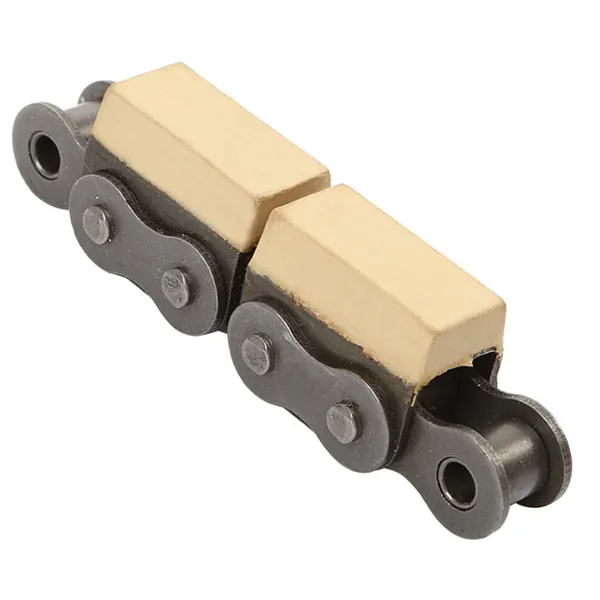
16A-G1 rubber top chain steps up to the ANSI #80 pitch base, bringing rubber-top conveying capability to applications where the #60 pitch chain approaches its load limit — delivering non-marking, vibration-damped conveying at significantly higher tensile ratings.
Product Overview
The move from 12A/12B pitch to 16A (#80) pitch increases the minimum tensile rating from approximately 29–31 kN to 55.6 kN — a near doubling of the structural chain capacity within the rubber top chain family. This capacity increase is the primary reason for specifying 16A-G1 over 12A-G1: when conveyor chain tension calculations show a 12A pitch chain operating above 50% of its rated load, the 16A base provides the necessary margin while retaining the G1 rubber top’s non-marking and noise-damping properties.
In practice, applications that drive the move to 16A pitch include long-run horizontal conveyors where accumulated chain weight and product weight generate high chain tension in the drive section; inclined conveyors handling heavy panel or glass formats where the gravity component of the load is significant; and heavily loaded sorting and grading conveyors in wood, glass, and stone processing where the combined product and fixture weight exceeds the safe working range of 12A chains.
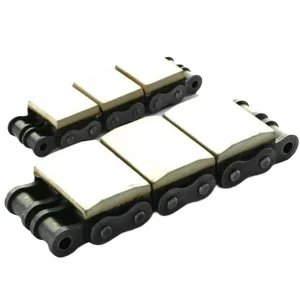
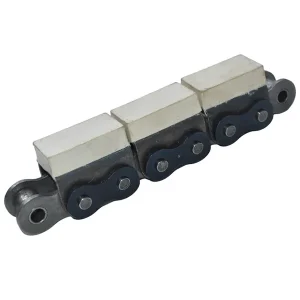
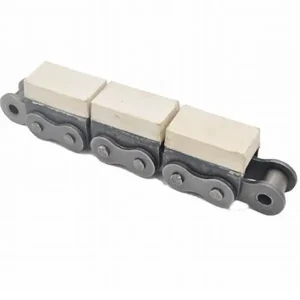
16A-G1 — G1 narrow rubber top on ANSI #80 (A-series) base
Specification — 16A-G1
| Chain No. |
Pitch P (mm) |
Roller Ø (mm) |
Inner Width (mm) |
Pin Ø (mm) |
Pin Length (mm) |
Plate Depth (mm) |
Rubber W (mm) |
Rubber H (mm) |
Overall W (mm) |
Q min (kN) |
Weight (kg/m) |
| 16A-G1 |
25.400 |
15.88 |
15.75 |
7.92 |
30.60 |
24.00 |
40.0 |
14.0 |
50.0 |
55.6 |
2.49 |
Rubber top chain in production conveyor environment
Rubber Profile and Material Properties
16A-G1 rubber top chains use 75–80 Shore A NBR compound as standard — matching the compound used in the smaller-pitch rubber top series for consistent surface properties across the chain range. The larger 16A base chain outer link plate provides a proportionally larger bonding area for the G1 rubber profile, contributing to improved delamination resistance at the higher loads this pitch range encounters. For stone slab and heavy panel applications where the chain operates in abrasive environments, a harder 90 Shore A compound with abrasion-resistant filler is available on request. At the 16A pitch, self-lubricating (SLR) variants are also available, important for the long conveyor runs common in large-format stone and panel processing plants where manual lubrication of inaccessible chain sections is impractical.
Core Performance Advantages
🤚
Positive Non-Slip Grip
The vulcanised rubber surface grips product bases firmly at conveyor accelerations and on inclined sections where smooth-surface chains allow slippage — eliminating the positioning errors and product damage that result from uncontrolled sliding.
🔇
Measurable Noise Reduction
Rubber’s damping properties absorb the micro-impacts at each sprocket link engagement, reducing conveyor operating noise at the product contact surface. In facilities with noise regulations, this can be a compliance factor.
🛡️
Surface-Safe Product Handling
Direct contact between bare steel chain and finished product surfaces causes scratching, denting, and marking. The rubber layer completely eliminates steel-to-product contact, maintaining surface integrity through the full conveyor run.
⚙️
Standard Sprocket Compatibility
The base chain dimensions are fully standard — the same sprockets used for the equivalent standard roller chain work without modification for the rubber top version. No hardware changes required for retrofitting.
Application Areas
Industrial conveyor application for 16A-G1
🪵
Heavy Panel and Sheet Material
Large-format engineered wood products — LVL, cross-laminated timber elements, structural composite panels — are heavy enough to require the 16A base chain’s higher load rating for conveying through sawing, sanding, and edge-profiling equipment.
🪟
Large Architectural Glass
Structural glass panels for facades and balustrades in 2,000mm × 4,000mm+ formats at 10–19mm thickness generate significant conveying loads requiring the 16A base chain capacity.
🏔️
Stone and Natural Marble Slabs
Granite, marble, and engineered stone slabs at 30mm thickness in 2,000mm × 3,000mm formats impose loads well above 12A capacity. 16A-G1 rubber top chains convey these materials through sawing, polishing, and edge-profiling on stone processing lines.
🏗️
Construction Material Conveyors
Precast concrete element conveyors, structural steel component handling, and heavy building material conveying applications where the 12A pitch’s load rating is insufficient.
Rubber top chain on production line
Related Components We Supply
◆
Matched Sprockets — ANSI #80 (A-series)
Standard sprockets in the pitch matching 16A-G1. No special tooth form needed — standard ANSI #80 (A-series) sprockets engage rubber top chains correctly at the roller-to-tooth interface.
◆
Rubber Top Connecting Links
Connecting links with matching rubber top profile for a smooth, uninterrupted conveying surface at the chain join point.
◆
Replacement Rubber Top Outer Link Sets
Individual outer link plate assemblies with vulcanised rubber profiles for field repair of worn sections without replacing the full chain.
◆
UHMWPE Guide Rails
Low-friction polyethylene guide profiles reducing lateral wear on rubber edges in side-guided conveyor configurations.
Customer Reviews
★★★★★
“We convey 30mm granite slabs through our CNC bridge saw using 16A-G1 rubber top chains. The rubber prevents the granite surface marking that bare-steel chain caused at our previous plant. The #80 pitch capacity comfortably handles our heaviest slabs — 350 kg each — without chain stretch issues. Running 26 months without rubber delamination.”
H
Hans Weber
Plant Manager — Stuttgart Stone Processing GmbH
★★★★★
“We switched from 12A-G1 to 16A-G1 on our LVL panel conveyor after chain tension calculations showed the #60 pitch at 72% of rated load. The 16A base chain operates at 38% of rated load under the same conditions — comfortable margin. Non-marking performance is identical to our 12A-G1 chains on the smaller-panel lines.”
L
Linh Nguyen
Engineering Manager — Ho Chi Minh City Wood Processing
★★★★★
“Specified 16A-G1 for our large-format glass conveyor handling 2,400 × 1,200mm laminates at 16mm thickness. The rubber top contact is critical for these values glass sizes — any steel contact at handling speeds causes surface stress marks. 16A pitch gives us the capacity margin we need without oversizing to an entirely different chain system.”
P
Patrick Dumont
Technical Director — Lyon Architectural Glass Plant
Frequently Asked Questions
Why would I choose 16A (#80) pitch over 12A (#60) pitch rubber top chain?+
The primary reason is load capacity. ANSI #80 base chain carries 55.6 kN minimum tensile versus 31.3 kN for #60. If your conveyor chain tension calculation shows the #60 chain at more than 50% of rated load, #80 provides the safety margin needed for reliable long-term operation. Secondary considerations include the longer service life of the larger pitch chain under equivalent loads (less stress per cycle) and the proportionally larger pin-bushing contact area that reduces pin-bushing wear rate at high loads.
What is the rubber top width for 16A-G1 versus 12A-G1?+
16A-G1 rubber top width is approximately 40mm versus 32mm for 12A-G1. The overall chain width is approximately 50mm for 16A-G1 versus 42mm for 12A-G1. The wider rubber profile reflects the proportionally larger outer link plate of the #80 pitch base chain. For applications where product width requires a wider rubber contact than 40mm, specify 16A-G2 (wide profile) at the same pitch.
Can I run 16A-G1 chains on my existing #80 pitch sprockets?+
Yes — 16A-G1 uses a standard ANSI #80 base chain. It runs on standard ANSI #80 (16A) sprockets without modification. The rubber profile does not affect sprocket engagement. Verify that your sprocket guard and conveyor frame provide adequate clearance for the 50mm overall chain width before installation.
Is 16A-G1 available in stainless steel for stone processing wash-down?+
Yes — 316L stainless steel 16A-G1 chains with abrasion-resistant rubber compound are available for stone processing facilities where water and stone dust create a corrosive and abrasive environment simultaneously. The 316L base chain resists the silica-saturated water wash-down. The abrasion-resistant rubber compound (90 Shore A) extends profile life in the grit-laden environment of wet stone cutting. Full stainless certification is available with every order.
What is the difference between 16A and 16B at the same #80 pitch?+
ANSI 16A and ISO 16B both have 25.4mm pitch, but differ in roller diameter (15.88mm for both in this case) and inner plate width (15.75mm for 16A vs 17.02mm for 16B). Pin length and plate thickness also differ between standards. These dimensional differences mean they require different sprockets. Use 16A for ANSI-standard North American equipment; use 16B for ISO-standard European equipment. Confirm the base chain standard from your machine’s documentation before ordering.
Get in Touch
Ready to Place Your Order?
Send us your chain specification and annual volume. Standard enquiries receive a quotation within 2 business days.
Further reading: ANSI chain breaking strength and load calculations.