Description
Rubber Top Chain — 12A-G1
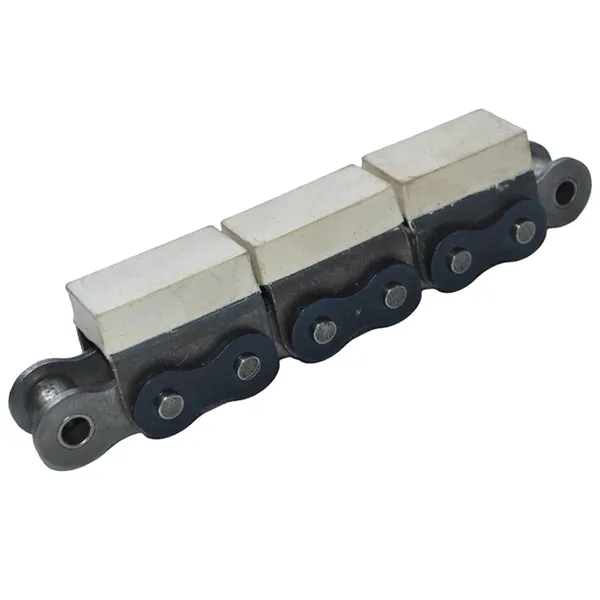
12A-G1 rubber top chain brings the non-marking, non-slip conveying properties of rubber-top design to the ANSI #60 pitch range — the most widely used pitch in North American industrial conveyor and material handling applications.
Product Overview
The ’12A’ designation follows ANSI chain numbering conventions where the pitch in eighths of an inch equals the first two digits divided by 8: 12 ÷ 8 = 1.5 inches? No — in ANSI nomenclature, ’60’ is the standard chain number for 19.05mm (3/4 inch) pitch, and ’12A’ refers to the ISO/ANSI A-series equivalent at the same pitch. The A-series classification distinguishes North American standard chains (larger roller diameter, wider inner plates relative to pitch) from European B-series chains at the same nominal pitch. This distinction is important: ANSI #60 sprockets are not the correct match for ISO 12B chain and vice versa, despite both operating at 19.05mm pitch.
The G1 rubber top on the 12A base delivers the same non-marking, vibration-damping conveying function as the equivalent 12B-G1 — the rubber profile geometry is identical, with the difference being solely in the base chain standard. For North American wood processing plants, automotive component lines, and food manufacturing facilities that have standardised on ANSI chain equipment, 12A-G1 is the appropriate rubber top specification that will run correctly on existing ANSI-profile sprockets without modification.
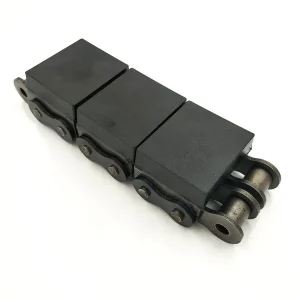
12A-G1 — G1 narrow rubber top on ANSI #60 (A-series) base
Specification — 12A-G1
| Chain No. |
Pitch P (mm) |
Roller Ø (mm) |
Inner Width (mm) |
Pin Ø (mm) |
Pin Length (mm) |
Plate Depth (mm) |
Rubber W (mm) |
Rubber H (mm) |
Overall W (mm) |
Q min (kN) |
Weight (kg/m) |
| 12A-G1 |
19.050 |
11.91 |
12.57 |
5.94 |
24.71 |
18.00 |
32.0 |
12.0 |
42.0 |
31.3 |
1.44 |
Rubber top chain in production conveyor environment
Rubber Profile and Material Properties
12A-G1 chains use NBR/SBR rubber compound in 75–80 Shore A hardness as standard — the slightly higher hardness versus the 60–70 Shore A used for glass conveying reflects the more robust product surfaces (wood, metals, cardboard, cans) that ANSI rubber top chains typically encounter. The 80 Shore A compound resists the abrasion from cardboard box bases and metal can contact more effectively than softer compounds, extending rubber profile service life in high-throughput packaging line applications. For food industry applications requiring FDA and USDA compliance, silicone rubber in 70 Shore A and food-grade NBR in 80 Shore A are available with full regulatory compliance documentation. Stainless steel 12A-G1 chains for food processing washdown environments are available in 304 and 316L grades with H1 food-grade rubber compound.
Core Performance Advantages
🤚
Positive Non-Slip Grip
The vulcanised rubber surface grips product bases firmly at conveyor accelerations and on inclined sections where smooth-surface chains allow slippage — eliminating the positioning errors and product damage that result from uncontrolled sliding.
🔇
Measurable Noise Reduction
Rubber’s damping properties absorb the micro-impacts at each sprocket link engagement, reducing conveyor operating noise at the product contact surface. In facilities with noise regulations, this can be a compliance factor.
🛡️
Surface-Safe Product Handling
Direct contact between bare steel chain and finished product surfaces causes scratching, denting, and marking. The rubber layer completely eliminates steel-to-product contact, maintaining surface integrity through the full conveyor run.
⚙️
Standard Sprocket Compatibility
The base chain dimensions are fully standard — the same sprockets used for the equivalent standard roller chain work without modification for the rubber top version. No hardware changes required for retrofitting.
Application Areas
Industrial conveyor application for 12A-G1
🪵
Wood Products Finishing Lines
North American hardwood flooring, cabinetry, and furniture production lines specify 12A-G1 as standard for conveyors through sanding, finishing, and quality inspection. The ANSI base chain is consistent with all other drive chains in these facilities, simplifying spares management.
🚗
Automotive Component Assembly
Engine component sub-assembly lines and body trim manufacturing plants use 12A-G1 chains to convey machined parts through automated assembly stations. The rubber surface prevents marking on machined bores and threaded features that would create assembly interference.
🥫
Food Can and Jar Conveying
Filled and sealed food cans and glass jars move through pasteurisation, labelling, and casing on 12A-G1 chains. For food contact zones, 316L stainless base with H1 food-grade rubber compound is available to USDA and FDA specifications.
📦
North American Packaging Lines
Case packing and palletising lines in North American manufacturing plants are standardised on ANSI chain. 12A-G1 rubber top chains provide the grip needed for cardboard case conveying without the surface damage to printed corrugated that bare-steel chain causes.
Rubber top chain on production line
Related Components We Supply
◆
Matched Sprockets — ANSI #60 (A-series)
Standard sprockets in the pitch matching 12A-G1. No special tooth form needed — standard ANSI #60 (A-series) sprockets engage rubber top chains correctly at the roller-to-tooth interface.
◆
Rubber Top Connecting Links
Connecting links with matching rubber top profile for a smooth, uninterrupted conveying surface at the chain join point.
◆
Replacement Rubber Top Outer Link Sets
Individual outer link plate assemblies with vulcanised rubber profiles for field repair of worn sections without replacing the full chain.
◆
UHMWPE Guide Rails
Low-friction polyethylene guide profiles reducing lateral wear on rubber edges in side-guided conveyor configurations.
Customer Reviews
★★★★★
“We build hardwood flooring finishing lines and spec 12A-G1 as our standard rubber top chain. The ANSI base chain means we can use the same sprocket inventory as our drive chain system — only one set of spares to manage. Quality here is consistent and the rubber profile hardness matches our surface protection specification for pre-finished flooring.”
M
Mike Harrison
Conveyor Systems Manager — Ontario Wood Products Plant
★★★★★
“Running 12A-G1 stainless with food-grade rubber on our can conveyor through the pasteurisation zone. The H1 lubrication certificate and 316L material documentation passed our USDA audit without any corrective actions. Delivery to Texas was 12 days from order — faster than our local distributor.”
M
Maria Gonzalez
Plant Engineer — Texas Food Manufacturing
★★★★★
“Specified 12A-G1 for our engine block component conveyor. The rubber surface prevents the contact marks on machined surfaces that were creating assembly interference with our previous bare-steel chain. Two years in service without any rubber delamination — excellent vulcanisation quality.”
J
James Wu
Production Manager — Michigan Automotive Assembly
Frequently Asked Questions
What is the difference between 12A-G1 and 12B-G1?+
Both chains have 19.05mm pitch and a G1 rubber top profile. The difference is in the base chain standard: 12A follows ANSI A-series (ANSI/ASME B29.1), with a roller diameter of 11.91mm and inner width of 12.57mm. 12B follows ISO B-series (ISO 606), with a roller diameter of 12.07mm and inner width of 11.68mm. These dimensional differences mean they require different sprockets and cannot be substituted for each other. The rubber top profiles are functionally equivalent.
Are 12A chains the same as ANSI #60 chains?+
Yes — in ANSI chain nomenclature, ’12A’ and ‘#60’ refer to the same 19.05mm pitch A-series chain. The ANSI B29.1 numbering uses numbers like 40, 50, 60, 80; the ISO/metric equivalent uses designations like 08A, 10A, 12A, 16A. Both systems refer to the same dimensional standard. 12A-G1 chains run on standard ANSI #60 sprockets without modification.
Can 12A-G1 be ordered with pre-installed attachment links?+
Yes — A1, A2, K1, and K2 attachment links can be integrated at any pitch interval within 12A-G1 chains. Attachment links use the same rubber top profile as the main chain. Common applications include cross-bar mounting for flight-type conveyors and EP pin attachments for carrier bracket mounting. Specify attachment type, interval, and total chain length when ordering.
What is the maximum conveyor speed for 12A-G1 rubber top chains?+
The maximum conveyor speed for rubber top chains is lower than for bare-steel chains of the same pitch because the rubber profile increases the effective chain mass and can be thrown outward at high sprocket speeds. For 12A-G1 with ANSI #60 pitch, the practical maximum conveyor speed is approximately 0.8–1.2 m/s depending on chain tension and guide rail condition. At higher speeds, the rubber profile corners experience centrifugal lift that reduces contact pressure and grip. For high-speed applications above 1 m/s, contact us to confirm suitability.
Is 12A-G1 available in self-lubricating specification?+
Self-lubricating rubber top chains are available using oil-impregnated sintered bushings in the 12A base chain. These chains do not require external lubrication at the pin-bushing interface, making them suitable for enclosed machinery and food processing conveyors where external lubricant application is impractical or prohibited. The rubber top profile is unchanged from the standard lubricated version — specify SLR (self-lubricating roller) when ordering.
Get in Touch
Ready to Place Your Order?
Send us your chain specification and annual volume. Standard enquiries receive a quotation within 2 business days.
Further reading: how roller chains work and key component functions.