
Every roller chain drive faces the same fundamental challenge: the lubricant that protects the pin-bushing interface must be kept in contact with those surfaces long enough to provide a useful film, while contaminants from the environment must be kept away from the same surfaces. Standard roller chain relies on periodic reapplication of external lubricant and hopes that operational conditions do not wash, throw, or abrade it away too quickly. O-ring roller chain takes a different approach — it seals a charge of grease inside the pin-bushing interface from the moment of manufacture, with a rubber O-ring at each joint preventing both lubricant escape and contaminant ingress for the life of the chain.
The O-Ring Seal: Construction and Function
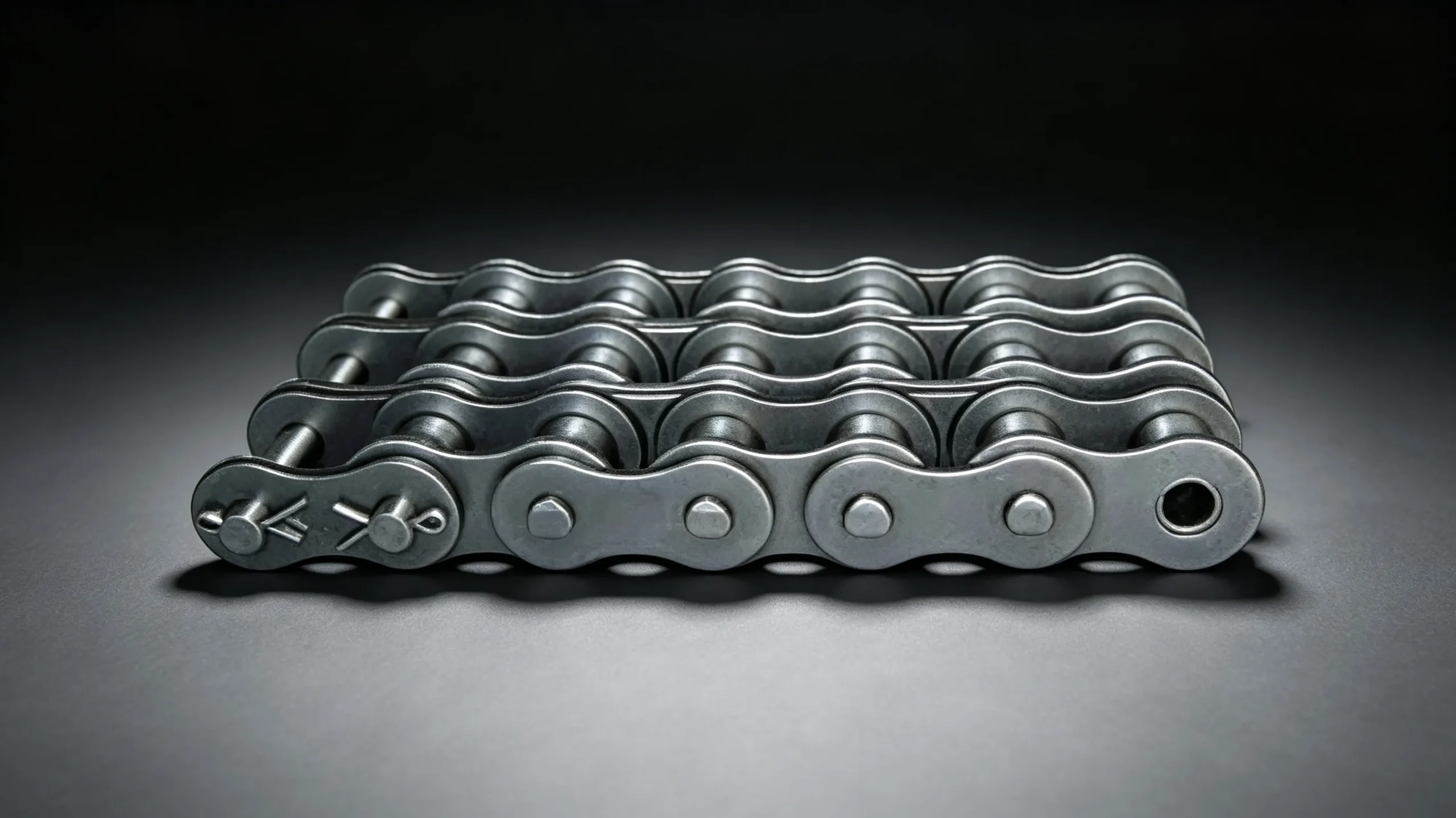
In an O-ring roller chain, four small rubber O-rings are fitted at each pin-bushing joint — one between each link plate face and the adjacent bushing/roller face. Before assembly, the bushing bore and pin outer surface are packed with a high-viscosity grease lubricant. As the chain is assembled, the O-rings are compressed between the plate faces, forming a seal that holds the grease in the pin-bushing annulus and prevents external contaminants from reaching it.
The O-rings are manufactured from elastomers chosen for their resistance to the operating environment. Nitrile rubber (NBR) is the standard material, suitable for temperatures from approximately -30 to 120 degrees Celsius and resistant to petroleum-based lubricants. For higher temperatures or chemical environments, fluoroelastomer (FKM/Viton) O-rings are available. The O-ring cross-section is carefully sized to provide adequate sealing compression without introducing excessive friction when the link articulates over a sprocket — the articulation drag of the O-ring seals is a real energy loss that must be accounted for in the drive design.
Benefits of O-Ring Chain in Detail
Extended Lubrication Intervals
The sealed grease charge in an O-ring roller chain pin-bushing joint is protected from the external environment and replenished continuously from the sealed reservoir — it does not need to be externally replaced during the chain service life under normal operating conditions. This is the primary benefit: O-ring roller chain eliminates or dramatically reduces the frequency of external lubrication required compared to standard chain in the same application.
Contamination Resistance
The O-ring seal physically prevents mud, grit, water, chemicals, and abrasive particles from entering the pin-bushing clearance. This makes O-ring roller chain particularly valuable in heavily contaminated environments: agricultural field equipment operating in muddy conditions, construction machinery in quarry or earthmoving operations, and marine equipment exposed to salt water and sand. In these environments, standard chain without the O-ring seal can reach its elongation limit in a fraction of the time that O-ring chain achieves.
Longer Service Life in Contaminated Applications
Comparative field testing of standard versus O-ring roller chain in muddy agricultural applications has shown life increases of 2 to 5 times in favour of O-ring chain. The improvement is application-dependent — in very clean, well-lubricated environments, O-ring chain offers little advantage over properly maintained standard chain. But in dirty, inaccessible, or infrequently maintained drives, the sealed design can deliver dramatic service life improvements.
The Trade-Offs: What O-Ring Chain Costs You
Higher Initial Cost
The additional components — four O-rings per joint, the grease packing process, and the precision required in plate face tolerances to achieve consistent seal compression — make O-ring roller chain more expensive than standard chain. The premium ranges from approximately 30 to 80 percent over standard chain of the same pitch, depending on supplier and quantity. This premium is usually recovered many times over in service life improvement for contaminated applications but represents an unnecessary cost for clean, well-lubricated drives.
Increased Articulation Friction
The compressed O-rings introduce friction when the chain articulates over a sprocket. This friction reduces the mechanical efficiency of the drive from the 97 to 99 percent typical of a well-lubricated standard roller chain to approximately 92 to 96 percent — comparable to a V-belt drive. For power-intensive drives where energy cost is significant, this efficiency reduction has a measurable impact on operating cost. Calculate the additional power loss before specifying O-ring chain for a high-duty drive.
Speed Limitations
The O-ring articulation friction also generates heat at elevated speeds. Above approximately 3 to 4 m/s, O-ring chain temperature can rise to levels that accelerate O-ring elastomer degradation. Standard O-ring roller chain specifications typically set a maximum operating speed of 3 m/s for most pitch sizes. For higher-speed applications requiring contamination resistance, self-lubricating chain with appropriate sealing is a better option.
Measuring Elongation on O-Ring Chain
The measurement method for O-ring roller chain elongation is identical to standard chain — multi-link span measurement with a vernier caliper. The O-ring seals do not affect the pin-centre-to-pin-centre dimension and therefore do not interfere with pitch measurement. The 3 percent elongation replacement threshold applies to O-ring chain in the same way as standard chain, though in practice O-ring chain typically reaches this limit through wear rather than through seal failure — the seals generally outlast the useful pin-bushing life of the chain in correctly specified applications.
| Factor | Standard Roller Chain | O-Ring Roller Chain |
|---|---|---|
| Lubrication requirement | Regular external application essential | Minimal — sealed grease charge lasts chain life |
| Contamination resistance | Low — dirt enters pin-bushing interface easily | High — O-ring seals block external contaminants |
| Mechanical efficiency | 97–99% (well lubricated) | 92–96% (O-ring articulation friction) |
| Maximum speed | Up to 15+ m/s (pitch dependent) | Typically 3–4 m/s maximum |
| Initial cost | Baseline | 30–80% premium over standard |
| Service life in dirty conditions | Short (heavily load dependent) | 2–5x longer than standard in comparable conditions |
| Service life in clean conditions | Long (with correct lubrication) | Similar to or slightly less than standard |
| Weight | Baseline | Marginally heavier (O-ring mass negligible) |
Selecting O-Ring Chain for Your Application
The decision to specify O-ring roller chain should be based on a clear understanding of the operating environment and the maintenance regime. If the drive operates in clean conditions with a disciplined lubrication programme, standard chain will deliver equal or better service life at lower cost. If the drive operates in mud, water, or heavy dust where lubrication is difficult to maintain and contaminant ingress is a real concern, O-ring chain is likely to deliver a total cost of ownership advantage despite the higher unit price.
O-ring chain is available across the standard ANSI and ISO pitch ranges, with the O-ring specification most commonly offered for mid-range pitches (ANSI 40 through 100). For very small pitches, the O-ring geometry is difficult to manufacture with consistent sealing performance. For very large pitches used in mining and heavy industry, the large joint dimensions make alternative sealing strategies more practical. Verify O-ring chain availability for your specific pitch size before designing a drive around it.
EverPower Roller Chains Australia supplies O-ring roller chain in ANSI and ISO series for agricultural, construction, and marine applications. Our Sydney team can advise on the correct pitch size, strand count, and O-ring material for your operating environment and maintenance schedule.
+61 2 9708 3322 | [email protected] | 27 Harley Crescent, Condell Park NSW 2201