Description
Rubber Top Roller Chain — 10A-G1
10A-G1 rubber top chain brings the grip and surface-protection properties of rubber-top conveying to the heavier ANSI #50 pitch range — suitable for applications where load demands exceed the capacity of the smaller 08B or 08A base chains.
Product Overview
The ’10A’ designation identifies the ANSI/ASME B29.1 standard roller chain base with a pitch of 15.875mm — the same as a standard ANSI #50 chain. The ANSI A-series base provides a higher tensile and fatigue rating than the ISO 08B base used in 08B-G1 and 08B-G2 chains, making 10A-G1 the appropriate rubber-top chain selection when the conveyor load requires more structural chain capacity than the 08B pitch range can deliver. Typical conveyor loads that move into the 10A range include heavier product carriers, longer conveyor runs with more chain weight in the circuit, and applications with higher coefficient of friction between chain and guide rails that generate greater chain tension.
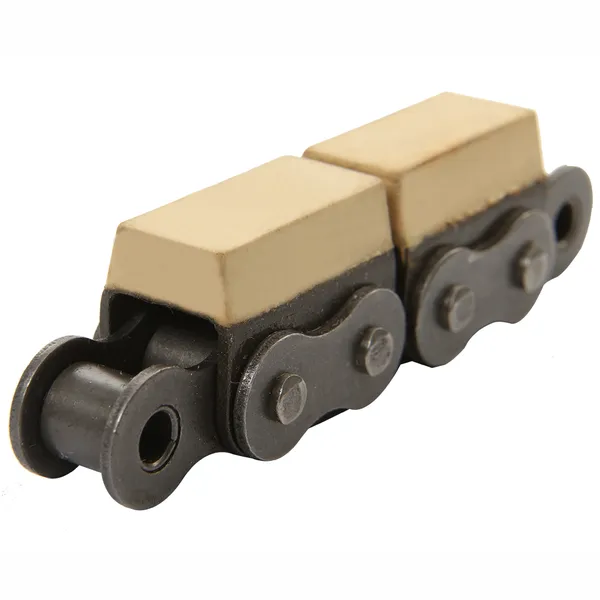
The G1 rubber profile configuration on the 10A base maintains the same narrow centred rubber pad geometry as the 08B-G1 variant, scaled proportionally to the larger pitch. The larger base pitch provides a proportionally wider outer link plate, which gives the G1 rubber pad a larger bonding footprint while maintaining the narrow product contact width that suits small-to-medium containers and component carriers. Food processing, mining equipment parts handling, automotive component assembly, and pharmaceutical manufacturing are the primary application sectors for this chain size.
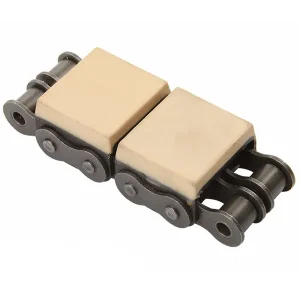
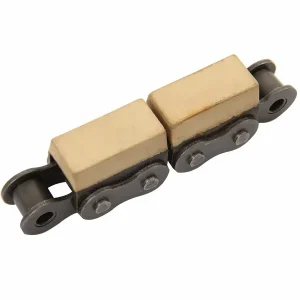
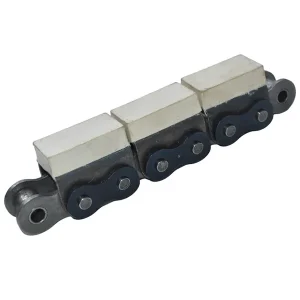
10A-G1 rubber top chain — single narrow rubber pad, ANSI A-series base attachment type
Dimensions and Specifications — 10A-G1
| Chain No. |
Pitch P (mm) |
Roller Ø (mm) |
Inner Width (mm) |
Pin Ø (mm) |
Pin Length (mm) |
Plate Depth (mm) |
Rubber Width W (mm) |
Rubber Height H (mm) |
Overall Width (mm) |
Q min (kN) |
Weight (kg/m) |
| 10A-G1 |
15.875 |
10.16 |
9.40 |
5.08 |
20.14 |
15.09 |
28.0 |
11.5 |
32.0 |
21.8 |
0.92 |
Rubber top chain conveying system — G1 attachment profile
Rubber Top Profile and Material
The rubber top compound for 10A-G1 chains follows the same NBR/SBR 80 Shore A specification as the 08B series rubber top chains. The proportionally larger outer link plate of the 10A base provides greater rubber bonding area per link, which contributes to improved delamination resistance relative to the smaller 08B base — particularly relevant in high-speed applications where the centrifugal force at sprocket wrap points generates peel stress on the rubber-plate bond. For food applications above 80°C (baking tunnel conveyors, pasteurisers), silicone rubber compound rated to +120°C is available as an upgrade. For outdoor agricultural applications exposed to ozone and UV, EPDM rubber compound provides better weathering resistance than standard NBR.
Key Performance Benefits
🤚
Non-Slip Product Control
The vulcanised rubber surface maintains positive product contact through acceleration, deceleration, and inclined conveying — applications where smooth-surface chains allow products to slip and misalign.
🔇
Vibration and Noise Damping
The rubber profile absorbs micro-impacts at sprocket engagement and at product loading points, measurably reducing conveyor noise in production environments where operator comfort and noise regulations apply.
🛡️
Surface Protection for Delicate Products
Rubber’s natural cushioning prevents surface marking on bottles, cans, glass panels, electronics, and finished consumer goods that would be scratched or dented by direct contact with bare steel chain surfaces.
⚙️
Interchangeable with Standard Chain
The base chain dimensions match the standard ISO B or ANSI A series specification for the same pitch. Rubber top chains run on standard matched sprockets without modification — no special tooth form or hardware change required.
Applications
🍕
Bakery and Food Production Lines
Bread loaves, pizza bases, and packaged food portions convey on 10A-G1 rubber top chains through ovens and cooling tunnels where the chain must handle elevated temperatures and frequent wash-down without the product adhesion problems that bare-steel chain causes with sticky doughs and glazed surfaces.
⛏️
Mining Equipment Component Handling
Replacement parts, wear plates, and maintenance components for mining equipment are conveyed on 10A-G1 chains in parts handling areas of mining workshops — the higher load rating of the #50 pitch base suits the heavier component weights, while the rubber top prevents surface damage to precision-machined replacement parts.
🚗
Automotive Parts Assembly
Engine components, transmission sub-assemblies, and body hardware move through automotive assembly lines on 10A-G1 chains. The rubber surface prevents surface scratching on machined and painted components at handoff points between assembly stations.
🌿
Agricultural Product Grading
Fresh produce grading systems use 10A-G1 rubber top chains to convey fruit and vegetables through weight and size sorting equipment. The rubber surface handles the irregular shapes and delicate skins of fresh produce without bruising or surface damage.
Matching Components We Also Supply
◆
Matched Sprockets for ANSI #50 (A-series) Pitch
Standard ANSI #50 (A-series) series sprockets in the pitch matching 10A-G1. Full range from 9 to 90 teeth in simplex and duplex bore. No special tooth form required for rubber top chains.
◆
Rubber Top Connecting Links
Connecting links with the same rubber top profile as the main chain, maintaining a continuous and smooth conveying surface at the join point — critical for delicate product handling applications.
◆
Replacement Rubber Top Outer Link Sets
Individual outer link plate assemblies with pre-vulcanised rubber profiles for field repair of damaged rubber sections without full chain replacement.
◆
UHMWPE Chain Guide Profiles
Low-friction polyethylene guide rails in standard widths for rubber top chain conveyor systems. Smooth guide surface reduces lateral wear on the rubber profile edges on curved or side-loaded conveyor runs.
Customer Reviews
★★★★★
“We build industrial bread production lines and specify 10A-G1 as standard for conveying through our cooling tunnels. The rubber surface prevents the bread-to-chain sticking that occurs with bare steel at the early cooling stage, and the #50 pitch base handles the weight of our 600mm-wide bread loaf carriers without approaching the chain’s load limit.”
P
Paolo Ferretti
Plant Engineer — Verona Bakery Equipment Mfr.
★★★★★
“We supply 10A-G1 to our mining maintenance workshops for parts conveying. The higher load rating suits the component weights involved and the rubber surface protects precision bearing housings and gear components from contact marks. Good availability and consistent delivery on our monthly orders.”
S
Sandra Mbeki
Procurement Manager — Johannesburg Mining Services
★★★★★
“Specified 10A-G1 for transmission component conveyors at our customer’s assembly plant. The chain ran without issue through commissioning and the rubber surface has shown no hardening or cracking in 16 months of operation in the 22°C assembly environment.”
L
Lars Gustafsson
Systems Integrator — Malmö Automotive Assembly
Frequently Asked Questions
What is the load capacity advantage of 10A over 08B rubber top chains?+
The 10A-G1 base chain (ANSI #50, 21.8 kN Q min) carries approximately 21% more tensile load than the 08B-G1 base (ISO 08B-1, 18.0 kN Q min) and 55% more than the 08B at the equivalent working load fraction. For conveyor designs where the chain tension calculation shows the 08B base approaching its working load limit (typically 1/6th to 1/10th of Q min depending on shock loading), moving to the 10A base provides the required safety margin without changing the attachment type or rubber profile.
Is 10A the same as ISO 10A or 10B?+
No — 10A refers to the ANSI A-series #50 chain (15.875mm pitch). The ISO equivalent by pitch is 10A-1 (ANSI notation for the same pitch in the A-series), not 10B-1, which is the ISO B-series chain with the same 15.875mm pitch but different roller diameter and inner width. A-series and B-series chains of the same pitch are not interchangeable. If your equipment uses ISO B-series standard, specify 10B-G1 instead.
Can I order 10A-G1 with attachment links at specified intervals?+
Yes — attachment links can be integrated at any pitch interval within the 10A-G1 chain run. Common attachment types for rubber top chains include A1 tabs for cross-bar mounting and EP (extended pin) attachments for flight and cleat installation. Specify the attachment type, interval, and total chain length when ordering.
What temperature range does the standard rubber top handle?+
Standard NBR rubber compound is rated from −20°C to +80°C. For bakery and pasteuriser applications above 80°C, specify the silicone rubber option rated to +120°C. For frozen food processing below −20°C, the standard NBR compound loses flexibility and should be replaced with a low-temperature NBR grade rated to −40°C. Specify operating temperature range when ordering if outside the standard range.
How does rubber top chain lubrication work in food applications?+
Rubber top chains require lubrication at the pin-bushing interface. In food processing applications, H1 food-grade lubricant must be used — standard mineral oil is not approved for food contact zones. The lubricant is applied to the inner side of the chain (the roller-plate interface) rather than the rubber top surface. Never apply lubricant to the rubber top surface — this reduces the friction coefficient and defeats the purpose of specifying rubber top chain.
Get in Touch
Ready to Place Your Order?
Send us your chain specification and annual volume. Standard enquiries receive a quotation within 2 business days.
See also: why food processing favours specialist roller chain specifications.