Description
Product Overview
Standard carbon steel roller chains corrode in any environment where moisture, salt, acid, or alkaline chemicals reach the pin-bushing interface. The corrosion products — rust, oxide scale, or chemical deposits — accumulate within the close-tolerance pin-bushing clearance, preventing normal articulation and accelerating wear. In severe cases, the corrosion products expand the effective bushing diameter enough to lock the links solid, causing the chain to fail by fracture at the first high-load moment. Corrosion resistant chains address this failure mode through three distinct approaches: selecting inherently corrosion-resistant base metals, applying protective surface coatings that act as a barrier between steel and the environment, or combining both strategies for maximum protection.
The correct approach depends on the specific corrosive agent, its concentration, operating temperature, and whether the chain contacts food, pharmaceuticals, or other regulated products. A chain that performs well in a mildly humid indoor environment will fail quickly in a coastal outdoor installation; a chain that handles dilute cleaning chemicals may not withstand the concentrated acid encountered in a citrus processing plant. Selecting the right specification from the start avoids the expensive cycle of premature failure and unplanned replacement that results from treating corrosion as a secondary consideration in the chain selection process.
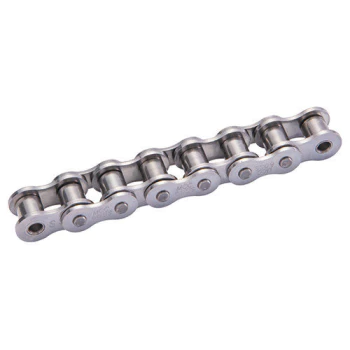
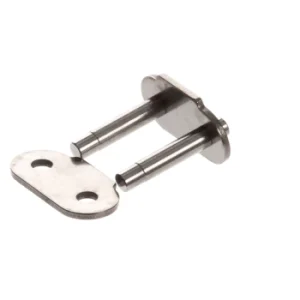
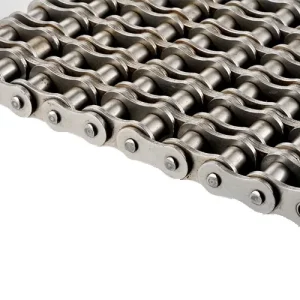
Corrosion resistant chains — zinc-plated, nickel-plated, and stainless steel for aggressive environments
Corrosion Resistance Options Compared
| Type | Base Metal | Salt Spray (hrs) | Temp Range | Chemical Resistance | Best Applications |
|---|---|---|---|---|---|
| Zinc-Plated | Carbon Steel | 250+ | −20 to +120°C | Mild — water, humidity | Outdoor equipment, mild industrial |
| Nickel-Plated | Carbon Steel | 500+ | −20 to +150°C | Moderate — dilute acids/alkalis | Light food handling, pharmaceutical, decorative |
| Dacromet Coated | Carbon Steel | 1000+ | −30 to +300°C | Good — road salt, weathering | Outdoor marine, road building, construction |
| Stainless 304 | SS 304 | 500–1000 | −40 to +300°C | Good — most organic acids | General food processing, dairy, mild seafood |
| Stainless 316L | SS 316L | 1000+ | −60 to +400°C | Excellent — chlorides, sea salt | Seafood, coastal, CIP chemical wash |
| Self-lubricating SS | SS 316L + SL | 1000+ | −20 to +140°C | Excellent + oil-free | Clean rooms, food contact without lubrication |
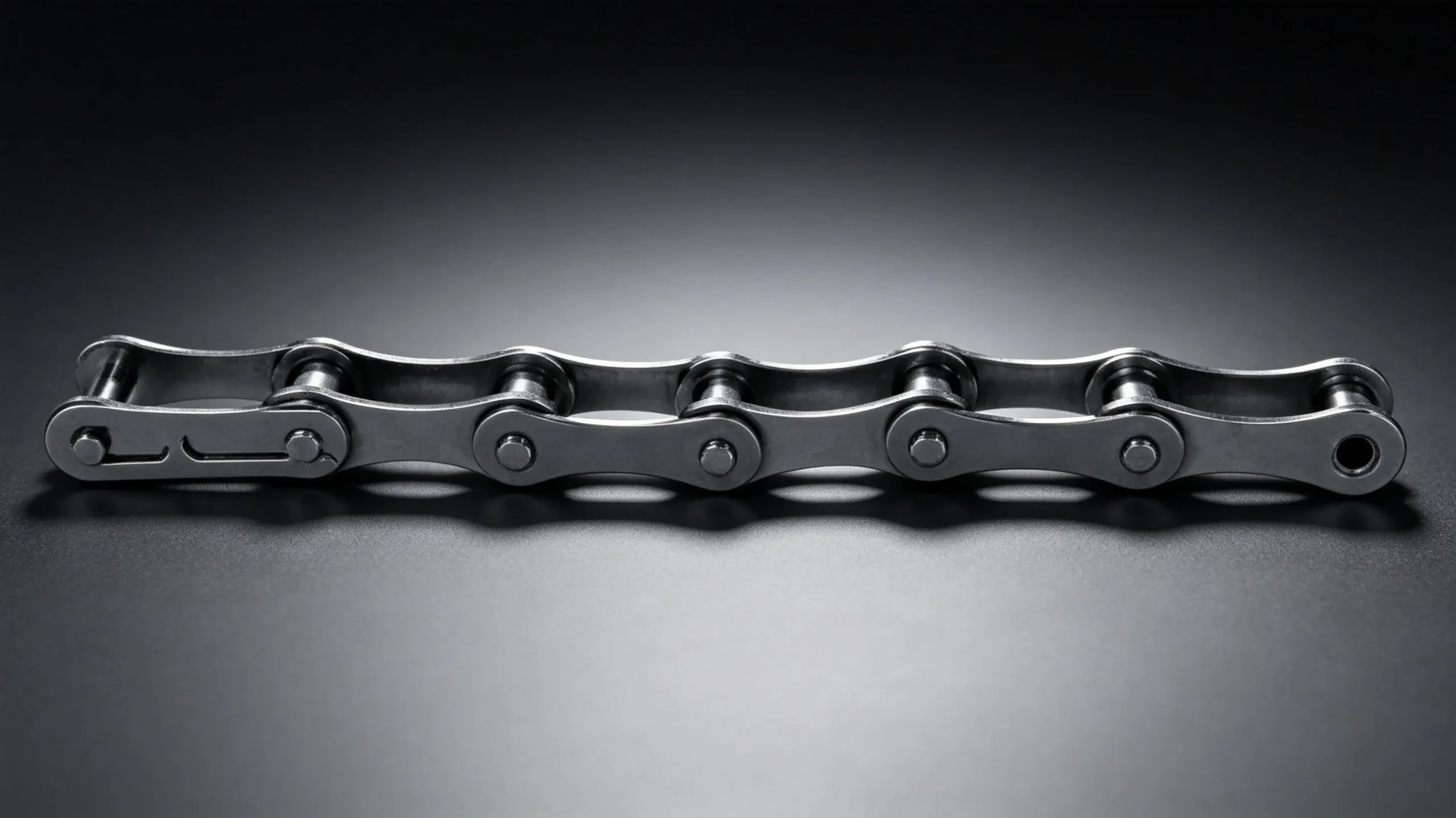
Zinc-Plated Chains — Outdoor and Moderate Corrosion
Zinc-plated roller chains apply an electrodeposited zinc coating over the entire assembled chain, providing cathodic protection — the zinc corrodes preferentially before the steel substrate, sacrificing itself to protect the base material. The standard zinc plating specification produces a coating thickness of 8–15 microns and passes 250 hours of neutral salt spray testing to ISO 9227. This is the minimum specification for outdoor applications in temperate climates and for industrial environments with regular condensation exposure. Zinc-plated chains retain the same dimensional specification and tensile rating as the equivalent standard carbon steel chain — the plating layer is thin enough not to affect the pin-bushing or roller-to-sprocket engagement geometry.
One limitation of zinc plating is its sensitivity to acidic environments: zinc dissolves rapidly at pH below 6, making zinc-plated chains unsuitable for citrus processing, vinegar production, or any application with regular acid contact. For these applications, nickel plating or stainless steel specification is the correct choice.
Nickel-Plated Chains — Enhanced Chemical Resistance
Electroless nickel plating deposits a uniform nickel-phosphorus alloy coating across all surfaces, including the interior of the pin-bushing interface — a key advantage over electrodeposited zinc, which cannot reliably coat recessed internal surfaces. The nickel coating provides a hard, corrosion-resistant barrier with good resistance to mild acids, alkalis, and organic solvents. Salt spray resistance typically exceeds 500 hours. The harder surface of the nickel coating also provides a modest wear resistance improvement at the roller-sprocket contact interface, which can extend chain life in lightly contaminated environments by reducing abrasive wear from surface deposits.
Nickel-plated chains are widely specified in pharmaceutical handling, light food processing where FDA compliance is required for incidental contact, and in commercial or architectural applications where chain appearance matters. The bright metallic finish of nickel plating is also a practical benefit in hygiene-sensitive environments — contamination and early rust formation are visually obvious against the nickel surface, whereas surface rust on a standard chain can be difficult to detect before it has progressed to the pin-bushing interface.
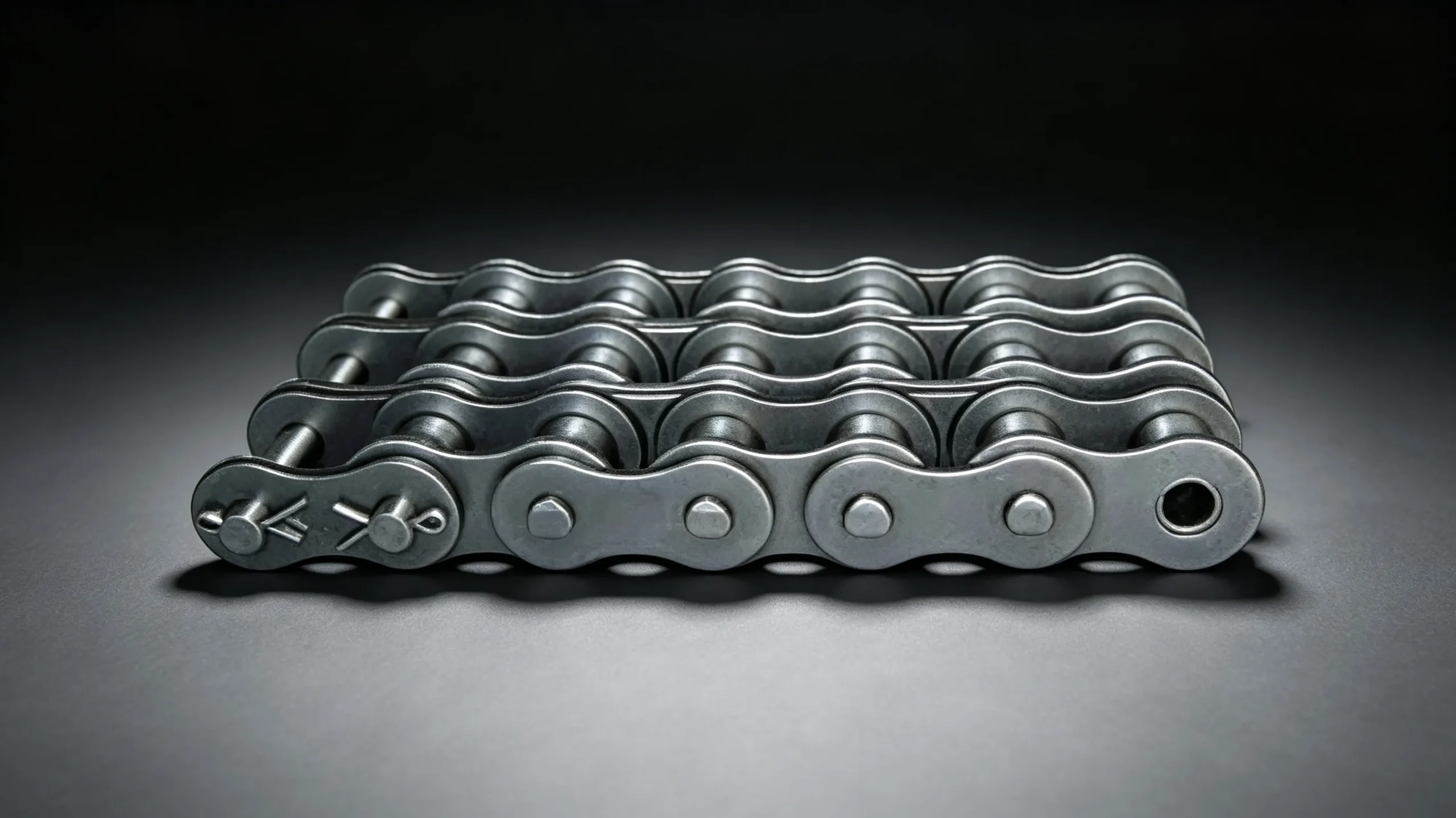
Stainless Steel Chains — Maximum Corrosion Resistance
304 Stainless Steel
304 stainless steel chains provide excellent corrosion resistance through the formation of a passive chromium oxide layer on all surfaces — a self-healing barrier that reforms after scratching or mechanical damage. 304 specification is appropriate for most food processing environments, including dairy, bakery, confectionery, and produce handling where the cleaning chemicals are oxidising agents (hypochlorite solutions) at moderate concentrations. Temperature range extends to 300°C for kiln and oven conveyor applications in food production.
316L Stainless Steel
316L stainless adds molybdenum to the 304 alloy, specifically to resist chloride pitting corrosion — the failure mode that causes 304 stainless to develop surface pits in seafood processing, coastal environments, and facilities using chlorinated cleaning systems. The L designation indicates low carbon content, which prevents sensitisation (carbide precipitation at grain boundaries) during welding and high-temperature exposure. For any application involving direct saltwater contact, regular chlorine-based CIP cleaning, or outdoor coastal exposure, 316L is the specification of choice. Full FDA 21 CFR and EU food contact compliance documentation is available with every stainless steel chain order.
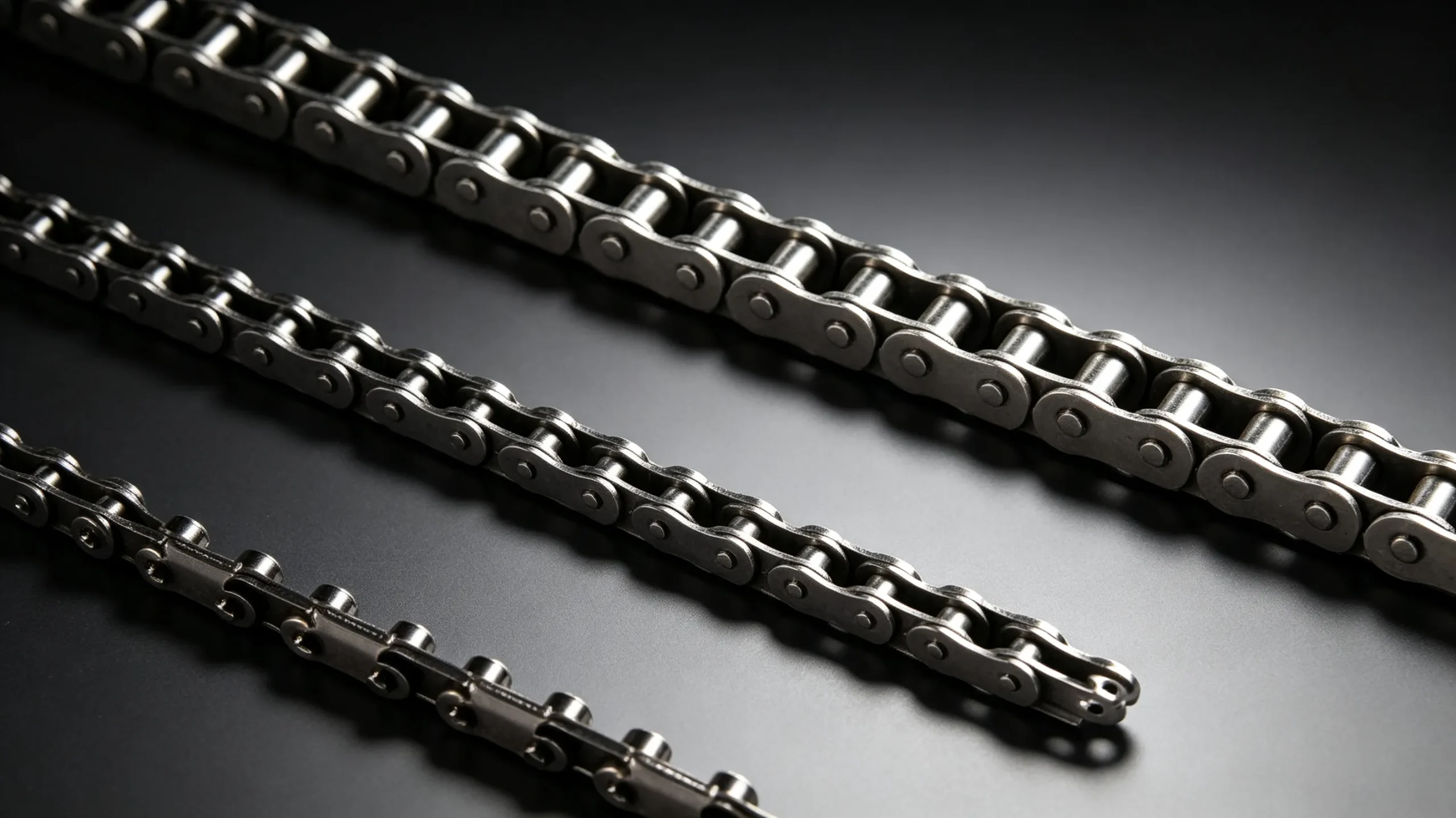
Chain Specifications — Zinc and Nickel Plated (ISO B Series)
| Chain No. | Pitch P (mm) | Roller Ø (mm) | Inner Width (mm) | Pin Ø (mm) | Plate Depth (mm) | Plate Thick. (mm) | Q min (kN) | Weight (kg/m) |
|---|---|---|---|---|---|---|---|---|
| 08B-1 ZP/NP | 12.700 | 8.51 | 7.75 | 4.45 | 11.81 | 1.60 | 18.0 | 0.69 |
| 10B-1 ZP/NP | 15.875 | 10.16 | 9.65 | 5.08 | 14.70 | 1.70 | 22.2 | 0.93 |
| 12B-1 ZP/NP | 19.050 | 12.07 | 11.68 | 5.72 | 16.13 | 1.85 | 29.0 | 1.15 |
| 16B-1 ZP/NP | 25.400 | 15.88 | 17.02 | 8.28 | 21.10 | 4.15 | 60.0 | 2.71 |
| 40-1 ZP/NP (ANSI) | 12.700 | 7.95 | 7.85 | 3.96 | 12.00 | 1.52 | 14.1 | 0.61 |
| 50-1 ZP/NP (ANSI) | 15.875 | 10.16 | 9.40 | 5.08 | 15.09 | 2.03 | 21.8 | 0.92 |
| 60-1 ZP/NP (ANSI) | 19.050 | 11.91 | 12.57 | 5.94 | 18.00 | 2.39 | 31.3 | 1.44 |
| 80-1 ZP/NP (ANSI) | 25.400 | 15.88 | 15.75 | 7.92 | 24.00 | 3.18 | 55.6 | 2.49 |
Stainless steel chains share the same dimensional specification as the above — tensile ratings differ slightly by grade. Contact us for full stainless steel specification tables.
Industry Applications
Food and beverage processing plants are the largest end-users of corrosion resistant chains. Fish and seafood processing requires 316L stainless for direct saltwater and chlorine exposure. Dairy facilities specify 304 stainless or nickel-plated chains for their resistance to the lactic acid and CIP cleaning solutions used in pasteurisers, fillers, and curd handling conveyors. Breweries and soft drink production plants use nickel-plated or 304 stainless chains in bottle and can conveyors that pass through the pasteurisation zone and the wash-down cleaning cycle.
Chemical processing plants require corrosion resistant chains for conveyors handling solvent-laden atmospheres, acid bath entry and exit conveyors, and powder handling systems where the materials being conveyed are themselves chemically aggressive. Coastal and marine installations — harbour equipment, coastal roadway maintenance machinery, offshore platform equipment — are exposed to salt spray continuously and require either Dacromet-coated or stainless chains depending on load requirements. Agricultural machinery operating in fertiliser distribution systems encounters both ammonia-based fertiliser compounds and regular outdoor weathering — nickel-plated or Dacromet specification is appropriate for this duty.
Components and Matching Parts
◆
◆
◆
◆
Customer Reviews
“We run 316L stainless chains on all our prawn processing conveyors. After switching to this supplier we passed our BRC audit without a single corrective action related to chain condition — the first time in three audit cycles. The material certificates confirmed 316L grade with full heat traceability. Re-order process is simple and lead time is consistent.”
“Specified nickel-plated 12B-1 for our pasteurisation tunnel conveyor. The chains have been running 22 months without any visible corrosion — previous unplated chains were showing rust at 4 months in the same environment. Price difference versus standard chain was small relative to the maintenance saving.”
“Ordered Dacromet-coated 16B-1 for our outdoor process conveyor exposed to solvent vapour and weathering. After 18 months the coating shows no breakdown at the plate edges or pin ends — the two positions where we typically see early corrosion failure on inadequately treated chains. Will continue ordering for our seasonal maintenance replacement cycle.”
Frequently Asked Questions
Get in Touch
Ready to Place Your Order?
Send us your chain specification and annual volume. Standard enquiries receive a quotation within 2 business days.
See also our article on why roller chain corrodes in outdoor applications and how to prevent it.